Free Things to Do in Oslo: A Full Day-by-Day Plan
Oslo has a reputation for emptying wallets, and the reputation is partly earned. But the city's most visited sight costs nothing, its best views cost nothing, and several of its museums let whole age groups in free. Here is a plan built around what genuinely costs zero krone.
Short answer
The best free things to do in Oslo are Vigeland Park, the Opera House roof, the Akershus Fortress grounds, the Botanical Garden, and Ekebergparken sculpture park, all genuinely free and open long hours. Free tip-based walking tours run daily, and children enter MUNCH, the Folkemuseum, the Nobel Peace Center and Astrup Fearnley free.
Oslo is the sixth most expensive country's capital in Europe, and Statistics Norway's own price-level survey puts household costs 28.6 percent above the EU average. That is the honest starting point. But the same survey shows where the money actually goes: food runs about a third above the European average and alcohol more than double, while the things that make Oslo worth visiting, its parks, its waterfront, its sculpture, its forest edge, sit outside the price system entirely. A visitor who plans around the free layer and pays only for a museum or two can spend a full three days here for close to nothing on activities.
This itinerary is built from verified, current facts rather than reassurance. Every claim below about what is free, open, or included comes from the venue, the operator, or the city's own published information.
What Is Actually Free in Oslo?
The genuinely free list in Oslo is long and real: Vigeland Park is free and open 24 hours a day all year, the Opera House roof is a public space with no ticket, the Akershus Fortress grounds are free to wander, the Botanical Garden is free, Ekebergparken's sculpture park is free, and the entire waterfront from Aker Brygge to Sørenga is a public promenade. On top of that, four major museums admit children free and the free walking tours cost only what you choose to tip.
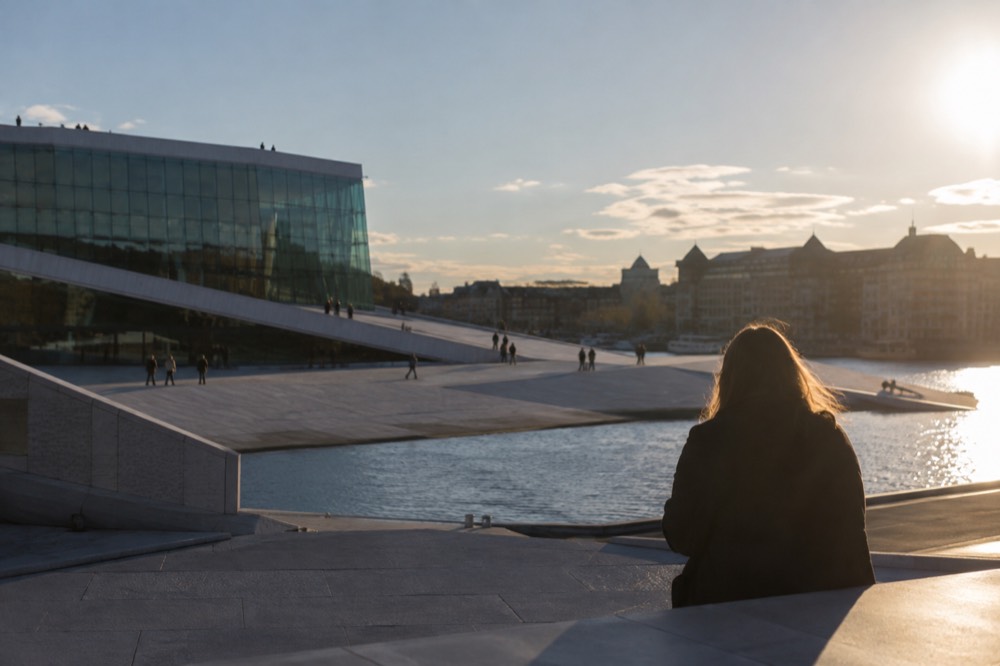
That list is not a scrape of generic travel content. The Vigeland Park fact comes from the Vigeland Museum itself, which manages the park: over 200 sculptures, no ticket, no closing time. The Opera House roof is marble and open to anyone who walks up it, a deliberate piece of Nordic civic architecture rather than an oversight.
The distinction that matters when planning is between free sights and merely cheap ones. The Oslofjord island ferries are wonderful value but they are not free: they are ordinary Ruter public transport, so they ride on a regular ticket. The free walking tours are free in the sense that payment is voluntary, which is a different proposition from a museum with no admission at all. This plan separates the three categories cleanly so a tight budget can be spent where it buys the most.
Can You Really See Oslo's Top Sights Without Paying?
Yes, and not just the minor ones. Oslo's single most visited attraction, the Vigeland sculpture park, is free, as is the Opera House, one of the city's defining buildings. The Akershus Fortress exterior and grounds, the Royal Palace park, the Oslo Cathedral, and the entire Aker Brygge waterfront all cost nothing to see. A first-time visitor can cover the classic postcard list of Oslo without buying a single attraction ticket.
The trick is knowing which version of each sight is free. The Royal Palace's park, the Queen's Park behind it, is open to the public and free; the palace interior tours are paid and seasonal. The Akershus Fortress medieval castle walls, grounds and harbor views cost nothing to explore, while the museums inside the complex charge admission. Oslo Cathedral is a working church and free to enter during opening hours.
For structure on day one, the free highlights walking tour is the practical backbone. It is the largest free walk in the city by a wide margin, it runs about two hours, and it is tip-based, so the price is whatever the walk was worth to you. It covers the center's main sights with a local guide, which turns the free list into a route rather than a set of pins on a map.
If you prefer to move at your own pace, the same ground works as a self-guided loop. Start at the Central Station, walk Karl Johans gate to the Royal Palace park, drop down through the National Theatre area to the City Hall waterfront, then follow the harbor past Aker Brygge to the Opera House roof. That is roughly three kilometers of the city's most famous public space, and every step of it is free.
Which Oslo Museums Are Free, and for Whom?
No major Oslo museum is free for all adults, but four of them let children in at zero cost: MUNCH (17 and under), the Norwegian Museum of Cultural History (0 to 17), the Nobel Peace Center (0 to 17), and Astrup Fearnley (under 20). Under-25s pay sharply reduced rates at MUNCH and the National Museum. The free layer for adults is the city itself: parks, fortifications and sculpture.
That is the verified position from each venue's own ticket page, and it changes the maths of a family trip considerably. Two adults with two teenagers at the Folkemuseum pay for two tickets instead of four. At Astrup Fearnley, a family with a 19-year-old still pays child-free pricing for the whole young-adult bracket.
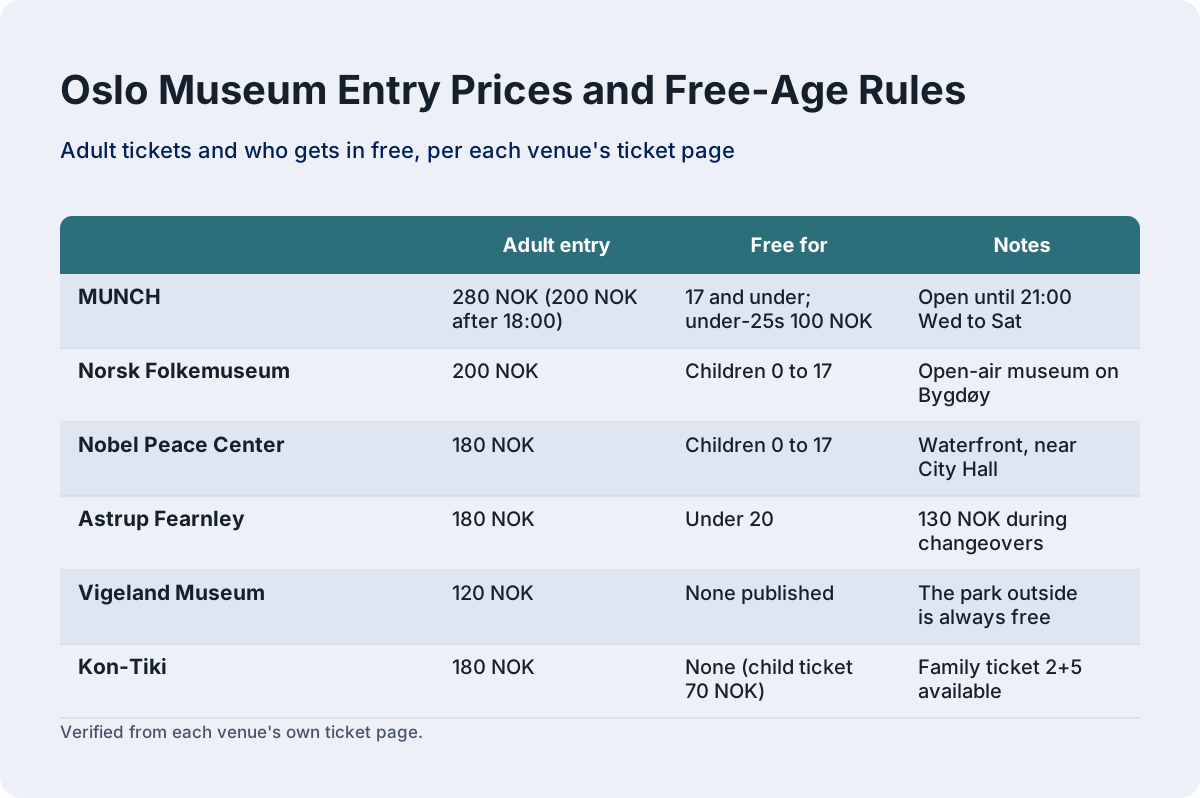
Here is the verified free and reduced-entry picture for the major museums, from the venues' own published pages:
| Museum | Adult entry | Free for | Notes |
|---|---|---|---|
| MUNCH | 280 NOK (200 NOK after 18:00) | 17 and under; under-25s pay 100 NOK | Open until 21:00 Wed to Sat |
| Norsk Folkemuseum | 200 NOK | Children 0 to 17 | Open-air museum on Bygdøy |
| Nobel Peace Center | 180 NOK | Children 0 to 17 | Waterfront, near City Hall |
| Astrup Fearnley | 180 NOK | Under 20 | Reduced to 130 NOK during exhibition changeovers |
| Vigeland Museum | 120 NOK | None published | The park outside is always free |
| Kon-Tiki | 180 NOK | None (child ticket 70 NOK) | Family ticket 2+5 available |
The evening pricing at MUNCH deserves a line of its own: entry drops to 200 NOK after 18:00 on the late-opening days, and the museum stays open until 21:00. For adults traveling without children, that is the closest thing to a free museum evening in Oslo, a full three hours of one of Europe's major art museums at a reduced rate.
The one museum question every Oslo visitor asks is the Viking one. The former Viking Ship Museum on Bygdøy is closed and will reopen as the Museum of the Viking Age in 2027, with no month published. Until then, the museum's own site points Viking-interested visitors to the Historical Museum in the center, and Viking Planet, the VR-based Viking experience, is the bookable substitute while the rebuild finishes.
Is the Free Walking Tour Really Free?
Yes, the free walking tours in Oslo are genuinely free to join and pay-what-you-feel at the end, typically two hours long and covering the city center's highlights. They are the largest free tour category in the city, with the main operator's walk carrying well over two thousand reviews. You reserve a spot, walk, and tip the guide in cash or by card if the walk earned it.
The big operator's free tour is the default budget answer for the whole city, and the themed alternatives cover ground the main walk skips. There is a contrasts walk focused on rich and poor, east and west Oslo, and a smaller orientation walk led by locals that works as a second option when the big one is fully booked. All of them are tip-based, and none requires payment to reserve.
One planning note that matters: the free walks are popular, and the meeting point is central. Reserve ahead in peak summer, and arrive a few minutes early. A tip-based walk is also the cheapest possible way to get a local's orientation before spending anything on structured sightseeing, which is exactly why budget itineraries put it on day one.
What Free Parks and Outdoor Art Can Fill a Whole Day?
Vigeland Park and Ekebergparken together hold hundreds of sculptures and both are free, open around the clock, and free of ticket desks. Add the Botanical Garden and the Akershus grounds and a visitor has two full days of walking through Oslo's best outdoor spaces without spending a krone on entry.
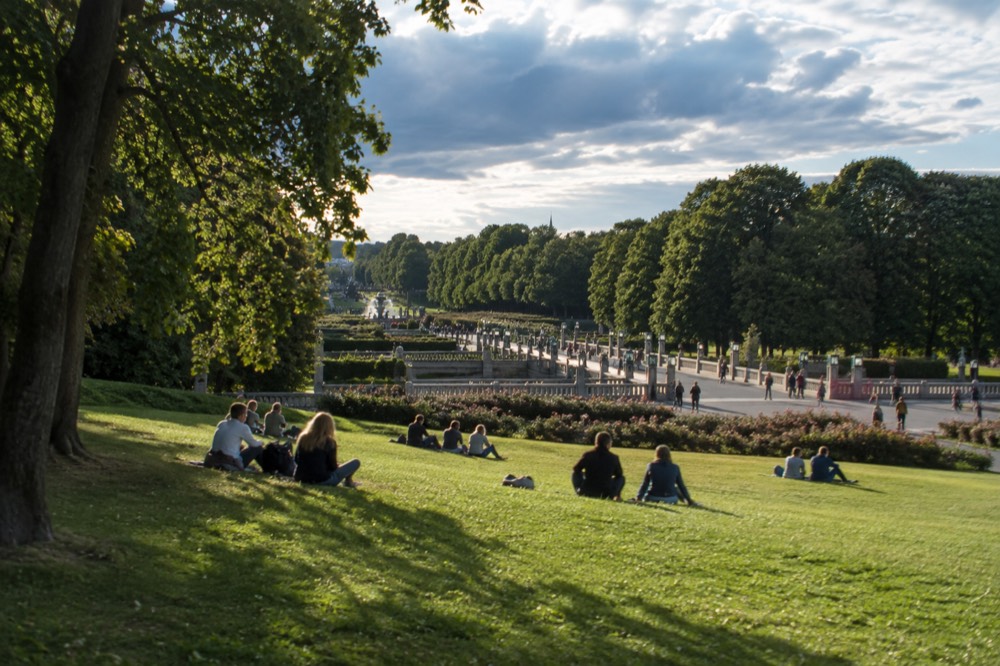
Vigeland Park is the anchor. Over 200 granite and bronze sculptures by Gustav Vigeland, the Monolith at the center, and the famous angry-boy statue, all in a public park that never closes and never charges. It is Oslo's most visited sight of any kind, paid or free, and it earns that position. The guided art walk exists for visitors who want the sculpture decoded, since the park itself explains nothing, but walking it alone costs nothing and loses nothing of the spectacle. The full index of guides sits on Oslo Travel Guide. The full index of guides sits on Oslo Travel Guide.
Ekebergparken, on the hillside east of the center, is the less famous sculpture park and in some ways the better walk: a forested hillside with international contemporary sculpture, viewpoint clearings over the Oslofjord, and the same free, always-open access. Getting there is a short tram ride, so it is not strictly free with transport, but the park itself is.
The Botanical Garden in the Tøyen district is the quiet third option, free to enter and especially good in late spring. It sits beside the old Munch museum building in a neighborhood that also covers the Tøyen and Grønland side of the city, which is the budget-eating district, so the two pair naturally for a low-spend afternoon.
What Does the Waterfront Cost?
Nothing. The entire Oslo waterfront promenade from Aker Brygge through Tjuvholmen to Sørenga is public space, free to walk its full length, and the Opera House roof is part of it. The harbor baths at Tjuvholmen and Sørenga are free public swimming. Only the boats cost money, and even the island ferries ride on an ordinary public transport ticket.
The Aker Brygge stretch is the postcard: converted shipyard buildings, the food hall, and the water on one side. Continue to Tjuvholmen for the beach and the architecture, cross to the Barcode towers, and end at the Opera House roof, where the marble slope is a public plaza that happens to be a building. Locals picnic there in summer; in winter it is a windswept viewing platform, still free.
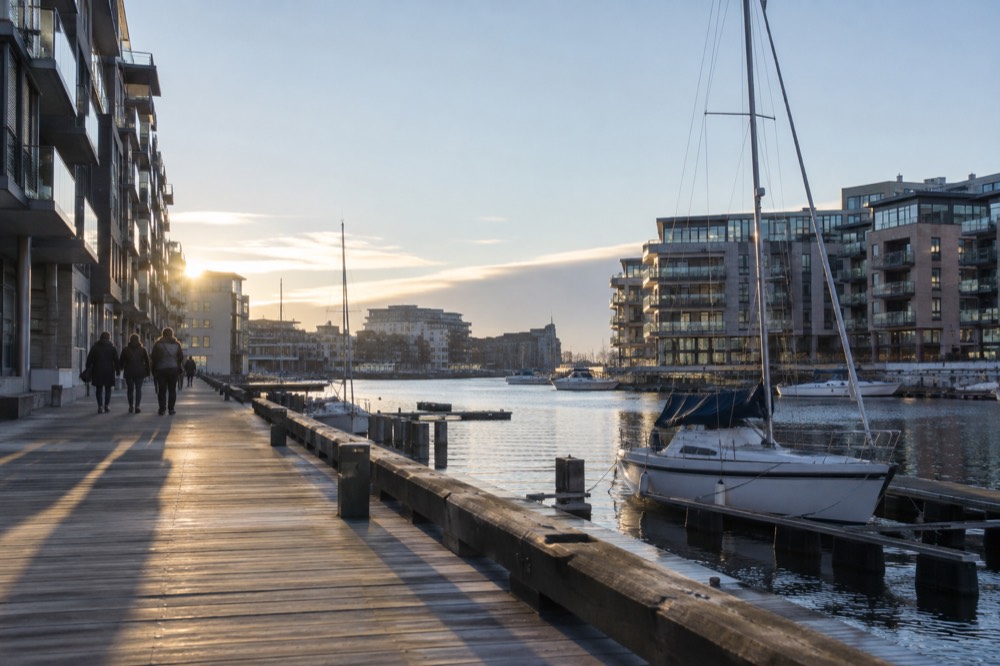
The swimming question is worth being precise about, because the fjord is why people come. The official public bathing spots, Sørenga seawater pool, Tjuvholmen, Huk on Bygdøy, and the island beaches, are free public access. Realistic July and August water temperatures sit around 15 to 20 degrees Celsius, which is bracing rather than balmy. The city publishes live bathing-water temperatures and quality results, so check before swimming rather than guessing.
The one paid element on the waterfront is the boats, and the honest framing is that they are cheap rather than free. The island ferries to Hovedøya, Gressholmen and the other Oslofjord islands are ordinary Ruter lines from Aker brygge, covered by a regular transport ticket. A day built around the free promenade with one ferry hop is still one of the lowest-cost full days in any Scandinavian capital.
How Do You Get Around Oslo for Free or Nearly Free?
Walking is the real answer: central Oslo is compact enough that the classic sights are all within a 30-minute walk of each other, and the free layer of the city, the parks, waterfront and fortress, is exactly the walkable layer. Beyond that, nothing in Oslo transport is free, but the Ruter 30-day zone 1 pass was cut from 805 to 655 NOK in May 2026, and single tickets bought in the app are the cheapest pay-per-ride option.
The walkability is not a slogan. The Royal Palace to the Opera House is about 15 minutes on foot. The Opera House to Aker Brygge is 10. Vigeland Park is the outlier, a tram ride west, and Ekebergparken a tram ride east, but the core free itinerary needs no ticket at all on a dry day.
For the days you do ride, the verified position on prices is narrower than most guides admit. Ruter's site renders its price table through JavaScript and the single, 24-hour and 7-day fares are not reliably published outside the app, so check live before budgeting. What is confirmed: a single zone 1 ticket is valid for 60 minutes from activation, each additional zone adds 30 minutes, and buying on board a bus or boat costs more than buying in the app. The 30-day zone 1 adult pass fell from 805 to 655 NOK from 3 May 2026, a real cut, relevant to anyone staying a month rather than a weekend.
| Free or cheap layer | What it is | What it costs |
|---|---|---|
| Central Oslo on foot | Palace, Cathedral, waterfront, Opera roof, Aker Brygge | Free |
| Vigeland Park | 200+ sculptures, open 24 hours year-round | Free |
| Ekebergparken | Forested sculpture park with fjord views | Free |
| Akershus grounds | Fortress walls, harbor views | Free |
| Botanical Garden | Tøyen, beside the old Munch building | Free |
| Island ferries | Ruter lines from Aker brygge | Ordinary transport ticket |
| Free walking tours | ~2 hours, tip-based | Whatever you tip |
What Does a Free Day in Oslo Actually Look Like?
A realistic zero-spend day: morning at Vigeland Park, midday walking Karl Johans gate and the Royal Palace park, afternoon on the waterfront promenade and the Opera House roof, and the free walking tour as the spine of the day, with only food and any tips as outgoings. Two such days are possible without repeating a single sight.
Here is how the pieces sequence, using only verified free elements:
| Time | Day 1 | Day 2 |
|---|---|---|
| Morning | Free walking tour of the center | Vigeland Park, arrive early |
| Midday | Karl Johans gate, Cathedral, picnic in the Palace park | Botanical Garden, Tøyen |
| Afternoon | Waterfront promenade, Aker Brygge | Ekebergparken sculpture walk |
| Late afternoon | Opera House roof | Akershus Fortress grounds |
| Evening | Tjuvholmen beach and harbor | Grønland budget dinner |
Food is where the free plan meets Oslo's real costs, and the honest numbers are the SSB ones: food and non-alcoholic drinks run about 33 percent above the European average, and alcohol is more than double. The workaround locals actually use is the supermarket: grocery stores sell beer and cider up to 4.7 percent, wine and spirits exist only at Vinmonopolet, which closes on Sundays and early on Saturdays. A picnic from a supermarket is the standard budget meal here, and the parks listed above are where it gets eaten. For the deeper budget picture, the Oslo on a budget guide breaks down eating cheaply in detail.
Weather shapes the plan more than in most cities. August is Oslo's wettest month on the 1991 to 2020 normals at 103 mm, not November as commonly assumed, and July's normal mean of 17.7 degrees Celsius is mild. In midwinter the sun is up for under six hours, which compresses any outdoor day. The free plan still works in the dark months, but the balance shifts toward the fortress walls, the Cathedral, and the free walks, with the rainy day and winter guides covering those versions.
Where Do Free and Cheap Meet: The Bygdøy Question
Bygdøy, the museum peninsula, is free to visit and its beaches and forests cost nothing, but its museums charge, the seasonal ferry from Rådhusbrygge 3 costs about 70 NOK each way and is not covered by ordinary Ruter tickets, and bus 30 reaches it year-round on a normal ticket. The free version of Bygdøy is its coastline: Huk beach and the forest paths.
The ferry distinction is the fact most guides scramble. The Bygdøy museum ferry and the Oslofjord island ferries are different systems from different piers with different ticket rules. The Bygdøy ferry runs seasonally from mid-March to early October, every 20 minutes, and an Oslo Pass covers it while a standard Ruter ticket does not. The island ferries from Aker brygge are Ruter lines and always ride on ordinary tickets. Getting this backwards costs a visitor either a surprise fare or a wasted walk to the wrong pier.
For a free day on the peninsula, bus 30 is the answer: it runs year-round to the museum stops on a normal ticket, and from its stops the coastal path to Huk beach and Paradisbukta is public and free. The museums, Kon-Tiki, Fram and the Folkemuseum, are the paid layer, and they are also the layer where a family with children pays the least, since the Folkemuseum admits everyone under 18 free.
Common Questions About Free Things to Do in Oslo
Is Vigeland Park free?
Yes, completely. The sculpture park is a public park, open 24 hours a day, all year, with no ticket and no gate. The separate Vigeland Museum next to it charges 120 NOK, but the park with its 200-plus sculptures, including the Monolith, costs nothing.
Can you walk on the Oslo Opera House roof for free?
Yes. The sloping marble roof is a public space, deliberately built as a plaza, and walking up it costs nothing at any hour. It is one of the best free viewpoints in the city, looking across the fjord to the islands.
Are the free walking tours in Oslo actually free?
They are free to join and tip-based. You reserve a spot, the walk runs about two hours, and you pay the guide what you feel it was worth at the end, by cash or card. No upfront payment is required.
Which Oslo museums are free for children?
MUNCH admits everyone 17 and under free, the Norwegian Museum of Cultural History is free for ages 0 to 17, the Nobel Peace Center is free for children 0 to 17, and Astrup Fearnley is free for anyone under 20. Under-25s also get reduced entry at MUNCH.
Is the Akershus Fortress free to visit?
The fortress grounds, walls and harbor views are free and open to walk around at any time. The museums inside the fortress complex charge admission, but the exterior and the ramparts, which carry most of the atmosphere, cost nothing.
Can you swim in Oslo for free?
Yes. The public bathing spots, including Sørenga seawater pool, Tjuvholmen, Huk and the island beaches, are free public access. Expect water around 15 to 20 degrees Celsius in July and August, and check the city's published bathing-water temperatures and quality results before swimming.