Oslo Pride: What to Expect from Norway's Biggest Festival
Oslo Pride is the largest pride festival in Norway and one of the biggest events in the capital's calendar. Here is how the week works, where the parade goes, what it costs and how to plan around it.
Short answer
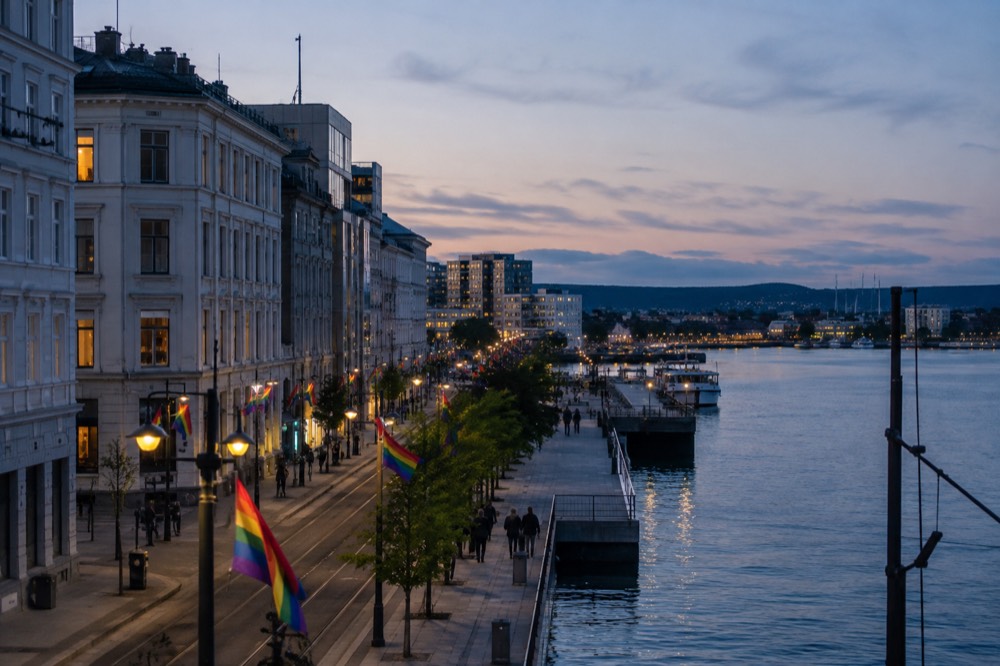
Oslo Pride is Norway's largest pride celebration, held in Oslo each June and culminating in a parade through the city centre to Rådhusplassen. Most of the program is free and open to all, including the parade, the opening ceremony and the closing festival area. No ticket is needed to watch or march; you just show up.
Oslo Pride: What to Expect from Norway's Biggest Festival
Few events rearrange Oslo's streets the way Oslo Pride does. For roughly ten days each June the city centre fills with rainbow flags, stages, film screenings, debates, parties and a parade that draws a crowd larger than almost anything else on the Norwegian summer calendar. The festival is organised by the Oslo Pride foundation together with volunteer groups, and it is open to everyone, visitors included, with no registration and no ticket for the core program.
Oslo itself is a compact, walkable capital, and pride week uses that compactness well. Most venues sit within a short walk or a single tram ride of each other, from the university quarter to the City Hall square on the waterfront. This guide covers the program, the parade route, where to watch it, where to stay, what the week costs and how to fold the rest of the city into your visit.
What Is Oslo Pride and How Big Is It?
Oslo Pride is Norway's largest pride festival and one of the largest annual events of any kind in the capital, running for roughly ten days each June and closing with a parade through the centre that regularly draws a crowd larger than almost any other event in the city. It is free, political, social and family-friendly at the same time, mixing concerts and club nights with debates, art exhibitions, seminars and a children's program. The organising foundation publishes the full schedule on its own site each year.
The festival grew out of the long Norwegian tradition of pride and commemoration that followed the partial decriminalisation of homosexuality in the country, and pride in Oslo has been held annually for decades in various forms. Today it functions as both a celebration and a political platform: Norway ranks among the most LGBTQ-friendly countries in Europe by legal protections, but the festival's own program still foregrounds international solidarity and the situation of queer people in countries where those protections do not exist.
That political streak shapes the tone. This is not a corporate street party that happens to have rainbow flags on it. Speeches from the main stage, a memorial moment for victims of discrimination and violence, and a strong presence from political parties, unions and volunteer organisations all sit alongside the pop acts and the drag shows. Visitors expecting only a party will find one, but they will find it inside a program with a spine.
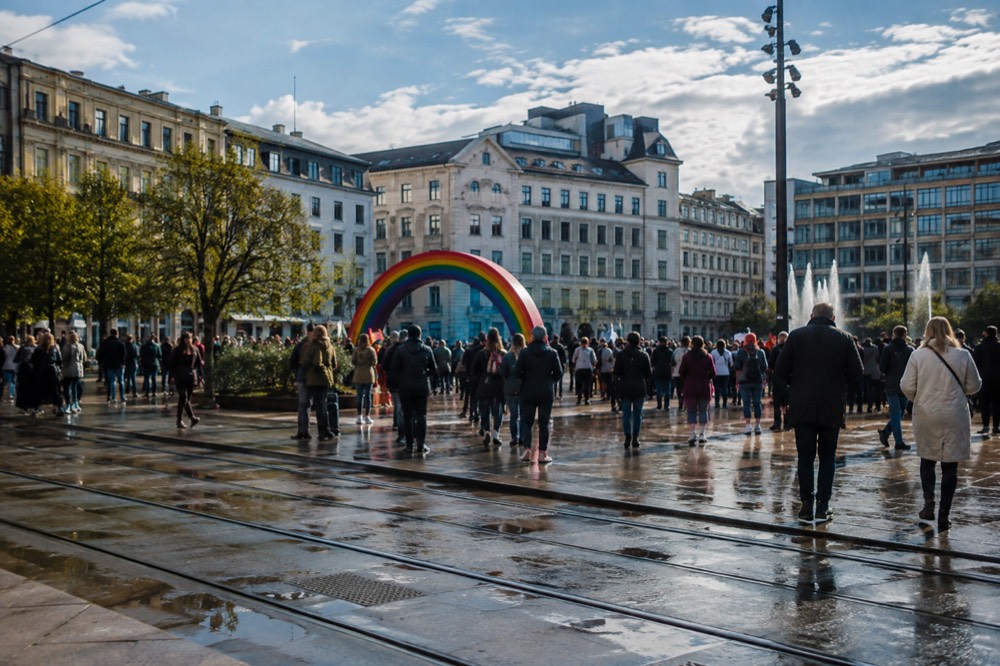
The scale surprises first-time visitors. During the parade the entire length of the route closes to traffic, trams reroute, and the waterfront around City Hall Square turns into a fenced festival zone with stages, food stalls and first-aid points. Plan around it rather than through it, and it becomes the best week of the year to be in the city.
When Is Oslo Pride and What Does the Program Look Like?
Oslo Pride runs in late June each year, typically for around ten days, and finishes with the parade on the closing Saturday. The program is published on the festival's official site a few weeks beforehand and spans talks, film, art, sport, family events and club nights, most of them free. The two fixed anchors are the opening ceremony and the Saturday parade with the closing festival at Rådhusplassen, the square in front of City Hall on the Oslofjord waterfront.
The structure is broadly the same every year even though the details change. The opening ceremony usually takes place in a central square, with speeches and a concert. Through the middle days, events spread across the city: film screenings, quiz nights, panel debates on trans rights and international queer politics, church services, library exhibitions, sports taster sessions and themed nights at bars and clubs, many of them in the Grünerløkka and city-centre nightlife areas. A dedicated family day gives parents and children their own program.
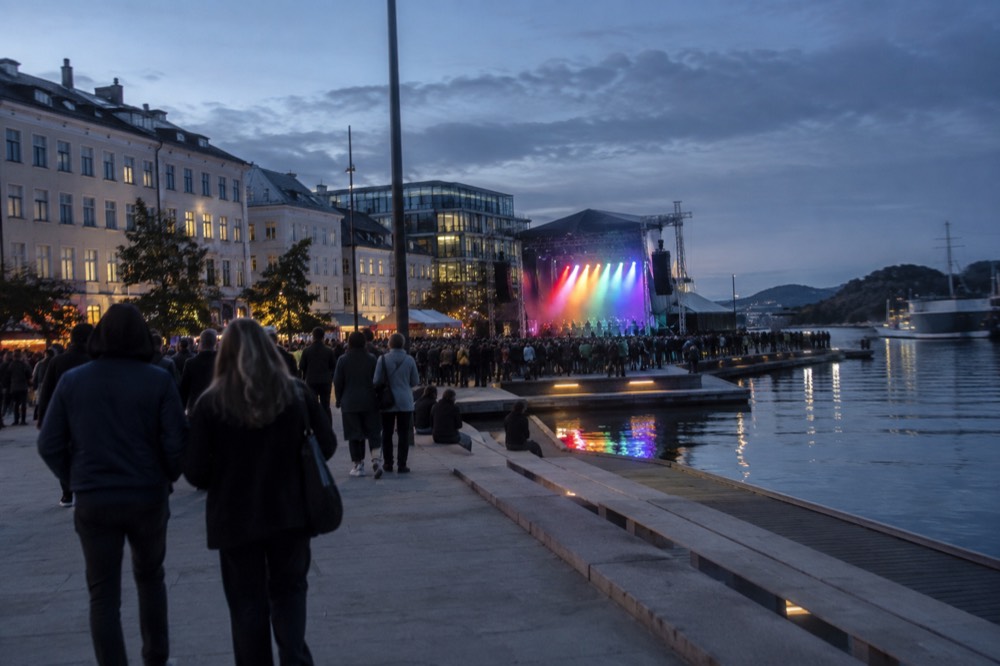
The final Saturday is what most visitors come for. The parade assembles early in the afternoon, steps off in the mid-afternoon and winds through the centre to Rådhusplassen, where the closing festival runs into the evening with a stage program. The square sits right on the water, and on a warm late-June evening, with the sun not setting until around 22:40 at this latitude, the atmosphere carries on well past the official end.
Here is how the week generally breaks down:
| Part of the festival | Timing | What it involves | Ticket needed |
|---|---|---|---|
| Opening ceremony | First days, evening | Speeches and a free outdoor concert in a central square | No |
| Program days | Throughout the week | Debates, film, art, sport, seminars, family events | Mostly no |
| Club and bar nights | Evenings | Themed parties across the city, many in Grünerløkka | Sometimes, via venues |
| Family day | One weekend day | Children's program, activities, performances | No |
| Parade | Closing Saturday, afternoon | March through the centre to Rådhusplassen | No |
| Closing festival | Closing Saturday, into the evening | Stage program, food stalls, crowds at City Hall square | No |
Two practical notes. First, the exact dates shift each year, so check the festival's own program page before booking flights, and note that the parade always falls on a Saturday, which makes a long weekend the natural trip length. Second, June is high season in Oslo, so accommodation fills early; the weekend in Oslo planning guide covers the short-trip logistics in more depth.
If you want a break from the crowds between events, the fjord is ten minutes' walk from the closing festival square, and the boat options below are the standard way to use it.
Where Does the Parade Go and Where Are the Best Viewing Spots?
The parade assembles in the city centre, marches through the main shopping and government streets, and finishes at Rådhusplassen, the square in front of Oslo City Hall on the waterfront, where the closing festival takes over for the evening. The exact route varies slightly year to year, but it always ends at City Hall, and the best viewing is either early along the route, where crowds are thinner, or at the square itself, where the party is.
The parade typically steps off from around the Grønland or central station side of the city centre and moves westward through the heart of town, passing near Karl Johans gate, the Parliament and the government quarter before descending to the water at Rådhusbrygge. The whole march takes a couple of hours to pass any given point, and the head of the parade arrives at City Hall before the tail has left the start.
Viewing strategy depends on what you want. Families with small children tend to line up early along the first stretch, where you can see everything at close range and leave easily when legs get tired. People who want the party atmosphere head straight to Rådhusplassen and claim a spot near the stage. Photographers often pick the stretch near the National Theatre or along the last downhill blocks to the water, where the light in the late afternoon comes off the fjord.
A few practical points worth knowing:
- Arrive early for the square. The best spots near the stage fill an hour or more before the parade arrives.
- The route and the square are closed to traffic, and trams reroute for the afternoon. Check the Ruter app on the day.
- Bring cash-free payment only; stalls and kiosks are card-first in Norway.
- Public toilets are limited. Use station or shopping-centre facilities before you claim your spot.
The parade's endpoint sits at the foot of the Oslo City Hall building, itself worth a look inside on a quieter day for its murals and the Nobel Peace Prize ceremony hall. The Aker Brygge waterfront, a five-minute walk south, is where the crowd drifts for food and drinks once the stage program winds down.
Is Oslo Pride Free to Attend?
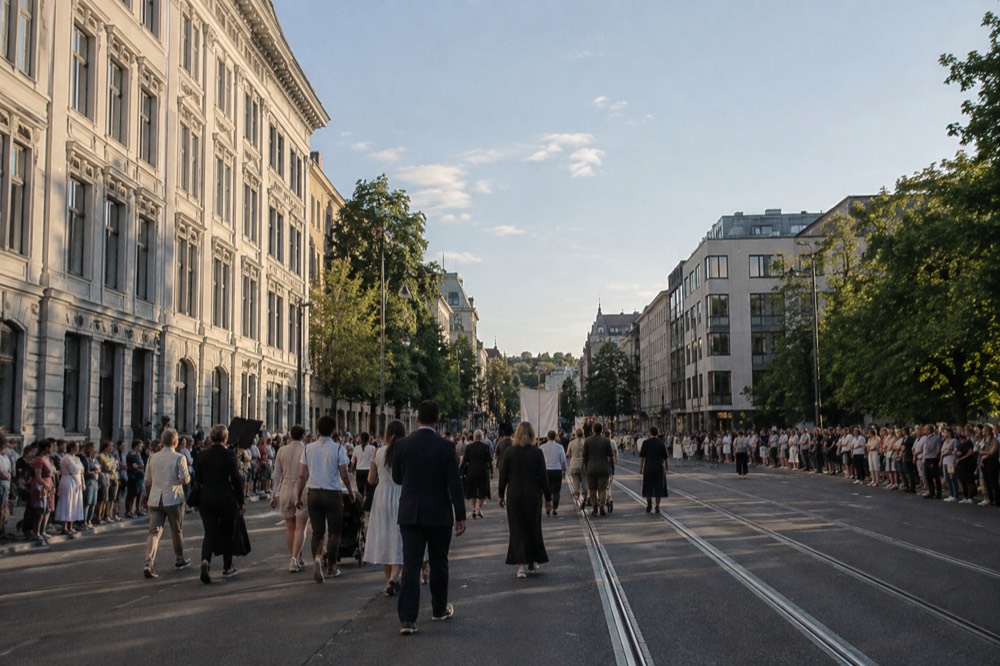
Yes, the core of Oslo Pride is free: the parade, the opening ceremony, the closing festival at Rådhusplassen and most of the daytime program cost nothing and need no ticket. What you pay for is the optional layer, meaning the evening club nights run by venues, food and drink at the festival area, and any travel and accommodation. As a budget, a visitor who attends only the free program can experience the whole festival without spending a krone beyond normal city costs.
That free core is deliberate and political. The festival's organising model keeps the public program open to all, and it is one of the reasons the event is so large: nobody is priced out of the parade or the closing concert. The paid layer exists in the evenings, when bars and clubs across the city host themed parties; those sell tickets through the venues themselves and through the festival's program page, and the popular ones sell out in advance.
For context on what the surrounding city costs, Norway is the sixth most expensive country in Europe on Statistics Norway's 2025 price-level comparison, with food about 33 percent above the European average and alcohol more than double. The way to keep a pride trip affordable is the same as for any Oslo trip: lean on the free outdoors, use public transport, and treat restaurants and bars as the occasional splurge rather than the default. The Oslo on a budget guide covers the money-saving mechanics in detail, and the free things to do in Oslo list pairs well with the free festival program.
A rough sense of where the money goes:
| Item | Typical cost | Notes |
|---|---|---|
| Parade and closing festival | Free | No ticket, open to all |
| Opening ceremony | Free | Outdoor concert and speeches |
| Daytime program events | Mostly free | Debates, film, exhibitions, family day |
| Club nights | Varies by venue | Ticketed, popular nights sell out |
| Food stalls at the festival | Normal Oslo prices | Card payment standard |
| Public transport | Ruter ticket | App is the cheapest way to buy |
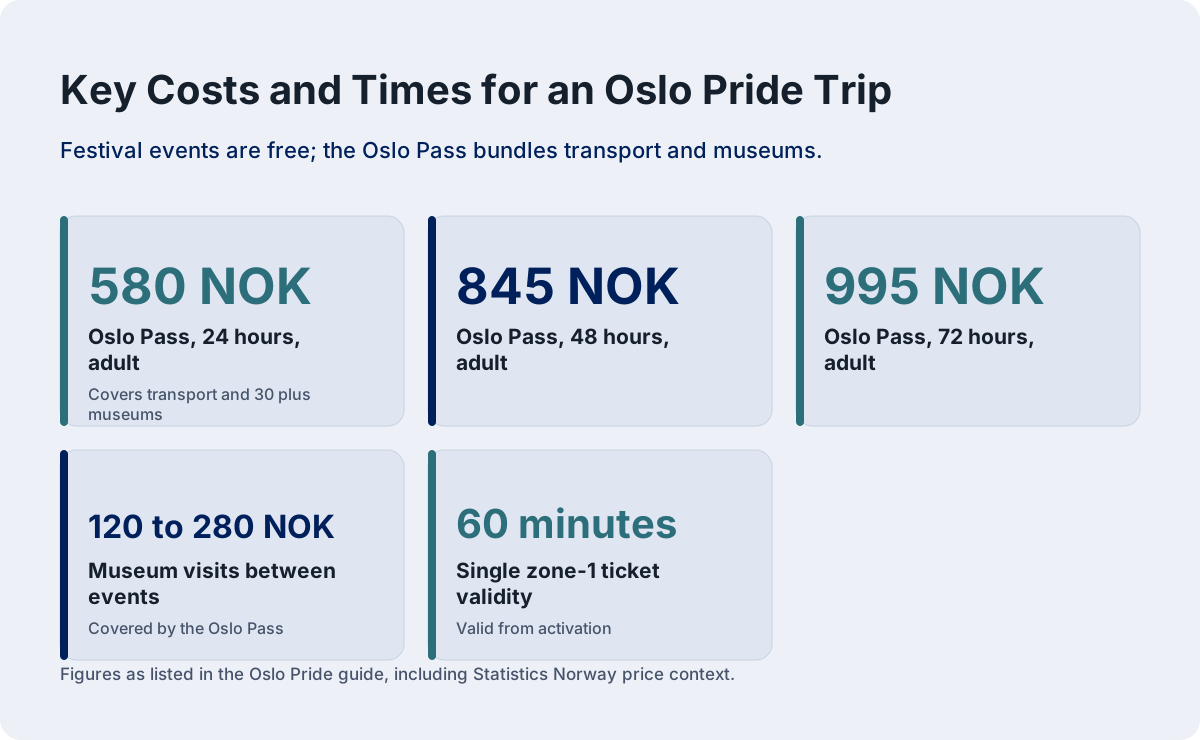
| Museum visits between events | 120 to 280 NOK | Covered by the Oslo Pass |
One money fact worth knowing while you are in town: the Oslo Pass, the city tourist board's combined transport-and-museum card, costs 580 NOK for 24 hours, 845 NOK for 48 hours and 995 NOK for 72 hours for an adult, and it covers the trams and trains you will use during the festival week as well as entry to more than 30 museums. Whether it pays off depends on how many museums you stack into your days, which the is the Oslo Pass worth it guide works through.
Where Should You Stay During Oslo Pride?
The practical answer is anywhere inside or just outside the Ring 1 centre, because the parade, the opening ceremony and the closing festival are all within a 15-minute walk of each other. Sentrum puts you closest to the action, Grünerløkka puts you in the nightlife district where many of the evening events happen, and Frogner and Majorstuen give quieter sleep within a short tram ride of everything. Book early, because June is peak season and the festival fills the city.
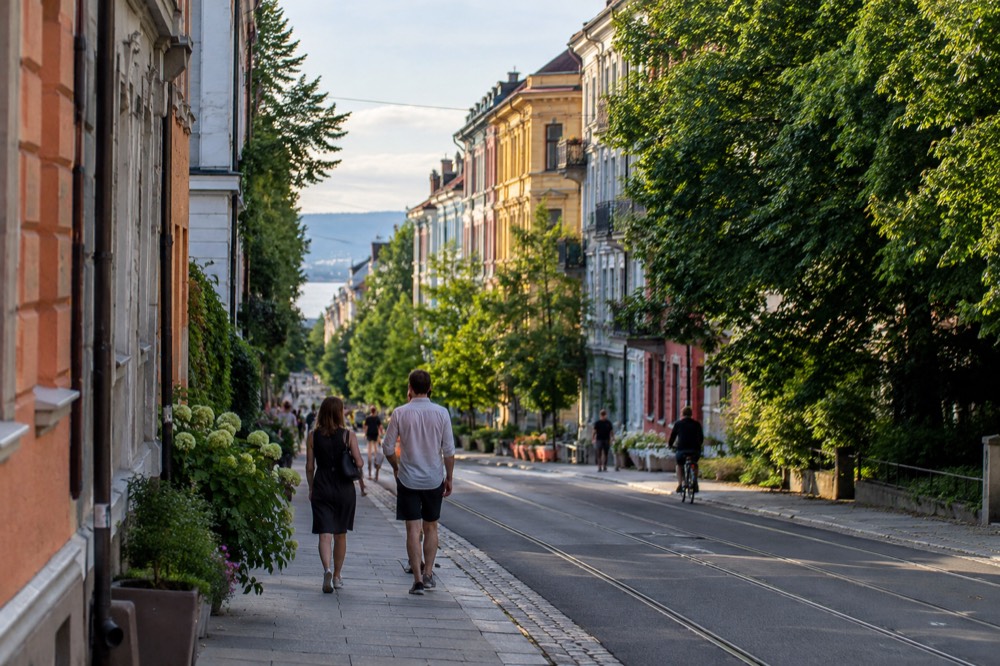
Each area has a distinct character during the week. Sentrum, the centre, is loud and convenient: you can walk to the parade route in minutes, but expect noise late into the closing Saturday. Grünerløkka, the former workers' district east of the river, is where a large share of the club nights and bar events take place, and it doubles as the city's best café and vintage-shopping neighbourhood during the day. Frogner and Majorstuen, west of the palace, are calmer, still well connected by tram, and sit next to the Vigeland sculpture park, which is free and open around the clock. The rest of the planning pages sit on Oslo Travel Guide. The rest of the planning pages sit on Oslo Travel Guide.
| Area | Walk to closing festival | Character during pride week | Best for |
|---|---|---|---|
| Sentrum | 5 to 10 minutes | Central, busy, noisiest on the final Saturday | Convenience, short trip |
| Grünerløkka | 20 to 25 minutes | Bar and club events, café culture by day | Nightlife, atmosphere |
| Frogner | 20 minutes by tram | Quiet, residential, museum-adjacent | Sleep, families |
| Majorstuen | 25 minutes by tram | Calm, well connected, local feel | Budget-conscious stays |
| Tøyen and Grønland | 25 minutes on foot or one tram | Mixed, cheaper, up-and-coming | Value |
The where to stay in Oslo guide goes deeper on neighborhoods, and the Grünerløkka area page covers that district on its own. One warning repeated by every planner: do not leave accommodation to the last minute. Pride week overlaps with early-summer conference and cruise season, and central hotels raise rates and fill up weeks ahead.
What Else Should You Do While You're in Oslo for Pride?
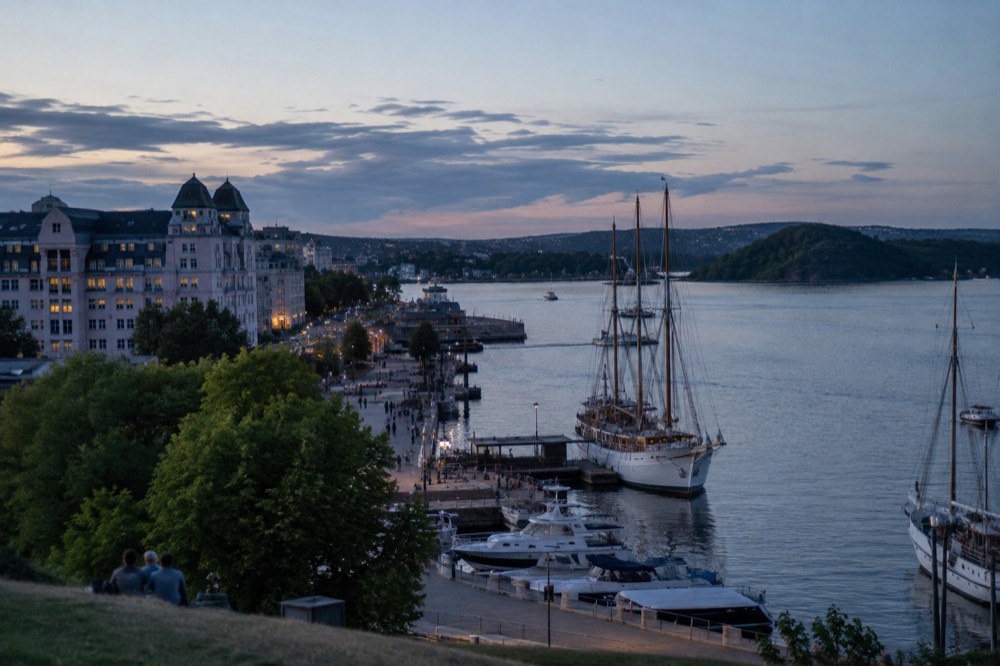
Treat the festival as the spine of the trip and build the rest of the city around it, because Oslo in late June is at its best: 18 hours of daylight, the Oslofjord islands a short ferry ride away, and the museums, parks and waterfront all within a compact centre. The strongest combinations are a fjord cruise on a free evening, the Bygdøy museum peninsula on a slower day, and a food walk through Grünerløkka, which doubles as the festival's nightlife district.
Late June gives you daylight from before 4 a.m. until nearly 11 p.m., which effectively adds a second evening to every day. The parade finishes in the early evening and the sun is still high; plenty of visitors drift from the closing festival straight onto the water. The silent electric fjord cruise is the most popular way to do that, a 90-minute loop with audio commentary, and it is the single best-reviewed activity in the city across thousands of reviews. It runs daily through the summer, and the Oslofjord cruise guide compares all the boat options, from the traditional wooden sailing ship to the evening shrimp-buffet dinner cruise.
For a slower day, the Bygdøy peninsula holds the Kon-Tiki and Fram museums, the cultural history museum and the maritime museum, reachable by seasonal ferry from Rådhusbrygge 3 or year-round by bus 30. The Kon-Tiki Museum ticket is the anchor of a Bygdøy visit, and the Bygdøy guide covers the peninsula in full, including the fact that the Museum of the Viking Age remains closed until 2027.
Between festival events, the city's food scene deserves at least one dedicated block of time. The Grünerløkka food culture walk is the strongest food product in that district, and it doubles as a way to learn the neighborhood where so many of the evening pride events happen. Alternatively, the best restaurants in Oslo and where to eat in Oslo guides map the options by budget and mood.
If you would rather burn energy than calories, the highest-reviewed bike tour in the city covers the main sights in three hours and is the best warm-season alternative to bus tours, using the city's flat, separated bike lanes. It pairs well with a morning before an afternoon of festival programming.
And for the evenings when the club nights do not appeal, the myths-and-legends evening walk is a two-hour themed tour of the city's darker stories, rated among the best walks in the city. It starts in the centre and finishes within walking distance of most Sentrum hotels, which makes it an easy fit before a late dinner.
How Do You Get Around During the Festival?
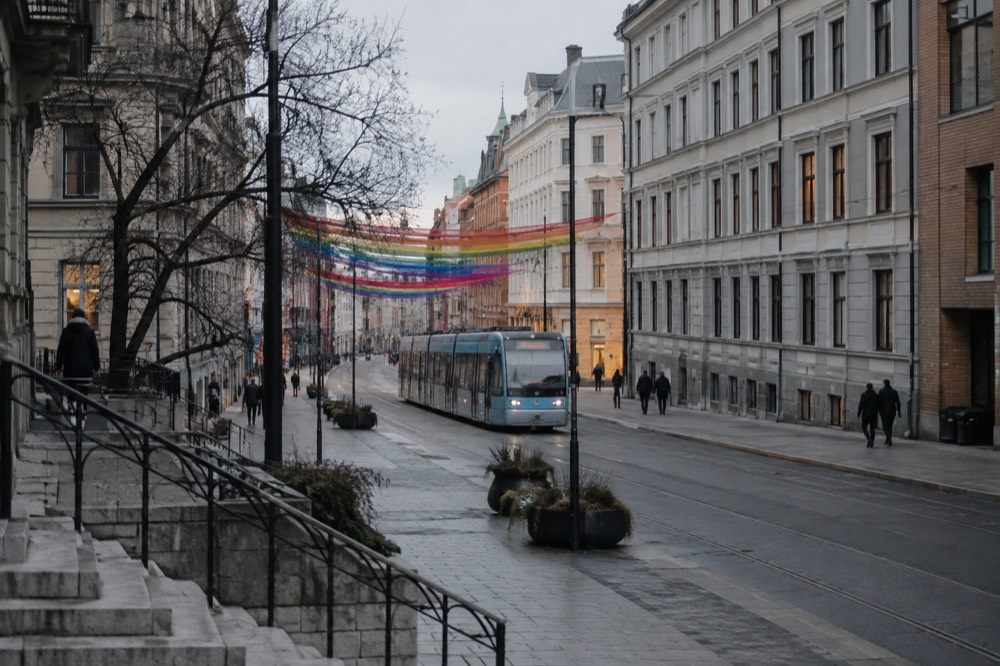
Public transport is the answer, and it keeps running through the festival, with the single exception of the parade afternoon when the route streets and the trams crossing them close temporarily. Oslo's network of trams, metro, buses and ferries is run by Ruter, tickets are bought cheapest in the Ruter app, and everything inside the central zone is a short ride apart. During the parade, plan to walk, and check the app for reroutes on the day.
The transport basics are simple once you know them. Central Oslo, including the whole metro network, sits in zone 1, and a single zone-1 ticket is valid for 60 minutes from activation. The island ferries from Aker Brygge run on ordinary Ruter tickets, as do the buses to Bygdøy. The airport is a separate matter: the Oslo Pass covers the Vy trains to and from Gardermoen but not the Flytoget airport express, which costs 268 NOK one way as an adult single; the Flytoget vs Vy comparison explains the difference and the money you can save.
| Journey | Best option | Notes |
|---|---|---|
| Airport to centre | Vy train or Flytoget | Vy rides on a Ruter ticket, Flytoget is separate, about 20 to 23 minutes |
| Around the centre during pride | Walking | The festival footprint is compact |
| To Grünerløkka | Tram or 20-minute walk | Several lines cross the river |
| To Bygdøy museums | Bus 30, or ferry in season | Ferry leaves Rådhusbrygge 3, seasonal |
| To the Oslofjord islands | Ruter ferry from Aker Brygge | Ordinary zone ticket, B1 line runs year-round |
| Parade afternoon | Walking only on the route | Trams reroute, check the Ruter app |
The getting around Oslo guide covers the full system, and the Ruter tickets page explains the ticket types. One habit worth adopting during the festival: keep the Ruter app on your home screen all week, because service changes and reroutes during event days are announced there first.
What Is the Weather and Daylight Like in Late June?
Late June is the best weather window Oslo offers: the July normal mean temperature is 17.7 degrees Celsius, June sits just below that at 15.3, and the days stretch to 18 hours and 50 minutes of daylight around the solstice, with the sun setting at 22:43 and rising at 03:53. Rain is always possible, June averages 80 mm on the 1991 to 2020 normals, so pack a layer and a light rain shell, but expect long, bright evenings rather than darkness.
The daylight is the part that reshapes a festival trip. The sun sets close to 11 p.m. in late June and the sky never reaches true darkness, only deep twilight, which means the closing festival, the post-parade dinners and the waterfront drinks all happen in full light. There is no midnight sun in Oslo, the city is at 59.91 degrees north, well south of the Arctic Circle, but the practical effect for a visitor is the same: your evenings are long, and sleep needs an eye mask.
What that means for packing and planning:
| Factor | Late June in Oslo | What to do about it |
|---|---|---|
| Daylight | About 18 hours, sunset near 22:43 | Plan late evenings; bring an eye mask for sleep |
| Temperature | Normal mean 15.3 C in June | Layers: t-shirt by day, jacket at night |
| Rain | 80 mm normal for the month | Light rain shell, check the forecast daily |
| Water temperature | Typically 15 to 20 C in July and August | Cold for swimming, fine for a quick dip |
| Sun | Low angle, long exposure | Sunglasses and sunscreen, the light is strong |
The Oslo weather by month and Oslo daylight hours guides carry the full tables if you are weighing other times of year, and the best time to visit Oslo page puts pride week in context against winter, spring and autumn alternatives.
What Practical Tips Make the Week Easier?
Three things carry most of the weight: book accommodation and any paid club nights well ahead, plan the parade afternoon on foot rather than by tram, and use the long daylight to shift your sightseeing to mornings, because festival afternoons and evenings fill up fast. Beyond that, Norway is a card-first country with no tipping expectation, the tap water is excellent, and English is spoken everywhere, so the practical friction of the trip is low.
A few specifics that visitors regularly ask about. Money: Norway uses the krone, not the euro, cards are accepted almost everywhere and many stalls are card-only, so there is no need to withdraw cash. Tipping: service is included in prices, and rounding up is a gesture rather than an obligation. Alcohol: it is expensive and its sale is restricted; supermarkets sell only low-strength beer with an evening cut-off, wine and spirits come from the state monopoly Vinmonopolet, which closes early on Saturdays and all day Sundays. Anyone wanting the nightlife layer of pride without the bar prices should pre-drink sensibly and expect venue queues for the popular themed nights.
Safety is a fair question for a large street festival. Oslo is a safe city by any European measure, the festival area is stewarded and policed, and the parade is famously family-friendly, with children on shoulders and prams in the crowd. The usual big-city care applies late at night in the nightlife districts, nothing more. The is Oslo safe guide covers the general picture.
Finally, fold in the rest of what the city does well, because pride week is also simply a good week to be a tourist in Oslo. The things to do in Oslo master list is the natural next stop for building out your days, and the Oslo at night guide covers the late-evening city, from the opera house roof to the waterfront bars, for the nights when the official program ends before the daylight does.
Common Questions About Oslo Pride
When is Oslo Pride held?
Oslo Pride runs in late June each year, typically for around ten days, and closes with the parade on the final Saturday. The exact dates shift annually, so check the festival's official program page before booking travel.
Is Oslo Pride free to attend?
Yes. The parade, the opening ceremony, the closing festival at Rådhusplassen and most of the daytime program are free and need no ticket. Only the evening club nights run by venues are ticketed, and those sell through the venues or the festival's program page.
Where does the Oslo Pride parade go?
The parade marches through the city centre and finishes at Rådhusplassen, the square in front of Oslo City Hall on the Oslofjord waterfront, where the closing festival with its stage program takes over for the evening. The exact route is published each year before the event.
Can visitors march in the parade?
Yes. The parade is open to all, and visitors commonly join the public sections at the back of the march. Organised groups, floats and the front sections are reserved for registered organisations, but nobody checks anyone out of the general procession.
Is Oslo Pride family-friendly?
Yes, deliberately so. The festival includes a dedicated family day, and the parade itself draws a mixed crowd of families, friends, community groups and partygoers. The closing square gets crowded and loud in the evening, which is the main thing to plan around with small children.
What should I pack for Oslo Pride?
Layers and a light rain shell. Late June in Oslo has a normal mean temperature of about 15 degrees Celsius, warm afternoons, cool evenings and a real chance of rain, with daylight stretching to nearly 19 hours. Comfortable walking shoes matter most, since the parade afternoon is best done on foot.