Ekebergparken: Oslo's Forest Sculpture Park Above the Fjord
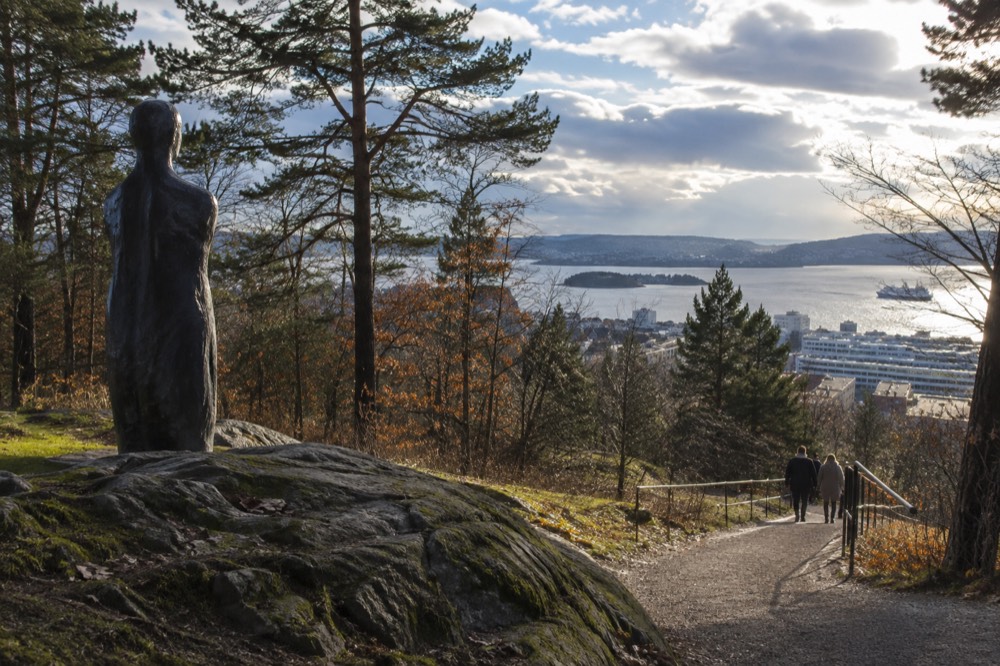
Ekebergparken is the sculpture park Oslo keeps half-hidden: a forested slope above the Oslofjord where international sculpture meets old-growth trees and one of the best views in the city.
Short answer
Ekebergparken is a sculpture and heritage park on the Ekeberg hill southeast of central Oslo, combining forest trails, large-scale sculpture, and wide views over the Oslofjord. Entry is free. Trams climb the hillside and the park has its own named stop, and most visitors spend two to three hours. It is open-air, so dress for the weather.
Ekebergparken: Oslo's Forest Sculpture Park Above the Fjord
Oslo has two famous sculpture parks, and the one most visitors miss is the one with the better view. Ekebergparken sits on the Ekeberg hill on the southeast side of the city, where the forest comes right down toward the Oslofjord, and it layers large-scale sculpture through the trees, along the ridgeline, and out onto lawns that look straight down at the harbor and the Opera House. The park is free to enter, it is a ten-minute tram ride from the center, and it does something no other Oslo attraction manages: it puts modern art, protected forest, and a panorama of the whole city in one walk.
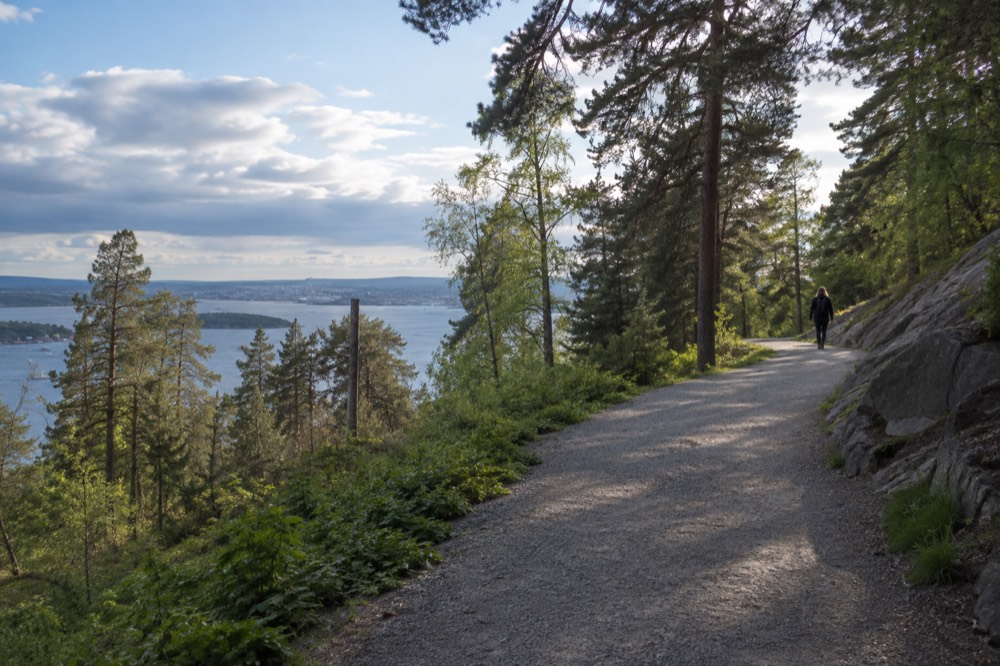
The site itself is older than the art. The Ekeberg hill has been part of Oslo's story for centuries, with walking paths, remnants of older buildings, and woodland that feels far from a capital city even though the towers of Bjørvika are in sight the whole time. The sculpture park was laid out within that existing landscape rather than replacing it, which is why the experience feels closer to a hike with art attached than to a museum with trees. Gravel paths climb through spruce and pine, sculptures appear where you least expect them, and the terrain does half the work of framing each piece.
This guide covers the practical side: how to get there, what it costs, what you actually see, when to go, and how Ekebergparken compares with the better-known Vigeland Park on the west side of the city. If you are building a full Oslo itinerary, our one day in Oslo guide shows where a hillside morning fits.
What Is Ekebergparken and Why Does It Matter?
Ekebergparken is a public sculpture and heritage park on the Ekeberg hill, southeast of Oslo's city center, where dozens of large-scale works by Norwegian and international sculptors are set inside protected forest and open lawns above the Oslofjord. Entry is free, the terrain is hilly, and the park doubles as one of the finest viewpoints in the city, looking across the water at the Opera House, Bjørvika and the city skyline. It is the east-side counterpart to Vigeland Park.
The park's identity comes from the collision of two things that rarely share a hillside: contemporary public sculpture and old Oslo woodland. The sculptures are not corralled into a plaza. They sit on cliff edges, in clearings, beside paths, and on the grass, and the curators clearly worked with the landscape rather than against it. Some pieces are monumental and visible from hundreds of meters away, others are small enough to walk past if you are not paying attention, which is the best argument for walking slowly.
The hill itself carries history. The Ekeberg area was a fashionable outing destination for Oslo residents long before the sculpture park existed, and traces of that era survive in the paths, walls and structures threaded through the woods. The park's managers publish the current layout and any seasonal closures on their own site, and it is worth a quick check before you go, because temporary installations rotate through the grounds and a work you read about may have moved or left.
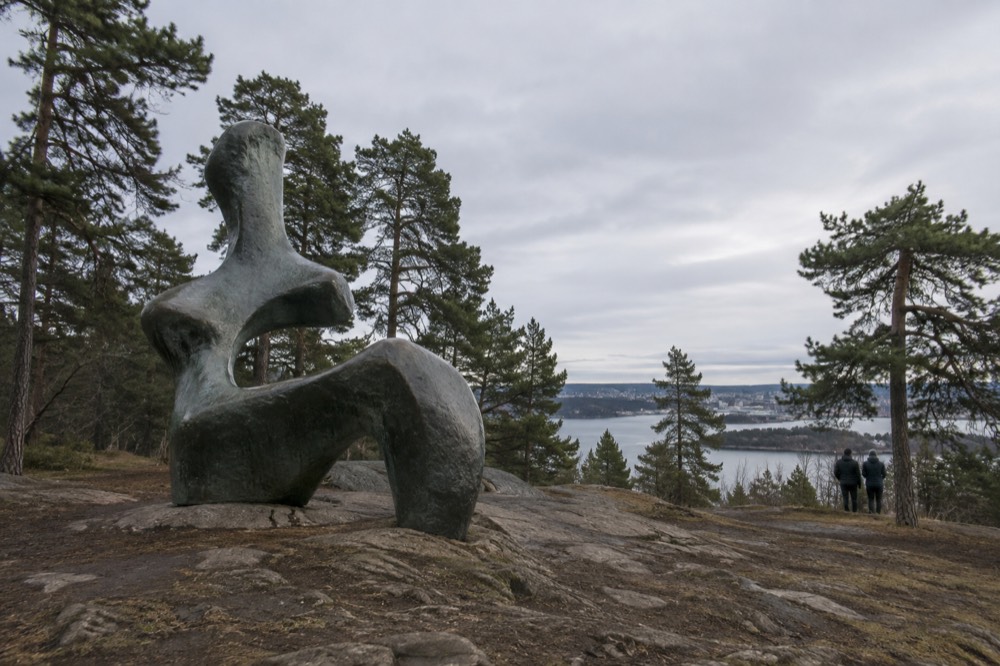
For most visitors the draw is simple: two to three hours of walking that combines art, forest and a view that competes with anything on the west side. Photographers rate the hill highly, and our best views in Oslo guide places the Ekeberg ridge among the spots worth crossing the city for. The angle over the fjord, with the Barcode district in the foreground, is one you cannot get from ground level anywhere else.
How Do You Get to Ekebergparken?
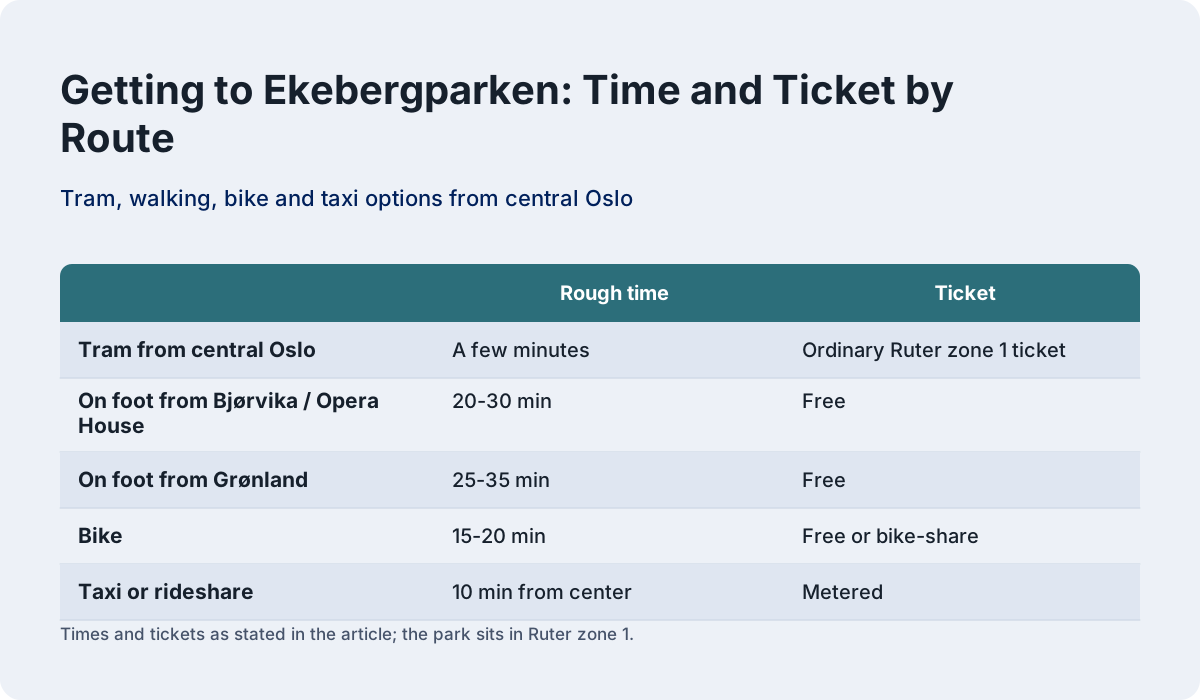
Ekebergparken is reached by tram up the Ekeberg hillside from central Oslo, and the park has its own named tram stop a short walk from the main entrance; the ride from the city center takes only a few minutes. The hill is also walkable from Bjørvika and Grønland in roughly 20 to 30 minutes on foot, uphill. The park sits in Ruter zone 1, so an ordinary central Oslo ticket covers the tram, and the Ruter app is the cheapest place to buy one.
The tram is the sensible answer for almost everyone. The Ekeberg line climbs from stops near the center straight up the hill, and the Ekebergparken stop drops you at the top of the park, which matters: the terrain slopes steeply toward the fjord, and arriving at the top lets you walk the park downhill with the view in front of you rather than behind you. Check the Ruter journey planner for the exact line serving the stop on your travel day, because Oslo's tram network is undergoing works into 2026 and some west-side services are affected.
Walking up is a real option if the weather is good and you like stairs. From the Opera House or Sørenga, the climb through the streets of the east side takes you past some of the neighborhoods covered in our Grünerløkka area guide, and the reward at the top is immediate. Coming down, you can drop toward the fjord promenade and loop back along the water.

| Route to Ekebergparken | Rough time | Ticket | Notes |
|---|---|---|---|
| Tram from central Oslo | A few minutes | Ordinary Ruter zone 1 ticket | Park's own stop; arrive at the top of the hill |
| On foot from Bjørvika / Opera House | 20-30 min | Free | Uphill climb; rewarding descent afterward |
| On foot from Grønland | 25-35 min | Free | Through east-side streets |
| Bike | 15-20 min | Free or bike-share | Steep sections; walk the last stretch |
| Taxi or rideshare | 10 min from center | Metered | Drops at the park entrance |
One planning note that saves real money elsewhere in your trip: Oslo's public transport is zoned, central Oslo including the entire metro network is zone 1, and a single zone 1 ticket is valid for 60 minutes from activation, with 30 minutes added per additional zone. Buy in the Ruter app rather than on board, because on-board purchases cost more. Our getting around Oslo guide unpacks the whole ticket system, including how the Oslo Pass interacts with it.
After a morning on the hill, many visitors head straight for the water, and that is where the city's best-reviewed products are. The selection below pairs the three most reliable ways to spend an afternoon after Ekebergparken: a guided art walk, the silent electric fjord cruise, and the wooden sailing ship.
What Does It Cost to Visit Ekebergparken?
Entry to Ekebergparken is free, like Vigeland Park, and there is no ticket, no gate fee and no need for the Oslo Pass to walk the grounds. The only costs are getting there, an ordinary Ruter zone 1 fare if you take the tram, plus whatever you spend on food or drink. It is one of the genuinely free things to do in Oslo, and it costs nothing but the shoe leather to climb the hill.
That free entry puts Ekebergparken in a small and valuable category in an expensive city. Norway is the sixth most expensive country in Europe on Statistics Norway's 2025 price-level comparison, with household prices 28.6 percent above the EU average and food 33 percent above, so a major attraction that charges nothing is worth planning around. The park belongs on any free things to do in Oslo list alongside Vigeland Park, the Opera House roof and the Akerselva river path.
The Oslo Pass, which covers over 30 museums plus Ruter transport in zones 1, 2, 3, 4V and 4N, has nothing to add here because there is nothing to pay for. Where the pass earns its keep is on museum-heavy days: three Bygdøy museums alone at full price total 560 NOK against a 580 NOK 24-hour adult pass that also carries you there and back. Our is the Oslo Pass worth it guide runs the full break-even maths if you are deciding.

Budget for the fringes instead. There is a café-restaurant at the top of the park serving the view along with the food, and prices are what you would expect from a hilltop terrace in Norway: restaurant and alcohol prices are the categories where the country runs far above the European average, with alcohol and tobacco more than double. If you want a drink with the panorama, accept the price or bring a thermos; either way, the view itself stays free.
If sculpture is your reason for visiting Oslo and you want interpretation rather than just scenery, the honest booking route is a guided art walk, and the strongest one in the city runs at Vigeland Park on the west side.
What Can You Actually See in the Park?
Ekebergparken's collection spans monumental steel and stone works, human-figure sculptures, and pieces placed for their interaction with the landscape, spread along forest paths, cliff edges and lawns across the hillside, with the Oslofjord as a constant backdrop. The park also preserves heritage structures and veteran trees from the old Ekeberg estate landscape, so the walk is as much about the setting as the art. Expect two to three hours at browsing pace.
The layout rewards wandering rather than route-following. Paths branch through the woods, and sculptures appear in clearings, at path junctions, and on the open ground near the top where the panorama opens up. Some works are deliberately confrontational in scale, others are quiet and easy to miss, and the curators have used the terrain so that the forest frames the art the way a gallery wall would. Walking downhill from the top entrance toward the fjord gives you the pieces and the view in one continuous descent.
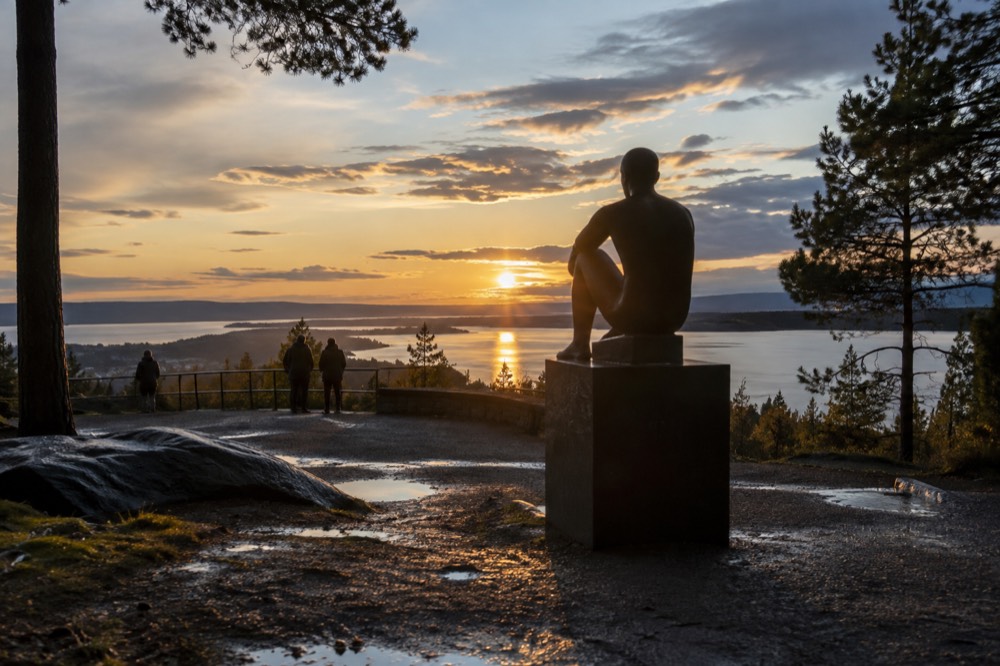
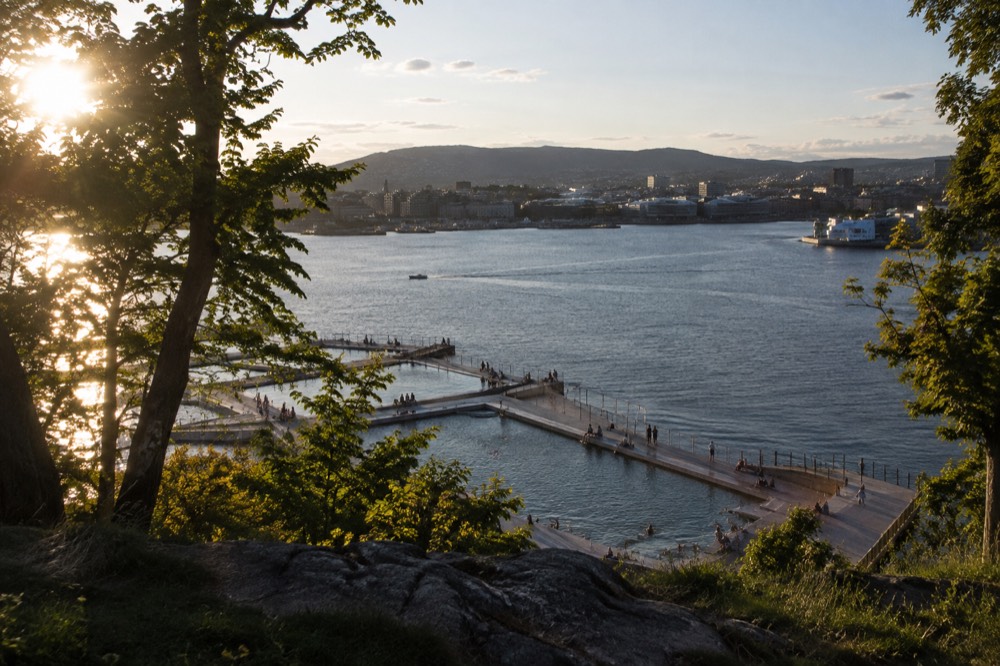
The view itself is the headliner. From the ridge you look across the inner Oslofjord at Bjørvika, the Opera House roof, the Barcode towers and, on clear days, a long stretch of the city. The angle is different from every other viewpoint in Oslo because you are looking at the skyline from the southeast across water, which is why photographers keep the hill on their list. Our Oslo photography spots guide covers the timing, and late afternoon light across the fjord is the reliable choice in summer.
| What you encounter | Where in the park | Time to allow |
|---|---|---|
| Large-scale abstract sculpture | Cliff edges and clearings | Stop-and-stare pace |
| Figurative human-form works | Along the main paths | 10-15 min each |
| Heritage structures and old walls | Wooded slopes | Passed while walking |
| The fjord and city panorama | Open ground near the top | As long as you like |
| Forest trails and veteran trees | Throughout the hillside | 45-60 min loop |
| Café-restaurant with terrace | Top of the park | 30-60 min |
Because the park is free and open-air, families get a lot out of it: children treat the sculptures as a treasure hunt and the lawns as a runway, and there is no entrance fee riding on how long anyone's attention lasts. If you are planning around kids, our Oslo with kids guide slots Ekebergparken into a family itinerary alongside the more obvious stops.
When Is the Best Time to Visit Ekebergparken?
The best months for Ekebergparken are May through September, when the forest is green, the café terrace is pleasant and the fjord view is at its clearest, though the park is open year-round and winter gives it a stark, quiet character of its own. Midsummer days run to nearly 19 hours of daylight in Oslo, so evening visits work in June and July. Aim for morning or late afternoon rather than midday for the best light on the panorama.
The seasonal argument is mostly about the light and the leaves. Oslo's daylight swings enormously across the year: at the summer solstice the sun rises at 03:53 and sets at 22:43, giving 18 hours 50 minutes of day, while at the winter solstice the day shrinks to 5 hours 53 minutes, with sunrise at 09:18 and sunset at 15:11. That swing, more than temperature, shapes what a hillside park feels like. Our Oslo daylight hours guide has the full table.
Weather matters more here than at an indoor attraction because the park is entirely outdoors. MET Norway's 1991-2020 normals for Oslo show July as the warmest month at a mean of 17.7 °C, January the coldest at −2.3 °C, and August as the wettest month at 103 mm of precipitation, a detail that surprises visitors who assume the deep winter is the soggy season. October is no picnic either, at 93 mm.
| Month | Normal mean temp | Normal precip | What it means for the park |
|---|---|---|---|
| Jan | −2.3 °C | 58 mm | Snow, short days, stark views |
| Mar | 1.3 °C | 41 mm | Late winter light, quiet paths |
| May | 11.4 °C | 60 mm | Green forest, long evenings |
| Jul | 17.7 °C | 87 mm | Peak green, terrace weather |
| Aug | 16.5 °C | 103 mm | Wettest month; pack a shell |
| Oct | 6.6 °C | 93 mm | Autumn color, muddy paths |
| Dec | −1.4 °C | 54 mm | Dark by 15:11; go at midday |
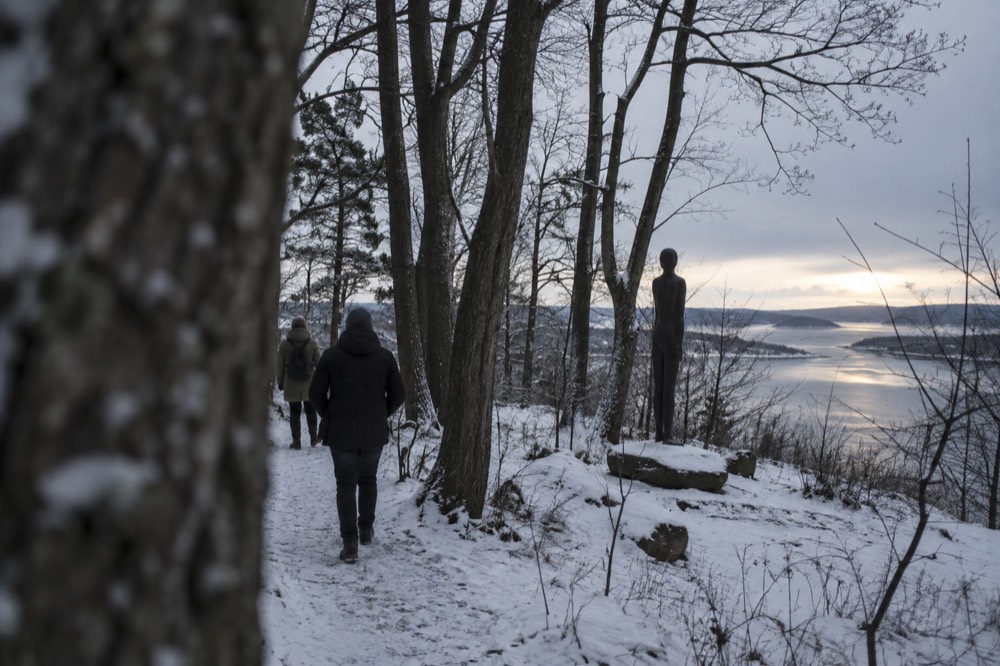
Winter deserves a word in its own defense. A snowy hillside with dark sculptures against white ground and a low sun over the fjord is one of Oslo's quietest spectacles, and the park is far emptier than in July. Dress properly, meaning real boots and layers, and check the paths: Oslo's winters hover around freezing, and the hill's gravel tracks can be slick. Our Oslo in winter guide covers the whole cold-season city, from the torchlit forest walks to snowshoeing in Nordmarka.
Ekebergparken or Vigeland Park: Which Should You Visit?
Visit Vigeland Park if you want one artist's monumental vision in a formal, flat, central park with over 200 sculptures; visit Ekebergparken if you want varied international work scattered through forest and a panorama of the fjord. They are different products: Vigeland is a single sculptor's life work and Oslo's most visited sight, Ekeberg is a curated group show on a hillside. With time for only one, first-timers usually choose Vigeland; with two half-days, do both.
The comparison is worth making carefully because the two parks anchor opposite sides of the city. Vigeland Park, inside Frogner Park on the west side, is free, open 24 hours a day all year, and holds the monolith, the bridge and the wheel-of-life cycle that make it the most photographed place in Oslo. It is flat, formal and instantly readable. Our Vigeland Park guide covers it in full.
Ekebergparken answers with variety and terrain. Multiple sculptors, a forested slope, heritage structures and the best view of the skyline from anywhere on land. It is less famous, so it is emptier, and the walk itself is genuinely a hike in places where Vigeland is a stroll. The trade is accessibility: Ekeberg's hill is hard work with a stroller or a mobility limitation, while Vigeland's avenues are easy ground.
| Ekebergparken | Vigeland Park | |
|---|---|---|
| Entry | Free | Free, open 24 hours, all year |
| Art | Many sculptors, international mix | One sculptor's life work, 200+ pieces |
| Terrain | Hilly forest paths | Flat, formal avenues |
| View | Fjord and city panorama | Park and surrounding Frogner |
| Crowds | Usually quiet | Oslo's most visited sight |
| Time needed | 2-3 hours | 1-2 hours |
| Best for | Walkers, photographers, repeat visitors | First-timers, families, short stops |
The strongest way to see the sculpture, if you want interpretation, is the guided art walk at Vigeland Park, which is the only well-reviewed bookable art walk in the city. A guide turns the monolith and the granite figures from scenery into an argument, and the walk runs about 90 minutes.
What Else Is Near Ekebergparken?
The park sits above the east side of the inner harbor, so the natural add-ons are the Opera House and the Sørenga seawater promenade below the hill, the Barcode district and MUNCH in Bjørvika, and the street-art-heavy districts of the east side, all within a short tram or ferry hop. The Oslofjord islands, reached by the B1 ferry from Aker brygge, make a full afternoon if you descend the hill by early afternoon.
Geography does the planning for you here. Coming down from Ekebergparken, you land near the water's edge at Bjørvika and Sørenga, where the promenade runs along the seawater pool and the Opera House roof rises on the far side of the inlet. The roof is free to walk, no ticket, and it is the natural bookend to a hillside morning: one view from above the city, one from the waterline. Our Oslo Opera House guide covers the building and the roof walk.
MUNCH is the indoor anchor of the same district, at 280 NOK adult admission, 200 NOK after 18:00, with under-25s at 100 NOK and 17-and-under free, and it stays open until 21:00 Wednesday through Saturday, which makes it the rare Oslo museum that works after a long summer evening outside. Our MUNCH museum guide has the details, and it pairs naturally with the park on a day that turns wet.
| Nearby | Segment | Why it pairs with Ekebergparken |
|---|---|---|
| Opera House roof | Bjørvika | Free, closes the loop downhill from the park |
| MUNCH | Bjørvika | Late opening Wed-Sat; rainy-day backup |
| Sørenga promenade | Below the hill | Seawater pool, cafés, flat walking |
| Oslofjord islands | Ferry from Aker brygge | Ordinary Ruter ticket; half-day trip |
| Grünerløkka | East side | Food, bars, river walk; see the area guide |
One transport warning that trips up visitors constantly: the Bygdøy museum ferry and the Oslofjord island ferries are different systems from different piers. The island ferries, lines B1, B1X and B2, are Ruter services leaving Aker brygge on an ordinary ticket, while the Bygdøy ferry leaves Rådhusbrygge 3, runs only from mid-March to early October and takes no Ruter ticket at all, though the Oslo Pass covers it. Our Oslo ferries guide keeps the two straight.
Practical Tips for Visiting Ekebergparken
Arrive by tram at the top stop and walk downhill, wear real shoes because the paths are gravel and steep in places, and give the park two to three hours. Entry is free, the café-restaurant at the top is the only on-site spend, and the park is fully outdoors so check the forecast and the park's own site for current opening hours and any seasonal closures before you set out.
Footwear is the most common mistake. This is a hillside forest, not a plaza, and after rain the gravel tracks get soft. Trail shoes or anything with grip beat city sneakers, and in winter, when Oslo's normals sit below freezing from December through February, proper boots are non-negotiable. A light shell belongs in the pack even in July, because August alone averages 103 mm of rain.
The descent logic matters more than people expect. Starting at the top and walking down means the panorama is in front of you for the whole visit and you finish at the water's edge near the Opera House, from where everything else in Bjørvika is a flat walk. Doing it in reverse means a climb at the end of your visit, which is a different kind of afternoon.
If you are stretching the day, the bike is a good format for linking the hill with the waterfront and the west side, and the highest-reviewed bike tour in the city covers the highlights in three hours.
For a longer Oslo stay, our 3 days in Oslo itinerary places the east side and its viewpoints on day two, after the center and before the museums. That sequencing works because Ekebergparken is a morning-and-early-afternoon attraction: you want the light on the fjord, and you want to be downhill by the time the museums and the waterfront take over the day. Anyone building a longer trip around art and viewpoints can find the full framework at Oslo Travel Guide, which keeps the whole city mapped by neighborhood and interest.
If the hill has sold you on Oslo from above, the water gives the same skyline back from below. The silent electric fjord cruise is the city's single best-reviewed activity, a 90-minute electric-boat loop with an audio commentary, and it leaves from the piers you can see from the ridge.
The wooden sailing ship is the more atmospheric alternative, two hours under canvas on the same water, and it suits visitors who would rather hear rigging than commentary. Both run year-round in practice, weather permitting, and both leave from the central piers, so neither needs much planning beyond a spare afternoon.
Between the free entry, the tram from the center and the walk down to the Opera House, Ekebergparken slots into almost any Oslo day without cost or complication, which in Europe's sixth most expensive country is not a small thing. For everything else the city offers, start with our things to do in Oslo overview.
Ekebergparken is the kind of attraction that rewards a second visit more than a first: the initial trip is for the view, and the return is for the sculptures you walked past while looking at the view. Go early, go downhill, and give the ridge line the time it earns.
Common Questions About Ekebergparken
Is Ekebergparken free?
Yes. Entry to Ekebergparken is free, with no gate fee and no ticket, the same policy as Vigeland Park. Your only costs are the tram fare if you ride up the hill and anything you spend at the café-restaurant at the top. The park is one of the genuinely free major attractions in an expensive city.
How do I get to Ekebergparken from central Oslo?
Take the tram up the Ekeberg hillside; the park has its own named stop a short walk from the main entrance, and the ride from the center takes only a few minutes. The park is in Ruter zone 1, so an ordinary central Oslo ticket covers it, bought cheapest in the Ruter app. On foot, allow 20 to 30 minutes uphill from Bjørvika.
How long should I spend at Ekebergparken?
Most visitors spend two to three hours at browsing pace, which covers the main sculptures, the forest paths and a proper stop at the viewpoint. If you add the café terrace or descend slowly to the Opera House, budget half a day for the whole loop.
Is Ekebergparken worth visiting compared with Vigeland Park?
They are different experiences. Vigeland Park is one sculptor's monumental life work on flat, formal ground and is Oslo's most visited sight; Ekebergparken is a curated group show of international sculpture threaded through forest on a hillside with the best skyline view in the city. First-timers usually pick Vigeland, but with two half-days available, do both.
When is the best time of year to visit Ekebergparken?
May through September, when the forest is green and the terrace is pleasant, though winter visits have their own stark appeal with far fewer people. Note that August is Oslo's wettest month on the 1991-2020 normals at 103 mm, so pack a shell even in summer, and in midwinter the sun sets by 15:11, so go at midday.
Is Ekebergparken suitable for children?
Yes, with caveats. The park is free and open-air, children treat the sculptures as a treasure hunt, and there is no ticket riding on anyone's attention span. The caveat is terrain: the hillside paths are gravel and steep in places, which is hard work with a stroller, so carriers beat wheels on this one.