Best Views in Oslo: Where to Look and How to Get There
Oslo's geography does most of the work for you: a city wrapped in a fjord, ringed by forested hills, and small enough that a good viewpoint is never more than a metro ride away. This guide covers the viewpoints that actually deliver, what each one costs to reach, and which tours are worth booking if you would rather someone else handle the logistics.
Short answer
The best views in Oslo are the Opera House roof (free, central), the Holmenkollen ski jump tower reached by T-bane Line 1, the Oslofjord seen from a boat, Ekebergparken's hillside overlook, and the forest edge above Frognerseteren. Most are free to reach on ordinary Ruter tickets; the tower and the boat tours are the only ones that cost real money.
Oslo sits in a bowl. The city center hugs the innermost stretch of the Oslofjord, the Marka forest rises immediately to the north and west, and the Ekeberg ridge closes off the east. That shape is the reason the city photographs well from almost any angle: water in the foreground, hills behind, and a skyline low enough that nothing blocks the horizon. It also means the best views in Oslo are not accidents you stumble into, they are specific spots with specific sightlines, and most of them sit on ordinary public transport lines.
This guide walks through the viewpoints that consistently earn their trip, what each one actually shows you, and what it costs in time and money to stand there. Some are free and take ten minutes. One involves a boat. One involves a chef cooking waffles over a forest fire. All of them are real, verified options rather than a list copied from another list.
What Are the Best Views in Oslo?
The strongest views in Oslo are the Opera House roof for a free city-and-fjord panorama from street level, the Holmenkollen ski jump tower for the highest platform over the city, a fjord cruise for the view back at the skyline from the water, Ekebergparken for the classic postcard angle across the harbor, and the Frognerseteren forest edge for a free hillside outlook reached by metro. Each one shows you a different version of the same city, and the best trip uses at least three of them.
That shortlist is not ranked, because the honest answer depends on what kind of view you want. The Opera House roof is the one you can do in twenty minutes between other plans, in any weather, at any hour, for nothing. Holmenkollen is the one that costs a ticket and a metro ride and pays you back with the entire metropolitan area laid out below the tower. The fjord boats flip the perspective entirely: instead of looking at the water, you stand on it and watch the city recede into its bowl of hills.
Ekebergparken, the sculpture park on the eastern ridge, gives the angle every Oslo postcard uses, the one looking northwest across the harbor toward the City Hall towers and Aker Brygge. And the forest edge above Frognerseteren, at the top of T-bane Line 1, is the quiet one: a viewpoint over the Nordmarka forest and, on a clear day, a stretch of the fjord beyond the city. None of these requires a car, a tour, or advance planning beyond a transit ticket.
Which Viewpoints Can You Reach Without a Car?
Every major viewpoint in Oslo is reachable on public transport, and almost all of them sit inside Ruter zone 1, the central zone that covers the entire metro network. The Opera House, Ekebergparken and Aker Brygge are walkable from the city center. Holmenkollen and Frognerseteren sit at the top of T-bane Line 1. The island viewpoints of Hovedøya and Gressholmen are served by the Ruter ferry lines from Aker brygge. A car buys you nothing here except parking problems.
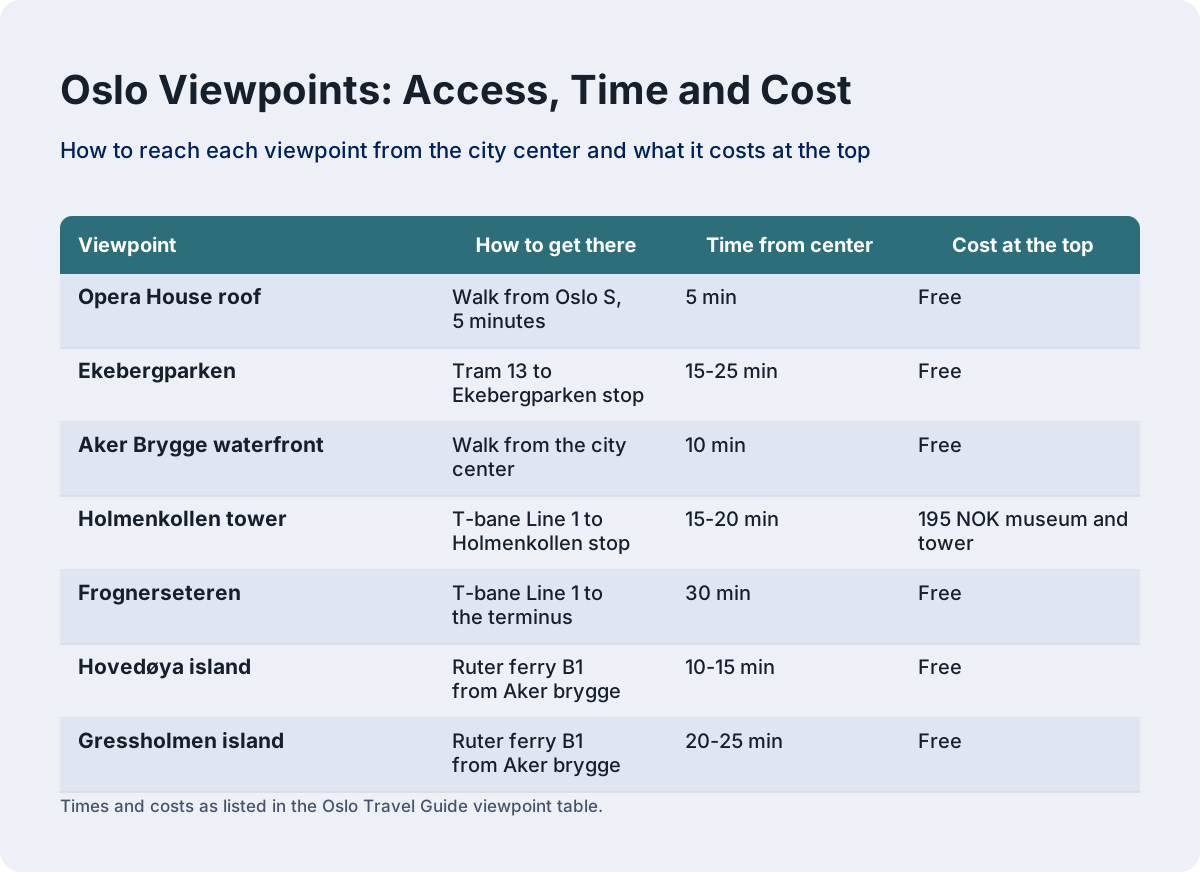
That is one of Oslo's quiet strengths as a sightseeing city. The transit network was built to move residents up and down the hillsides, and it moves visitors just as efficiently. The table below sums up the practical facts for each viewpoint: how you get there, roughly how long the trip takes from the city center, and what it costs once you arrive.
| Viewpoint | How to get there | Time from center | Cost at the top |
|---|---|---|---|
| Opera House roof | Walk from Oslo S, 5 minutes | 5 min | Free |
| Ekebergparken | Tram 13 to Ekebergparken, or walk up | 15-25 min | Free |
| Aker Brygge waterfront | Walk from the city center | 10 min | Free |
| Holmenkollen tower | T-bane Line 1 to Holmenkollen stop | 15-20 min | 195 NOK museum and tower |
| Frognerseteren | T-bane Line 1 to the terminus | 30 min | Free |
| Hovedøya island | Ruter ferry B1 from Aker brygge | 10-15 min | Free |
| Gressholmen island | Ruter ferry B1 from Aker brygge | 20-25 min | Free |
Two notes on that table. First, the Ruter single fare is not something this site publishes a number for, because the price table on Ruter's own site renders through an app and the figures could not be verified cleanly; buy in the Ruter app, where tickets are cheapest, and let the journey planner count your zones rather than guessing. Second, the Oslo Pass covers all of this transport in zones 1 through 4N, including the ferries, which matters if you are also visiting museums, as the pass includes entry to over 30 of them.
If you would rather compress several of these viewpoints into one booked half-day, there is a tour built exactly for that, and it covers the two that are hardest to combine on your own.
The trio above spans the three ways to buy a view in Oslo: a half-day bus tour that pairs Holmenkollen with Vigeland Park, a full-day package that adds a fjord cruise, and a guided forest hike that ends with a chef-cooked waffle stop at a fjord overlook. The rest of this guide looks at each viewpoint family in detail so you can decide which ones deserve your time.
Is the Holmenkollen Ski Jump View Worth the Trip?
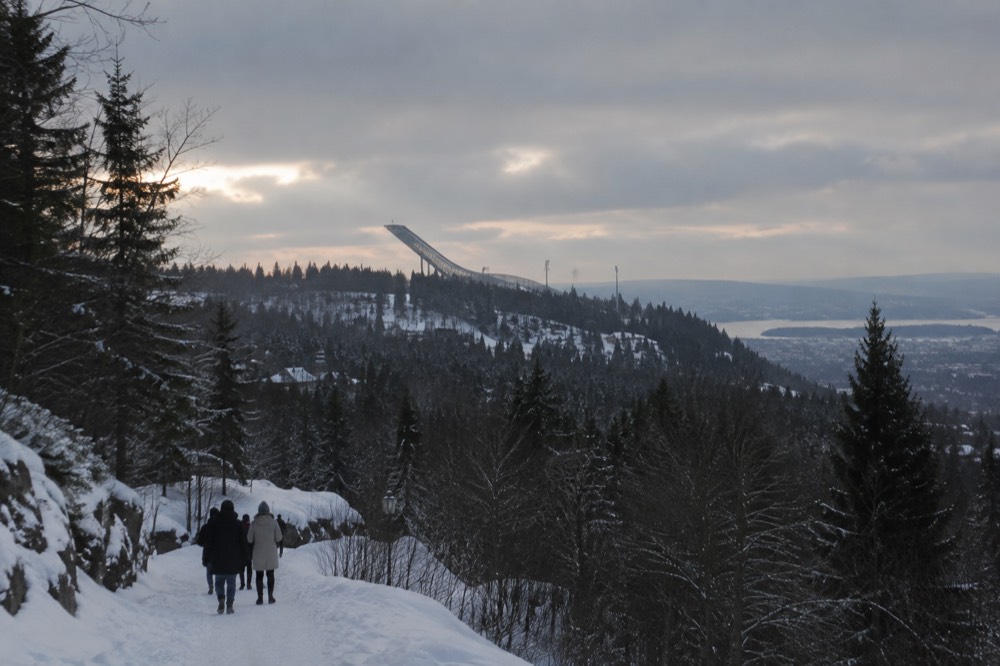
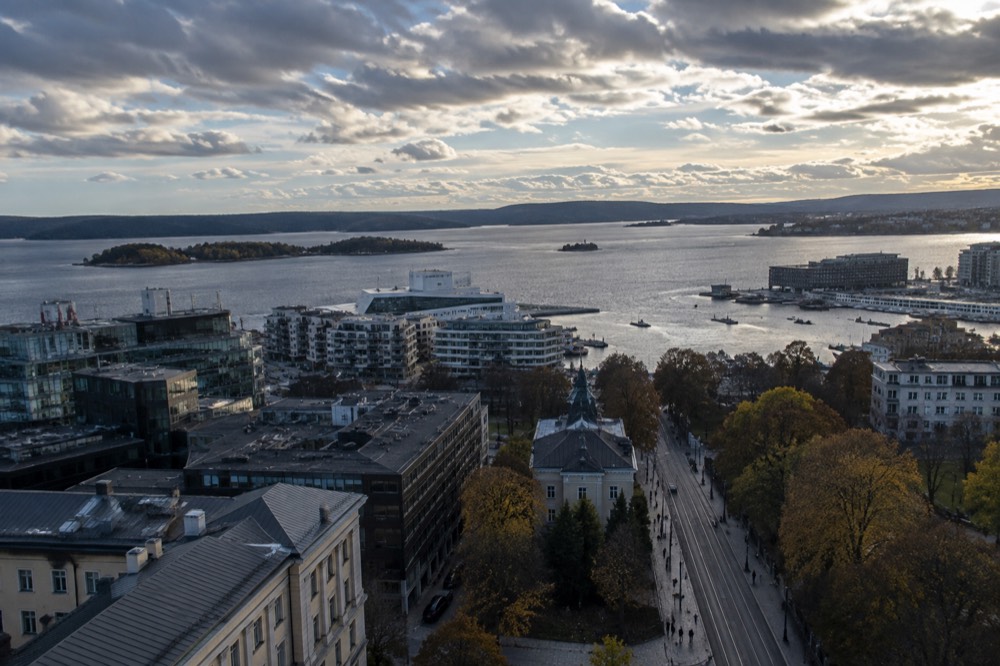
Yes, the Holmenkollen view is worth the trip, and it is the single most dramatic platform over Oslo. The ski jump tower stands at the top of the city's western hills, and from the observation deck the entire Oslofjord basin opens up below you, with the city center, the islands and the water all in one sweep. The trip takes about 20 minutes by metro from the center, and the Ski Museum plus tower entry costs 195 NOK.
The tower is the highest of the viewpoints in this guide that you can actually stand on, and the difference between it and the street-level views is not subtle. From the Opera House roof you see the city at eye level with the water behind it. From Holmenkollen you see the whole system at once: how the fjord fingers its way between the islands, how the built-up area thins into forest at the edges, and how much of what surrounds Oslo is simply trees.
Getting there is simple. T-bane Line 1 runs from the city center toward Frognerseteren and stops at Holmenkollen, and the metro ride itself is part of the experience, climbing through residential neighborhoods into the woods. The walk from the stop to the jump is a few minutes uphill. The combined Ski Museum and jump tower ticket is 195 NOK, and the museum, which covers 4,000 years of skiing history, is a genuinely good rainy-day pairing rather than a filler attraction.
One honest caveat: there is no standalone ticket for just the tower, and no standalone Holmenkollen ski jump product on any booking platform this site works with. The only bookable route that includes the jump is a combination tour, which is why the half-day Holmenkollen and Vigeland tour is the practical answer for visitors who want the view without managing their own metro connections. It pairs the tower with Vigeland Park, the free sculpture park that is Oslo's most visited sight, and covers both in a single three-hour loop.
If you would rather do it independently, the metro runs every few minutes and the whole outing costs one zone 1 ticket plus the 195 NOK entry. Either way, go on a clear day if you can manage it, because the payoff at the top scales directly with the visibility.
Can You See the Best Views from the Water?
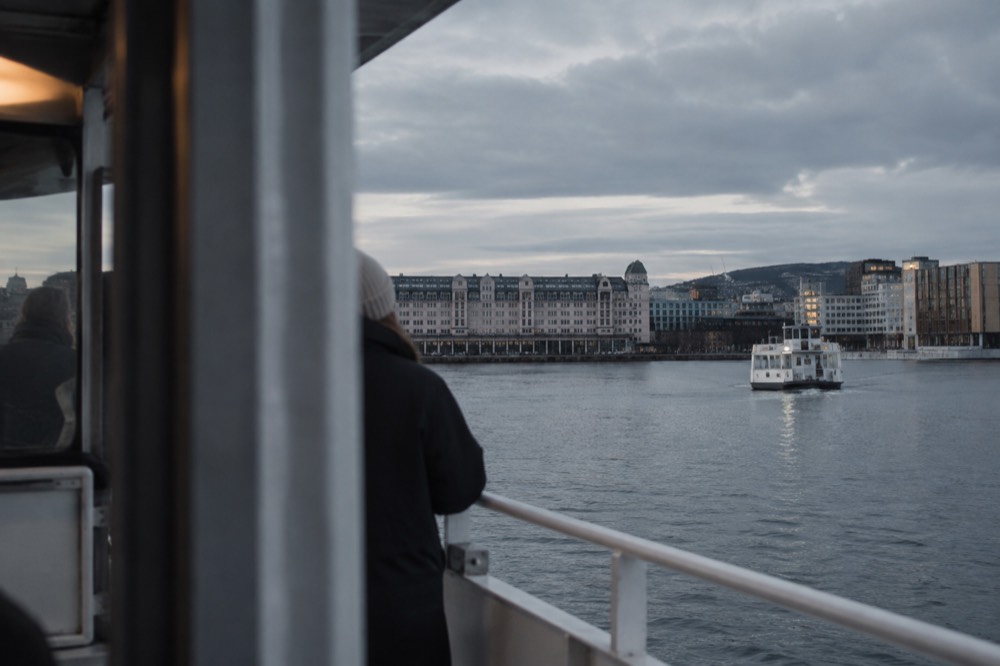
Yes, and the water view is the one most visitors underuse. Oslo is the only European capital where a working public ferry network doubles as a sightseeing route: the Ruter island ferries B1 and B2 run from Aker brygge on an ordinary transit ticket, and they deliver a moving view of the harbor, the islands and the city's hillside amphitheater that no land viewpoint can match. For a curated version, sightseeing boats run the same water on a schedule.
The perspective from the fjord is the inverse of every viewpoint above. From land you look at the water; from the water you watch the city arrange itself, the Opera House slope, the barcode towers of Bjørvika, the City Hall brick twin towers, and then the hills taking over behind them. The public ferries do this for the price of a transit ticket, and they stop at islands where you can climb a few minutes to an overlook and get the skyline framed across open water.
Hovedøya, the closest island, has the ruined Cistercian abbey and quiet swimming coves. Gressholmen, further out, has a hill in the middle with a view back at the whole city. Langøyene, on the summer-only B2 line, is the swimming and camping island. All of them ride on a regular Ruter ticket, and the Oslo Pass covers them too. Check the seasonal schedules before you plan: the summer timetable runs into late August, and some lines reduce frequency outside it.
For visitors who want the commentary and the guarantee of a seat, the sightseeing boats are the bookable version of the same water. The silent electric boat with audio guide is the city's single best-reviewed activity on the platforms this site tracks, running 90 minutes around the inner fjord. The premium guided version stretches that to two hours with a live guide instead of headphones.
The full-day alternative pairs a city bus tour with a fjord cruise in one package, which is the standard play for cruise passengers and anyone with exactly one day in the city. Whichever version you choose, the water is where Oslo looks most like itself, and it is the one viewpoint family where the paid option and the free option run on literally the same water.
Where Are the Best Free Views in Oslo?
The best free views in Oslo are the Opera House roof, Ekebergparken's hillside overlooks, the Aker Brygge waterfront, the Frognerseteren forest edge at the top of Line 1, and the island viewpoints reached by cheap public ferry. Vigeland Park is also free and open around the clock, though its art is the draw rather than its elevation. Oslo is unusually generous with free viewpoints because its best ones are public land, not ticketed attractions.
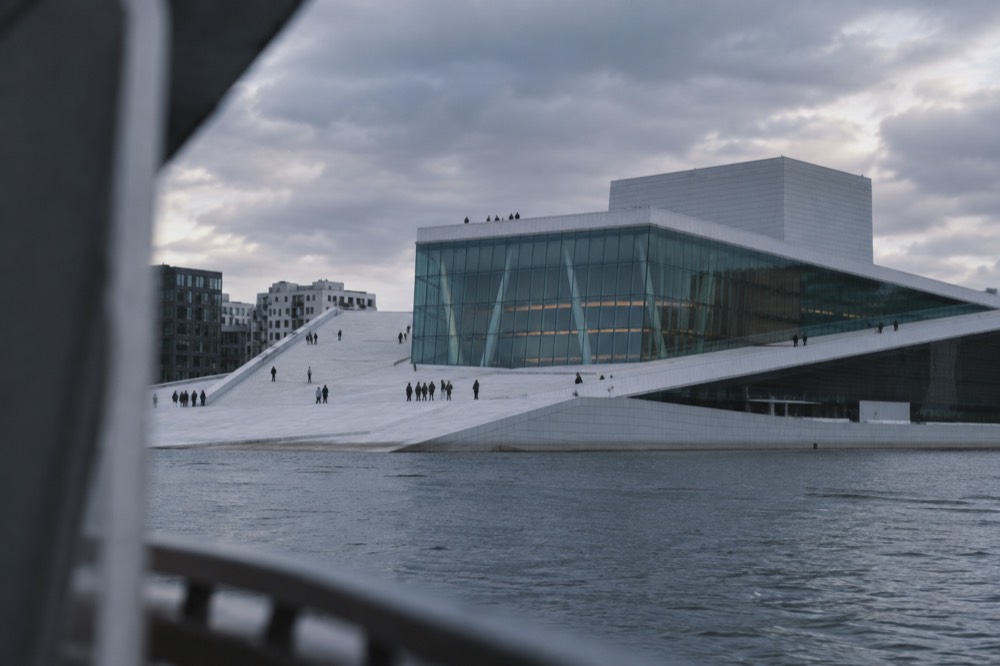
The Opera House roof deserves its fame. The building's sloping marble and granite roof is designed to be walked on, rising from the waterfront to a low summit that looks back across the fjord toward the city. It costs nothing, it is open to anyone, and it works at any hour, which makes it the default evening viewpoint for anyone staying nearby. On a summer evening, when the sun sets after 21:00, the roof fills with locals doing exactly what the tourists are doing. Everything else covered here is indexed on Oslo Travel Guide. Everything else covered here is indexed on Oslo Travel Guide.
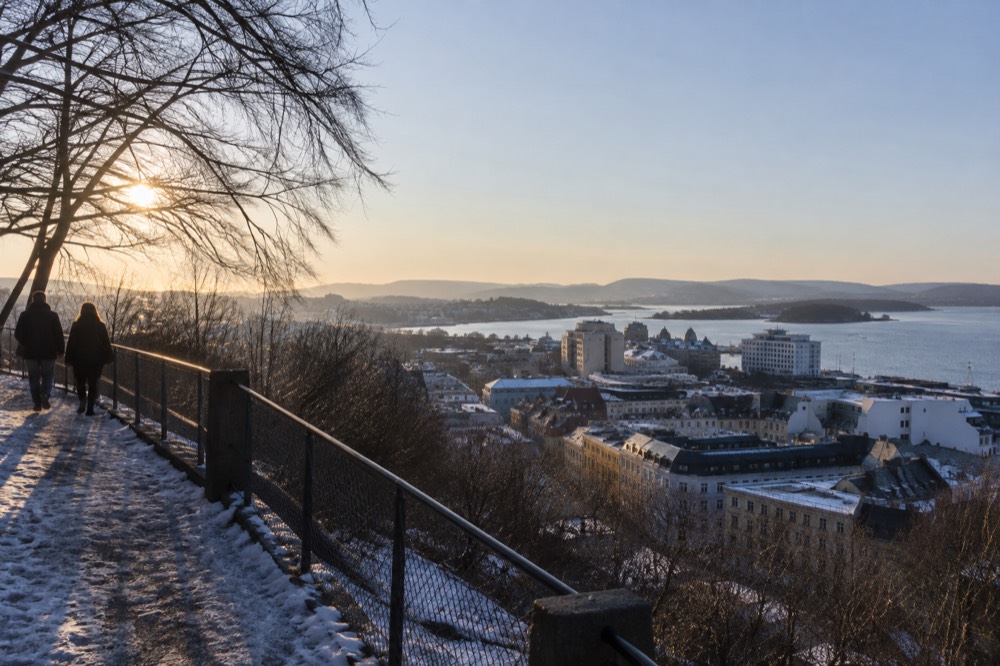
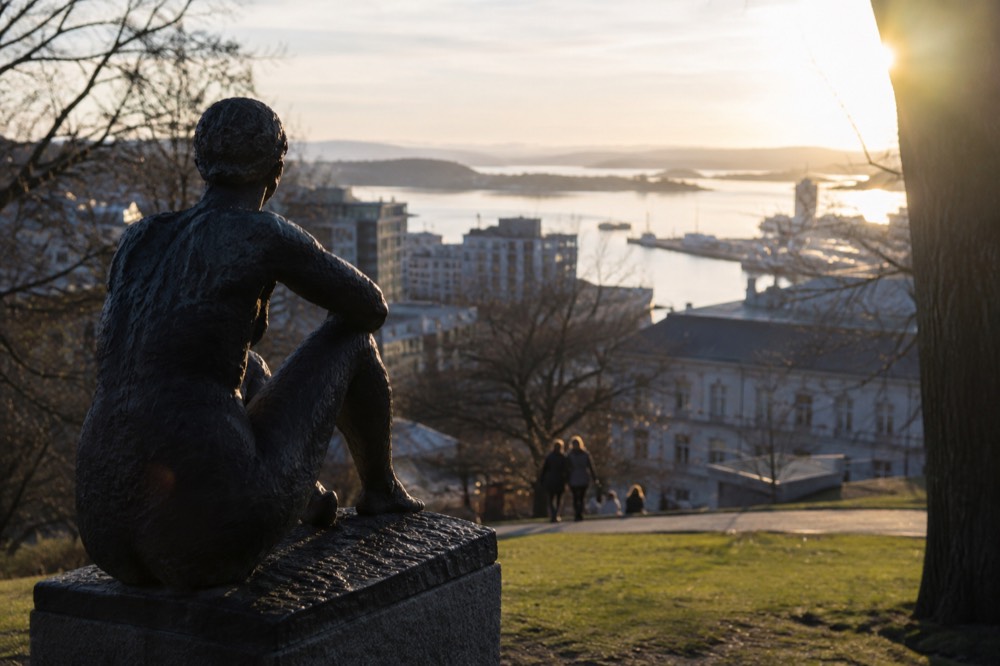
Ekebergparken, the sculpture and heritage park on the eastern ridge, holds the classic postcard angle. From its upper slopes you look northwest across the harbor toward Aker Brygge and the City Hall towers, with the Akershus fortress point below. The park itself is free, open year-round, and doubles as an outdoor sculpture collection, so the walk between viewpoints is its own attraction. Tram 13 stops at the park entrance.
Frognerseteren, the terminus of T-bane Line 1, sits at the forest edge above the city. The view here is more about the setting than the skyline: you are standing where the Marka forest begins, with the hills rolling away north and a partial view down over Oslo. The restaurant at the top is a traditional stop for apple cake, and the metro ride up is included in a zone 1 ticket, making this the cheapest hilltop outing in the city.
What About Sunset and Evening Views?
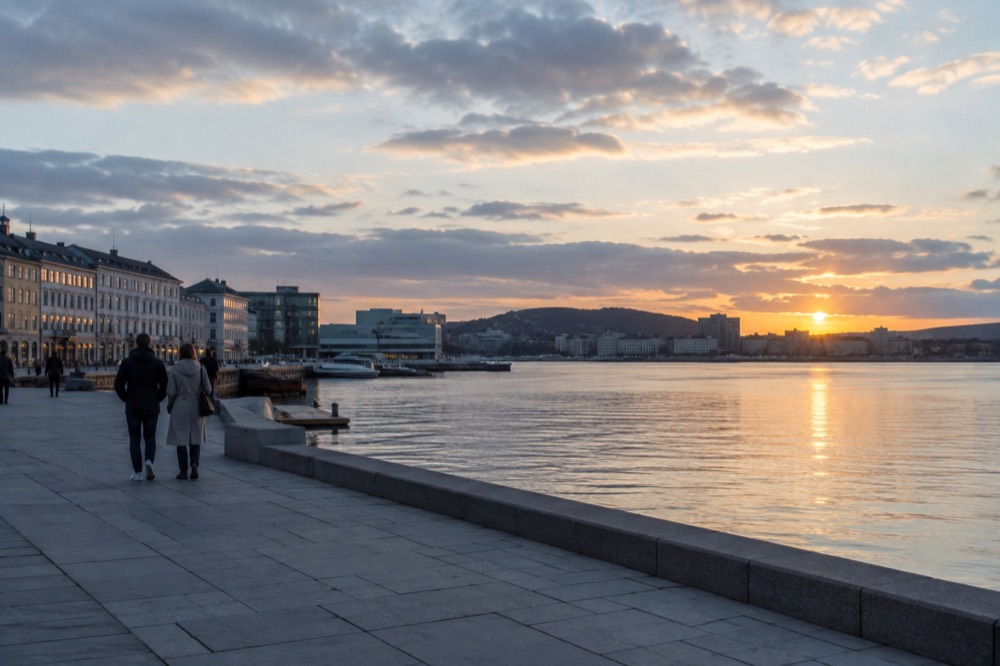
Oslo's summer light makes its viewpoints dramatically better after dinner: the sun sets as late as 22:43 in late June, and the twilight that follows never turns into true darkness, so the Opera House roof, the Ekeberg ridge and the Aker Brygge piers all stay usable well past midnight. In winter the opposite applies, with the sun setting before 15:15 in December, so evening views become city-light views and the water becomes the place to be.
The daylight swing at Oslo's latitude is enormous, from 5 hours 53 minutes of daylight on the winter solstice to 18 hours 50 minutes on the summer solstice, and that swing reshapes the whole viewing day. In June and July, the golden hour over the fjord starts around 21:00 and the sky never fully darkens, which is why the Opera House roof stays populated late. There is no midnight sun in Oslo, and any guide implying otherwise is wrong, but late June delivers bright twilight at midnight, which is close enough for photography.
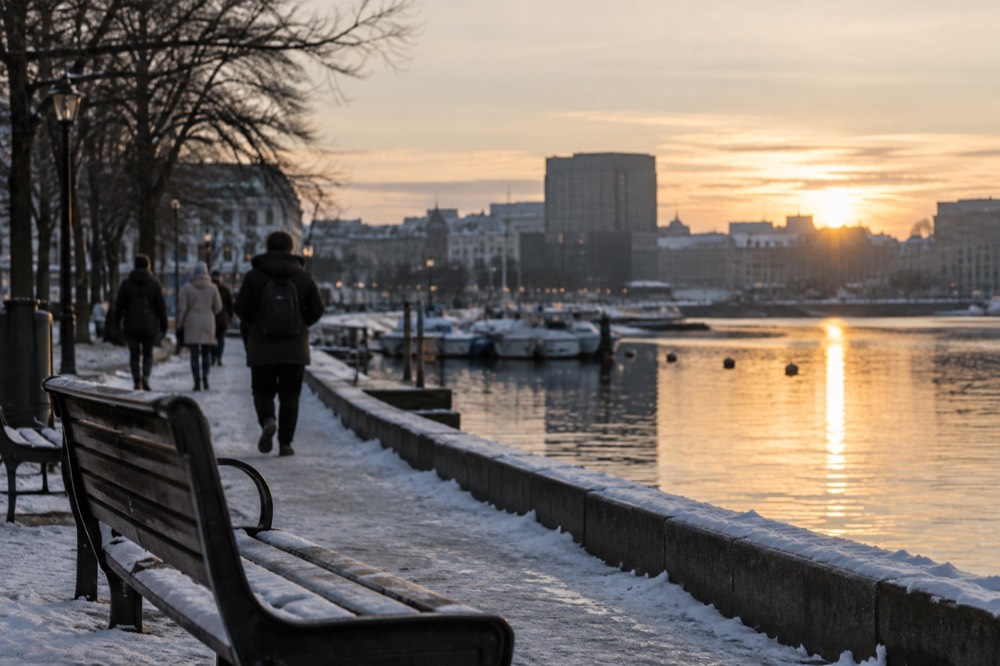
In the dark months, from October through March, the equation flips. The sunset happens in the mid-afternoon, the city lights come on early, and the best evening view becomes the skyline from the water. This is exactly when the evening fjord cruise with a shrimp buffet earns its place: three hours on the inner fjord, with the illuminated waterfront sliding past and a Norwegian shrimp spread on board. It is a floating dinner with the view built in, and it is one of the few Oslo products that is genuinely better in winter than in summer.
For a land-based winter evening, the evening myths and legends walk covers the medieval center by lamplight, which is atmospheric rather than panoramic, and the Opera House roof under city lights is still free and still open. If you are planning around the winter darkness, the Oslo daylight hours guide breaks the month-by-month numbers in detail.
Which Views Are Best in Winter and from the Forest?
The forest views are the ones visitors miss most. Oslo is the rare capital where a metro line delivers you to the edge of a protected forest, and the viewpoints along that edge, above Frognerseteren and Sognsvann, look out over hills and water rather than buildings. In winter the same trails become snowshoe and ski terrain, and the guided winter options, a torchlit forest walk with a campfire and a snowshoe hike, are among the best-reviewed activities in the entire city.
Nordmarka, the forest that starts where the metro stops, is not a park in the landscaped sense. It is a working forest of hundreds of square kilometers, with marked trails, and it begins inside the city's transit zones. The viewpoint logic inverts here: instead of a tower or a roof, you earn a clearing or a ridge, and the payoff is a horizon of forest with the fjord glinting beyond it. The trail network around Sognsvann, the lake at the end of another metro line, is the gentlest introduction.
The bookable version of the forest view is the fjord-view hike, a three-and-a-half-hour guided walk that ends with a chef cooking Norwegian waffles over a fire at the overlook. It carries a perfect 5.0 rating across its review base, which is rare for anything, and it is the strongest answer to the question of what Oslo's outdoors actually looks like up close.
In winter the forest options multiply. The guided snowshoeing tour runs the same terrain under snow, and the torchlit evening walk with a campfire is the signature dark-season experience inside the city limits. All of these are covered in more depth in the Oslo hiking guide and the winter overview at Oslo in winter.
| Season | Best land viewpoints | Best water options | Notes |
|---|---|---|---|
| Summer | Opera House roof, Ekebergparken, islands | Public ferries, sightseeing boats | Sunset after 21:00, light all night |
| Autumn | Frognerseteren, forest trails | Evening shrimp cruise | Colors in Marka, fewer crowds |
| Winter | Holmenkollen tower, Opera House roof | Evening cruise, island ferries on B1 | Sunset before 15:15 in December |
| Spring | All viewpoints | Island ferries resume fuller schedules | Snow lingers on forest trails into April |
Are There Tours That Cover the Best Views in One Day?
Yes, and for many visitors one booked day beats three separate transit trips. The full-day bus and fjord combo packages the city tour, the Holmenkollen area and a fjord cruise into a single 7.5-hour outing, which is the standard choice for first-timers and cruise passengers with one day ashore. The half-day Holmenkollen and Vigeland tour covers the two hardest-to-pair sights in three hours. The premium silent boat and the guided hikes cover the rest of the spectrum.
The honest way to choose is by how much of the city you want to buy. The table below compares the main view-focused tours by format, duration and what they actually show you.
| Tour | Format | Duration | What it shows you |
|---|---|---|---|
| Holmenkollen and Vigeland half-day | Bus tour | 3h | Ski jump area, Vigeland Park, city highlights |
| Full-day bus plus fjord combo | Bus and boat | 7h 30m | City tour, Holmenkollen, fjord cruise |
| Silent electric boat, audio guide | Boat | 1h 30m | Inner fjord, harbor skyline, islands |
| Premium silent boat, guided | Boat | 2h | Same water, live guide, smaller feel |
| Fjord-view hike with waffles | Guided walk | 3h 30m | Forest trails, fjord overlook, waffle stop |
| Evening cruise, shrimp buffet | Dinner boat | 3h | Illuminated waterfront at night |
Every figure, price and rating for these products comes from the live listings rather than being typed into this page, because they move. What stays true is the structure: the bus tours own the hilltops, the boats own the water, and the hikes own the forest. A well-built Oslo trip uses one from each column, or two if the days are short.
For more on pairing sights into days, the one day in Oslo itinerary and the three days in Oslo plan slot these viewpoints into full schedules. And if you are weighing the transit costs of doing it all independently, the Is the Oslo Pass worth it guide runs the break-even math against the museum prices.
Common Questions About the Best Views in Oslo
What is the best free view in Oslo?
The Opera House roof. It is free, central, open around the clock, and gives a genuine panorama over the fjord and the city. Ekebergparken's overlooks and the Frognerseteren forest edge are close behind, both free and both on public transport.
Is the Holmenkollen ski jump tower worth the ticket?
For most visitors, yes. It is the highest public platform over the city, the view covers the entire fjord basin, and the included Ski Museum is a strong attraction in its own right. Entry is 195 NOK for the museum and tower combined.
Can you see the Oslofjord islands on a normal ticket?
Yes. The Ruter ferry lines B1 and B2 run from Aker brygge to Hovedøya, Gressholmen, Langøyene and the other islands on an ordinary transit ticket, and the Oslo Pass covers them too. Check seasonal schedules, as some lines run a reduced service outside summer.
Where is the best sunset view in Oslo?
In summer, the Opera House roof or the Aker Brygge piers, since the sun sets over the fjord as late as 22:43 in late June. In winter, the water itself is the best evening viewpoint, which is why the evening shrimp buffet cruise works so well in the dark months.
Do I need a car to reach the viewpoints?
No. Every viewpoint in this guide sits on public transport inside Ruter's central zones, from the metro to Holmenkollen and Frognerseteren to the ferries to the islands. A car adds parking costs and gains you nothing.
What is the best view tour for a short visit?
The half-day Holmenkollen and Vigeland tour if you have three hours, or the 90-minute silent electric boat if you have less. The full-day bus and fjord combo is the choice for a single day that has to include everything.