Oslo Daylight Hours: What to Expect by Month
Oslo sits at 59.91 degrees north, far enough that its daylight changes more dramatically over the year than almost any other European capital. Here is exactly what that means for your trip.
Short answer
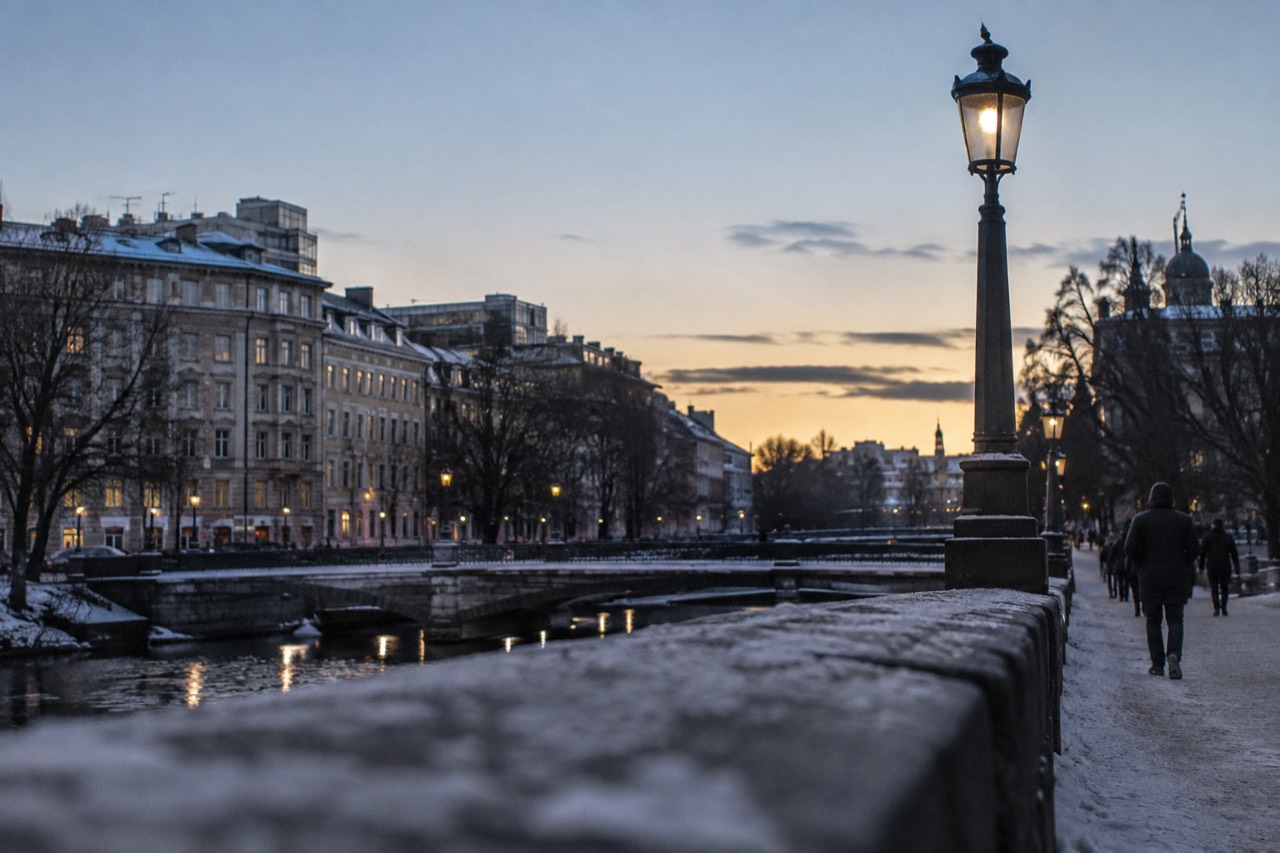
Oslo gets between 5 hours 53 minutes and 18 hours 50 minutes of daylight per day. On 21 December the sun rises at 09:18 and sets at 15:11. On 21 June it rises at 03:53 and sets at 22:43. There is no midnight sun in Oslo, but summer evenings stay light until nearly midnight.
Oslo's latitude shapes the city more than any single attraction does. At 59.91 degrees north it sits level with the southern tip of Greenland and well north of every capital most visitors come from, and the sun answers for that. In late December the sun is above the horizon for under six hours. Five months later it barely manages to set before it is time to rise again. Most itineraries are built around museums and opening hours while ignoring the one clock that actually governs a day in this city: the daylight.
This guide lays out the real numbers, month by month, from MET Norway's own sunrise data for the Blindern station, and then turns those numbers into planning advice. How dark is dark, really. Whether you can swim at 22:00 in July. Why your December sightseeing needs to run in reverse order from your June plan. The short version: Oslo is a city you visit twice, once in each season, and the two visits are barely the same place.
How Many Daylight Hours Does Oslo Get?
Oslo receives between 5 hours 53 minutes and 18 hours 50 minutes of daylight across the year, a swing of more than a factor of three. The shortest day, 21 December, runs from sunrise at 09:18 to sunset at 15:11. The longest, 21 June, runs from 03:53 to 22:43. Around the equinoxes the city gains or loses roughly five to seven minutes of daylight per day, so two visits three weeks apart in spring can feel like different seasons.
Those figures come from MET Norway's Sunrise 3.0 API, calculated for 59.9139 N, 10.7522 E, in Oslo local time. The rate of change matters as much as the extremes. Around the equinoxes, mid-March and mid-October, the day lengthens or shortens by close to seven minutes daily, which is why two visits three weeks apart in spring can feel like different seasons. A trip in early April gets over 14 hours of usable light. A trip in mid-March gets under 12.
The table below shows the full arc of the year at mid-month checkpoints, using the 15th of each month so the numbers are representative rather than extreme.
| Date | Sunrise | Sunset | Day length |
|---|---|---|---|
| 15 Jan | 09:04 | 15:49 | 6 h 45 m |
| 15 Feb | 07:54 | 17:08 | 9 h 14 m |
| 15 Mar | 06:34 | 18:19 | 11 h 45 m |
| 15 Apr | 06:00 | 20:34 | 14 h 34 m |
| 15 May | 04:40 | 21:48 | 17 h 08 m |
| 21 Jun | 03:53 | 22:43 | 18 h 50 m |
| 15 Jul | 04:21 | 22:23 | 18 h 02 m |
| 15 Aug | 05:31 | 21:09 | 15 h 38 m |
| 15 Sep | 06:44 | 19:38 | 12 h 54 m |
| 15 Oct | 07:55 | 18:08 | 10 h 13 m |
| 21 Dec | 09:18 | 15:11 | 5 h 53 m |
One habit worth building early: check the actual sunrise and sunset times for your exact travel dates on yr.no, MET Norway's own weather service, before you build a daily plan. The mid-month figures above bracket the range, but a week either side of a solstice moves the numbers noticeably, and Oslo's clocks shift between CET in winter and CEST in summer, which catches out visitors who quote a summer time an hour wrong.
When Does the Sun Rise and Set in Oslo?
Sunrise in Oslo ranges from 03:53 at the June solstice to 09:18 at the December solstice, and sunset ranges from 15:11 in December to 22:43 in June. In practical terms, winter visitors get daylight from roughly 09:00 to 15:00, while summer visitors get light from before 04:00 until nearly 23:00, with twilight extending both ends. That is a five-hour shift in the middle of the day between seasons, and it moves the whole usable sightseeing window with it.
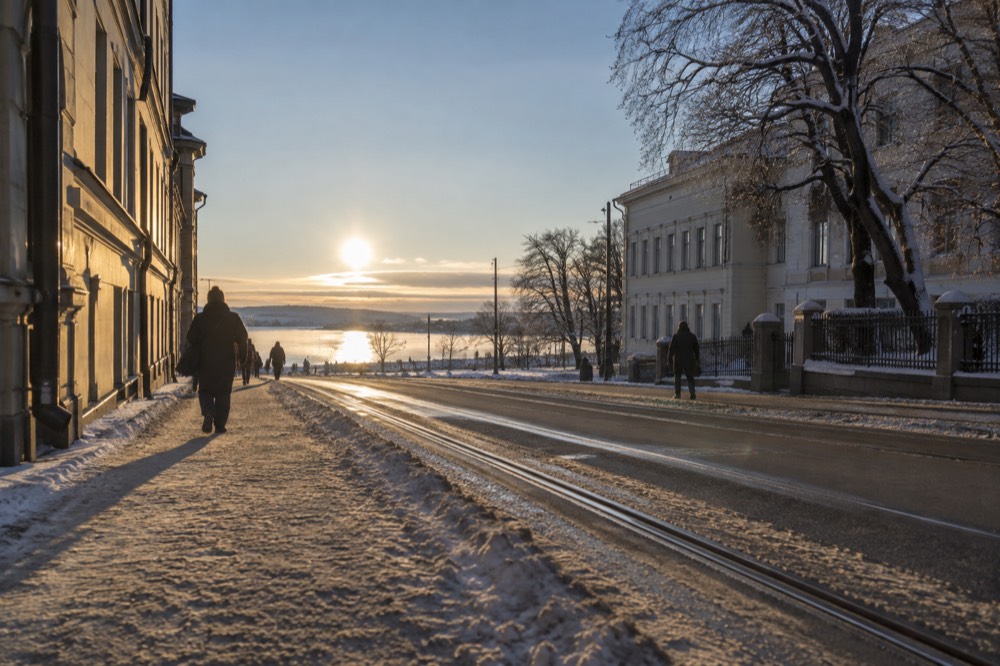
The winter window deserves more respect than most itineraries give it. With sunrise at 09:18 in late December, anything scheduled before 10:00 happens in the dark or at best in blue twilight, and the light that does arrive is low and slanting, which photographers will recognize as the whole day being golden hour. The sun never climbs higher than about 6 degrees above the horizon at midwinter, so shadows are long all day and the light is soft and directional from morning to afternoon.
Summer inverts the problem. The sun sets at 22:43 in late June, but it sets so shallowly that civil twilight, the period when it stays bright enough to read outdoors, runs until after midnight. It never gets properly dark. Curtains and an eye mask are not a joke suggestion in a June Oslo hotel room, they are the difference between sleeping and lying in a bright room at 01:00. Many hotels provide blackout blinds for exactly this reason, but a cheap sleep mask is lighter to pack.
The shoulder months are the quiet sweet spot. April and September both deliver 13 to 15 hours of daylight with sunrise at a civilized hour and sunset late enough for an evening walk after dinner, without the June problem of a bedroom that never darkens. Our month-by-month weather guide pairs these daylight numbers with temperatures and rainfall so you can judge the whole picture: Oslo weather by month.
The three products above share one thing: they all work with the daylight rather than against it. The torchlit forest walk is built for the dark months and starts in the afternoon so the torchlight section lands after sunset. The skiing experience uses the winter window efficiently. And the Kon-Tiki ticket is the classic rainy-day or short-day fallback, an indoor hour on Bygdøy when the light runs out early.
Does Oslo Have Midnight Sun?
No, there is no midnight sun in Oslo. Midnight sun requires a latitude north of the Arctic Circle at roughly 66.5 degrees north, and Oslo sits at 59.91 degrees, nearly seven degrees too far south. In late June the sun does set at 22:43, but the sky stays in deep twilight all night and it never gets fully dark. The real midnight sun is a northern Norway experience, in places like Tromsø and Nordkapp, and it cannot be day-tripped from Oslo.
This is one of the most persistent misconceptions about the city, and it produces genuinely bad trip plans: visitors book a June weekend in Oslo expecting a sun that never sets, then wonder why the sky dims at midnight. What Oslo does have in June is something close, and it is worth naming precisely. Because the sun sets so shallowly, the night never reaches real darkness, and the sky holds a glow toward the north all night. Locals call these white nights in the same spirit as St Petersburg's, and they are genuinely usable: you can sit outside at Aker Brygge at midnight in late June and see what you are eating.
The distinction matters for planning in both directions. If your heart is set on the actual midnight sun, the honest itinerary is a separate flight north, and our guide to getting from Oslo to Tromsø covers the realistic options. If what you want is long, bright summer evenings, Oslo delivers those in full from mid-May through late July, and you do not need the Arctic for them.
The same latitude logic runs in reverse in winter, and this is where Oslo genuinely surprises people. There is no polar night in Oslo either: the city is far enough south that the sun always rises, even on the darkest day. The December day is short, but it exists, and it is brighter than many visitors expect.
How Dark Is Oslo in Winter?
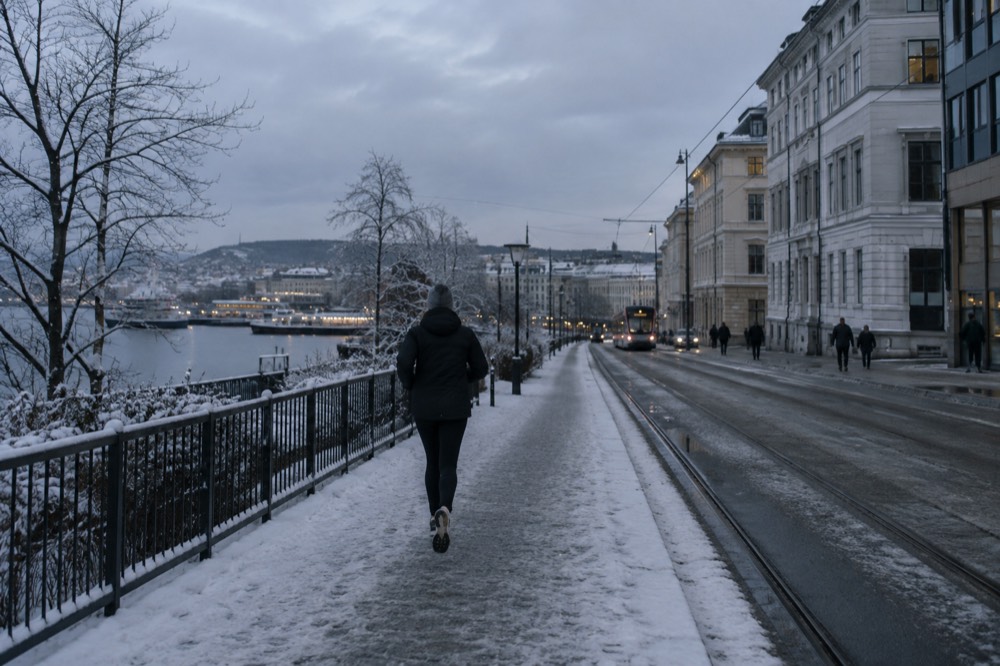
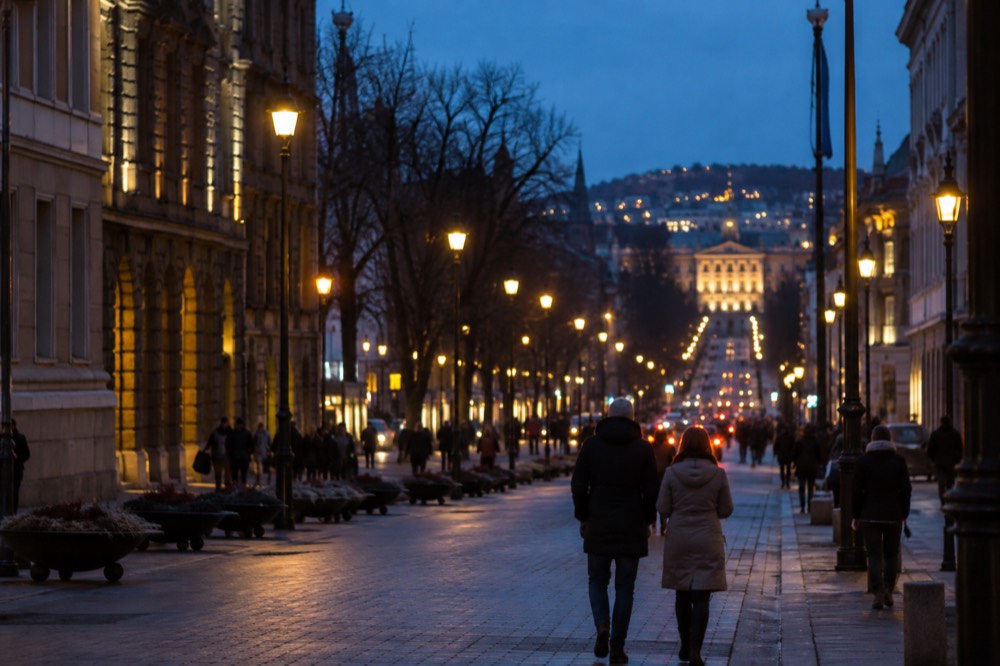
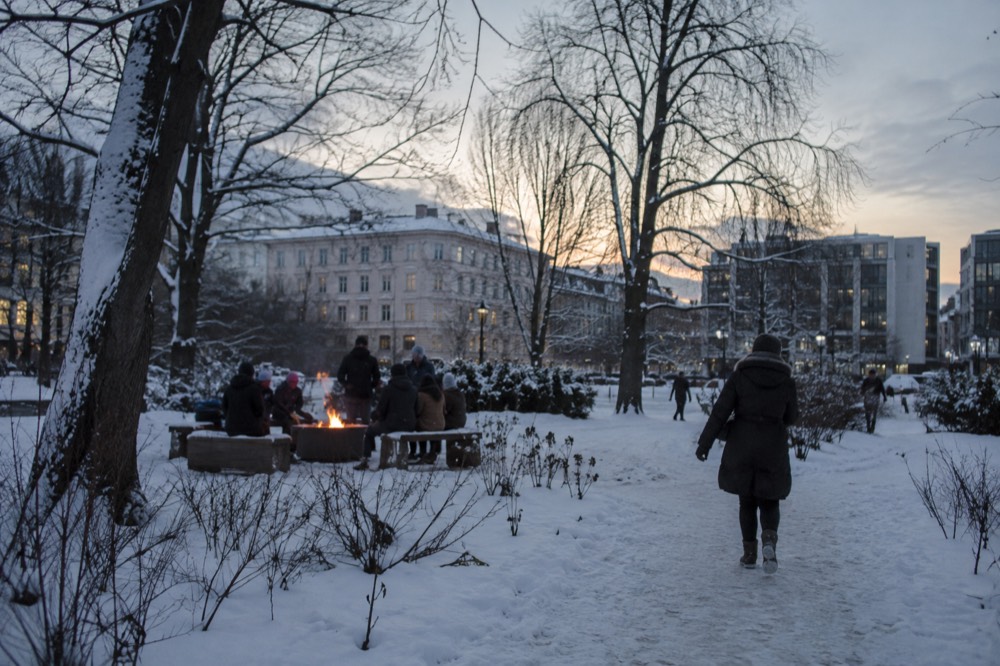
Oslo's winter darkness is real but not extreme: on the shortest day the sun is up from 09:18 to 15:11, and the twilight on either side extends usable light to roughly 08:30 and 16:00. That is about six and a half hours of usable daylight, comparable to a heavily overcast December day in Berlin or Amsterdam, except that the light is often clear and blue rather than grey. Oslo gets no polar night, so the sun always appears above the horizon.
The character of that winter light is the part descriptions usually miss. Because the sun stays under about 6 degrees at midwinter, the light is low, long and blue-toned for the entire day. Snow on the ground, when it comes, doubles the effect by reflecting that low light upward. Photographers get a full day of what other cities get for twenty minutes at dawn. The practical trade is that the sightseeing window is compressed: outdoor sights want to be scheduled between 10:00 and 14:30, and indoor ones, museums, cafes, the MUNCH galleries, belong to the dark shoulders on either side.
There is also a psychological dimension worth stating plainly. Six hours of daylight, arriving as it does after a dark morning, shifts the whole rhythm of a day. Norwegians lean into it rather than fighting it: candlelit cafes, torchlit trails, early dinners, and a deliberate culture of kos, the Norwegian idea of cozy warmth against the dark, which is the direct ancestor of what the rest of the world now calls hygge. A winter trip planned around the darkness instead of against it is a better trip, and our Oslo in winter guide builds that itinerary in full.
The torchlit forest walk with a campfire is the clearest example of the lean-in approach, and it exists precisely because of this daylight curve.
The operator's listing describes a three-and-a-half-hour experience that moves into the forest as the light fades and ends around a campfire, which is the shape of winter Oslo in a single evening. It is also worth pairing with the fact that winter darkness is what makes any aurora discussion possible at all, though Oslo's latitude makes sightings rare; our northern lights in Oslo page takes the honest line on that.
How Does Daylight Change Month by Month in Oslo?
Oslo's daylight grows from 6 hours 45 minutes in mid-January to 18 hours 50 minutes at the June solstice, then falls back symmetrically to 5 hours 53 minutes in late December. The change is fastest around the equinoxes, when the city gains or loses six to seven minutes per day, and slowest near the solstices, when the day length barely moves for two weeks on either side. February and March are the months where the change is most visible day to day.
The symmetry has a planning consequence that is easy to exploit: mid-March and mid-September have nearly identical day lengths, 11 hours 45 minutes against 12 hours 54 minutes, but completely different weather. March is still winter in Oslo, with normal mean temperatures of 1.3 °C. September is mild at 12.2 °C. If your schedule is daylight-driven rather than temperature-driven, the two months are interchangeable on paper and very different on foot. The full index of guides sits on Oslo Travel Guide. The full index of guides sits on Oslo Travel Guide.
| Month | Approx. day length (mid-month) | Daylight gained or lost that month |
|---|---|---|
| January | 6 h 45 m | +1 h 15 m from solstice |
| February | 9 h 14 m | +2 h 29 m |
| March | 11 h 45 m | +2 h 31 m |
| April | 14 h 34 m | +2 h 49 m |
| May | 17 h 08 m | +2 h 34 m |
| June | 18 h 50 m | +1 h 42 m |
| July | 18 h 02 m | −48 m |
| August | 15 h 38 m | −2 h 24 m |
| September | 12 h 54 m | −2 h 44 m |
| October | 10 h 13 m | −2 h 41 m |
| November | ~7 h 30 m | ~−2 h 45 m |
| December | 5 h 53 m | −1 h 30 m to solstice |
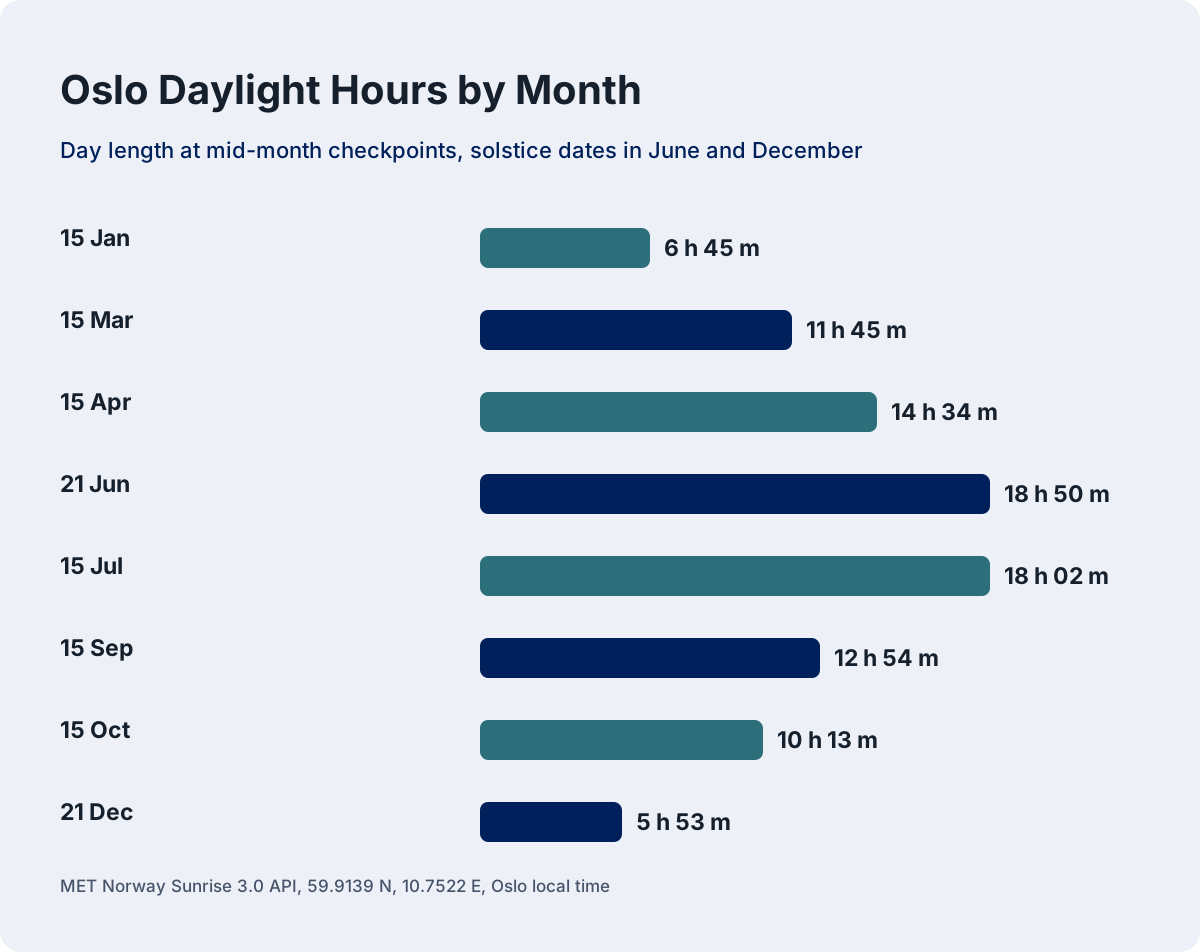
Read the table as a rate-of-change map rather than a list. February through April is when Oslo gains light fastest, and it is why Norwegians treat February as the emotional start of spring even while the thermometer still reads winter. Equally, August through October is when the light leaves, and the autumn half of the year loses daylight at almost exactly the rate spring gains it. Anyone comparing a September booking against an October one is comparing 13 hours of light against 10, which is a bigger difference than any museum schedule.
How Should You Plan Sightseeing Around Oslo's Daylight?
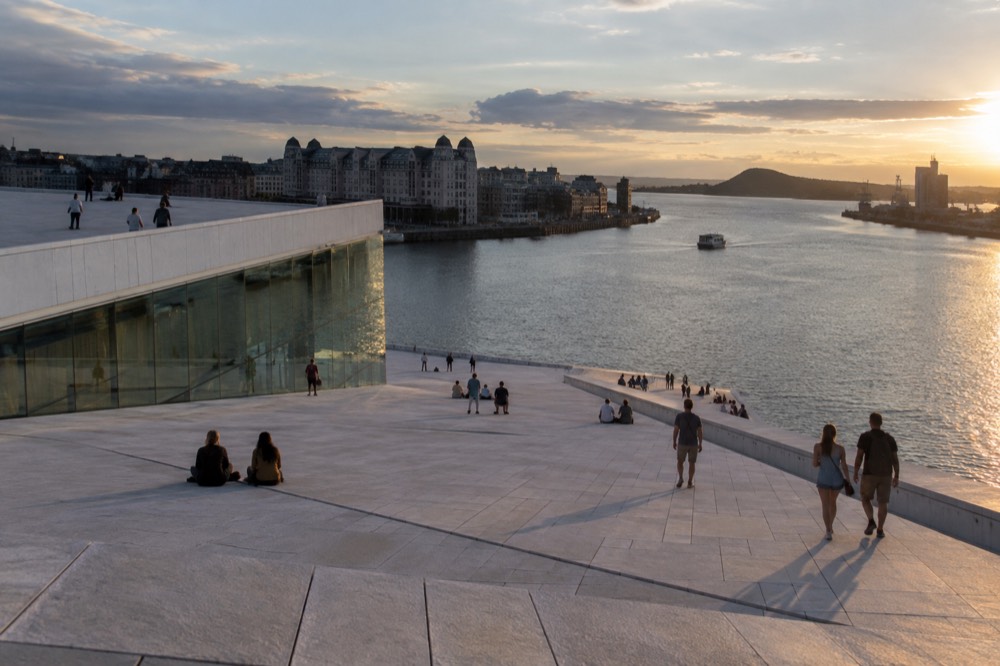
In winter, front-load every outdoor sight into the 10:00 to 14:30 window and push museums, meals and evening events to the dark shoulders. In summer, invert it: keep mornings slow, do indoor sights in the middle of the day, and save the outdoors for the endless evening, when the fjord light is at its best and the crowds have thinned. The mistake to avoid is a summer itinerary that ends at 18:00, which throws away five hours of the best light of the day.
Concretely, a December day in Oslo wants to look like this: breakfast in the dark, an indoor sight or two from 09:00, then Vigeland Park or the Opera House roof or the Akershus Fortress walls between 10:30 and 14:00 while the low sun does its work, then a museum, then dinner, then something that uses the evening, whether that is a torchlit walk, a sauna, or simply a candlelit bar. The city's Christmas market and winter programming are scheduled with exactly this shape in mind, and our Oslo in December guide lays out a full plan.
A June day wants the opposite shape. Sleep in, because the light will still be there at 22:00. Spend the hot midday hours indoors at the National Museum or MUNCH if it is warm, or on the water if it is not. Then, from about 18:00, the city belongs to the evening: a fjord cruise, a swim at Sørenga or Huk, a walk up to Ekebergparken for the view, dinner outdoors at Aker Brygge. The evening cruise with a shrimp buffet is practically designed around the June sunset, since it puts you on the water for the hours when the light goes gold and then blue.
| Season | Usable daylight | Best use of mornings | Best use of evenings |
|---|---|---|---|
| Dec to Jan | ~08:30 to 16:00 | Indoor sights, cafes | Torchlit walks, saunas, bars, Christmas market |
| Feb to Mar | ~07:30 to 18:30 | Outdoor sights from 10:00 | Museums with late hours, dinner |
| Apr to May | ~05:30 to 21:30 | Outdoor sights early | Fjord walks, waterfront dining |
| Jun to Jul | ~04:00 to 23:30+ | Slow start, indoor sights | Fjord cruises, swimming, midnight walks |
| Aug to Sep | ~06:00 to 20:30 | Outdoor sights | Island ferries, park evenings |
| Oct to Nov | ~07:30 to 17:30 | Outdoor sights from 09:30 | Museums, early dinner, evening walks |
The shoulder seasons reward flexibility most. In April you can start an outdoor day at 06:00 and still be walking at 20:30, which is enough light for two full sightseeing blocks with a long lunch between them. In October the window has narrowed enough that a single well-chosen outdoor block, one park, one viewpoint, one fortress, plus one museum, is a realistic day rather than a rushed one.
Does More Daylight Mean Better Weather in Oslo?
No, daylight and weather are separate clocks in Oslo, and they peak at different times. Daylight peaks at the June solstice, but the warmest normal month is July at 17.7 °C mean, and the wettest month on the 1991 to 2020 normals is August at 103 mm. June gives the most light, July the warmest days, August the most rain with still-long evenings. Planning on daylight alone will put you in the wettest month without warning.
MET Norway's official 1991 to 2020 normals for the Blindern station make the point cleanly. July's mean of 17.7 °C is mild rather than hot, and it is the winter, not the summer, that is extreme by European capital standards: January's normal mean is −2.3 °C. August, which still delivers 15 hours 38 minutes of daylight at mid-month, carries 103 mm of normal precipitation, more than any other month. November, the month everyone assumes is Oslo's grey nadir, actually averages less rain at 85 mm, though with far less light to enjoy it in.
| Month | Normal mean temp (°C) | Normal precip (mm) | Day length (mid-month) |
|---|---|---|---|
| Jan | −2.3 | 58 | 6 h 45 m |
| Feb | −2.0 | 46 | 9 h 14 m |
| Mar | 1.3 | 41 | 11 h 45 m |
| Apr | 6.2 | 48 | 14 h 34 m |
| May | 11.4 | 60 | 17 h 08 m |
| Jun | 15.3 | 80 | 18 h 50 m |
| Jul | 17.7 | 87 | 18 h 02 m |
| Aug | 16.5 | 103 | 15 h 38 m |
| Sep | 12.2 | 82 | 12 h 54 m |
| Oct | 6.6 | 93 | 10 h 13 m |
| Nov | 2.2 | 85 | ~7 h 30 m |
| Dec | −1.4 | 54 | 5 h 53 m |
Recent observed data sharpens the picture. In the thirteen months to August 2026, Blindern recorded a high of 32.9 °C on 15 July 2026 and a low of −17.2 °C on 11 January 2026, with 131 days of precipitation. So the normals are not abstractions: Oslo genuinely spans a thirty-degree range over a normal year, and the daylight curve tells you when the warm half of that range is available.
The planning synthesis is that May and June are the light-and-dry compromise, July is the warm-and-bright peak with a real chance of heat, and August is the gamble: the longest evenings of the late summer against the highest rainfall odds. Our best time to visit Oslo guide weighs all of this, including crowds and prices, rather than daylight alone.
What Time Zone and Clock Changes Affect Oslo's Daylight?
Oslo runs on CET, UTC+1, in winter and CEST, UTC+2, in summer, with the switch in late March and late October. The clock change means the June sunrise at 03:53 and the December sunrise at 09:18 are both in local summer and winter time respectively, and quoting a summer time an hour out is the single most common daylight mistake in Oslo trip planning. Norway is not in the EU, but it follows the same daylight-saving schedule as its neighbors through the EEA arrangement.
The practical trap is subtle. A visitor who looked up June sunset times in January, or read a blog that mixed CET and CEST, will plan an evening around a sunset that is an hour off, which in June is the difference between a golden fjord and a dark one. The times quoted throughout this guide are all in Oslo local time for the season in question, and yr.no will give you the correct local figures for any date.
The clock change also has a small effect worth knowing when booking. The spring switch in late March costs you an hour of sleep but delivers sunsets that jump abruptly from around 18:30 to beyond 19:30 within days, which is why late March feels like the moment winter breaks. The October switch does the reverse, snapping sunsets back from about 18:00 to about 17:00, and it is the psychological start of the indoor season. Neither change alters the total daylight, only where the clock places it.
Which Oslo Activities Depend on the Daylight?
The fjord cruises, island ferries, park visits, rooftop walks and photography all depend directly on daylight hours, while museums, food tours, evening walks and the campfire experiences depend on darkness or are indifferent. In summer the water-based activities gain the most, since the evening light on the Oslofjord is the city's best asset. In winter the torchlit and campfire products are the ones built for the dark, and the museums carry the short days.
The summer list is long because the evenings are enormous. The silent electric fjord cruise and the wooden sailing-ship cruise both run daylight-dependent routes where the light on the water is half the product. The island ferries to Hovedøya and Langøyene are worth the trip mainly when you can linger in the evening light, and swimming anywhere in the fjord is a daylight activity by definition. Our Oslo in summer guide sequences these against the June and July light curve.
The winter list is shorter but more distinctive. The torchlit forest walk and the guided snowshoeing in Nordmarka are both structured around early darkness, and the learn-to-ski half-day uses the compressed daylight window efficiently, which matters when the sun sets before 16:00. Museums are the daylight-independent backbone: Kon-Tiki, Fram, MUNCH and the National Museum all carry a winter day comfortably, and the paradox of Oslo in December is that the short days push you toward exactly the sights the city is most famous for.
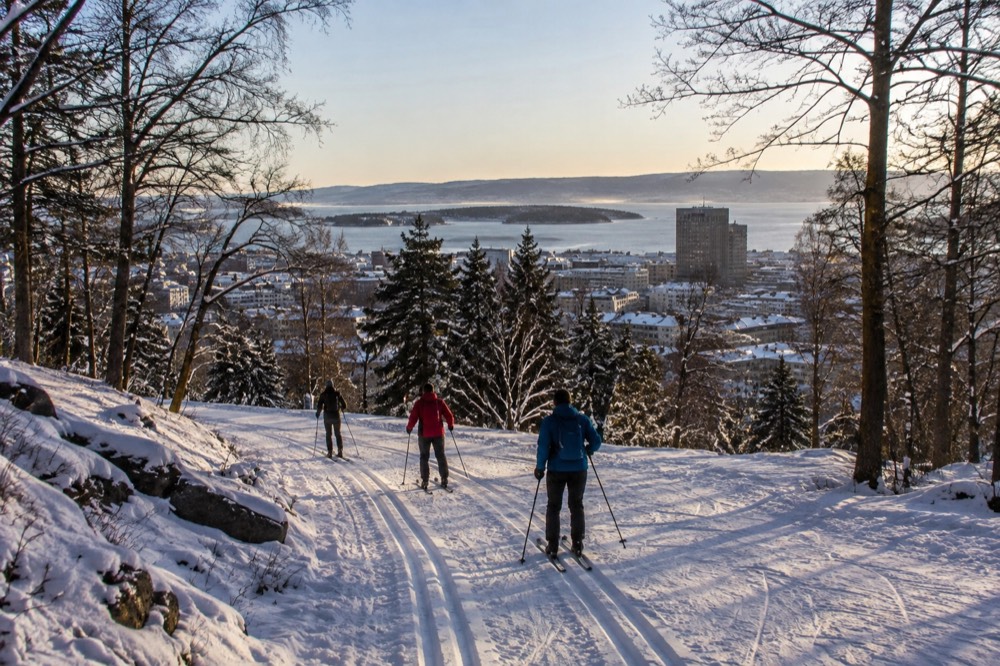
The skiing experience is the clearest daylight-scheduled winter product after the torchlit walk: it runs as a half-day, which fits the 10:00 to 14:30 usable window almost exactly, and it makes Oslo one of the very few European capitals where learning to ski is a half-day city activity rather than a mountain expedition.
Do Locals Change Their Routines with the Daylight?
Yes, and visibly: Norwegians shift their whole daily rhythm with the seasons, moving outdoors en masse in the long light of April through September and retreating to candlelit interiors, saunas and early evenings from October through February. The February light revival is treated almost as a holiday, and the dark months carry a deliberate culture of cozy indoor socializing that Norwegians call kos. Visitors who mirror this rhythm enjoy both seasons more than those who fight it.
The most useful thing a visitor can copy is the seasonal migration. In summer, Oslo's residents move their lives outdoors: the waterfront at Aker Brygge and Sørenga fills from late afternoon, parks fill with picnics after work, and the fjord islands become evening destinations. In winter the migration reverses toward candlelight, fireplaces, long restaurant dinners and the saunas, and the city's programming follows, with Christmas markets, late museum evenings and torchlit events filling the dark hours deliberately.
The second habit worth copying is the February turn. Locals speak about the return of the light in February the way other cities speak about a festival, and the numbers justify it: the city gains over two and a half hours of daylight in February alone. A February visit catches the tail of winter activities like snowshoeing and the ski trails in Nordmarka, but with sunrise already back before 08:00 and sunset past 17:00, which is a materially easier trip than December.
Common Questions About Oslo Daylight Hours
How many daylight hours does Oslo get?
Oslo gets between 5 hours 53 minutes and 18 hours 50 minutes of daylight per day across the year. The shortest day is 21 December at 5 hours 53 minutes; the longest is 21 June at 18 hours 50 minutes, per MET Norway's sunrise data for the city's coordinates.
Does Oslo have midnight sun?
No. Midnight sun requires a latitude north of the Arctic Circle at roughly 66.5 degrees north, and Oslo is at 59.91 degrees. In late June the sun sets at 22:43 and the sky stays in twilight all night without ever going fully dark, but the sun does set. The real midnight sun is in northern Norway, around Tromsø and farther north.
What time does the sun set in Oslo in winter?
At the December solstice the sun sets at 15:11, having risen at 09:18. Through January and February sunset moves rapidly later, reaching 17:08 by 15 February and past 18:00 by mid-March.
What time does the sun set in Oslo in summer?
In late June the sun sets at 22:43, and in mid-July at 22:23. Civil twilight keeps the sky bright until after midnight, so it never gets properly dark in Oslo in the weeks around the summer solstice.
How dark is Oslo in December?
Oslo's shortest day has the sun above the horizon for 5 hours 53 minutes, from 09:18 to 15:11, with usable twilight extending that to roughly 08:30 to 16:00. There is no polar night: the sun always rises in Oslo, every day of the year.
When does Oslo start getting dark in autumn?
Daylight falls fastest in September and October, at roughly two and a half hours lost per month. By 15 October sunset is at 18:08 and the day is down to 10 hours 13 minutes, and after the late-October clock change sunsets land before 17:00.
The daylight curve is the one variable in Oslo you cannot book around, only plan around. Match your itinerary's shape to the season's light and the city works with you: winter for torchlight, museums and gold-lit afternoons, summer for a fjord that stays swimmable until late evening. For the full seasonal picture with temperatures and rainfall, continue with our month-by-month guide on oslotravelguide.com, or see best time to visit Oslo for the crowd and price side of the same decision.