Tjuvholmen: Oslo's Waterfront Art and Beach District
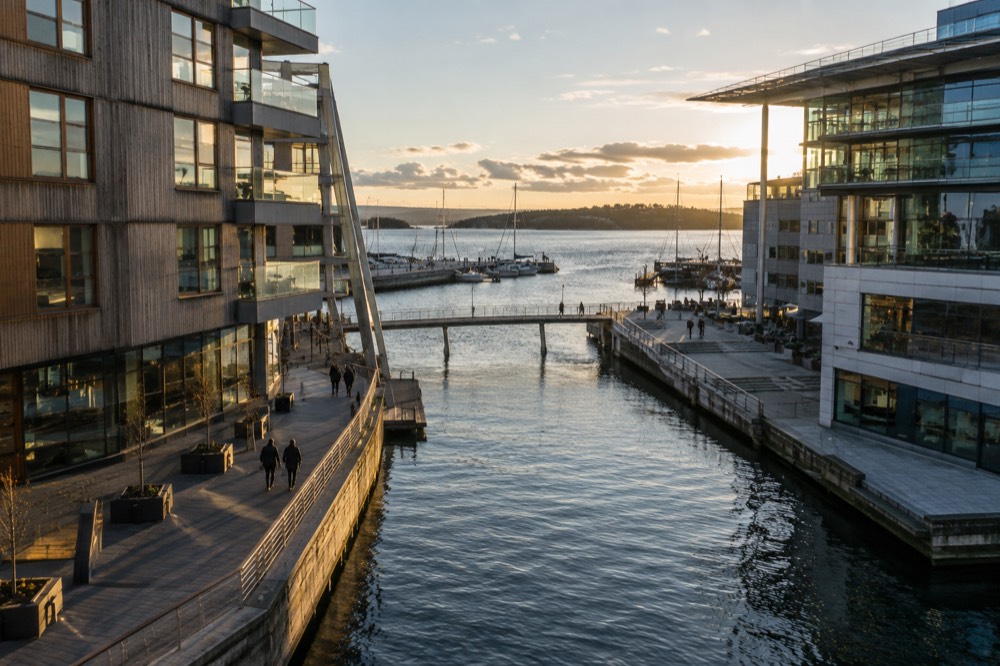
Tjuvholmen is the newest piece of central Oslo: a canal-cut peninsula of glass architecture, a modern art museum, a sculpture park and a city beach, all within a ten minute walk of the City Hall.
Short answer
Tjuvholmen is a waterfront peninsula southwest of Oslo City Hall, built on former shipyard land. It holds the Astrup Fearnley Museet (180 NOK adult, under-20s free), a free sculpture park, a small sand beach and a cluster of restaurants. Most visitors spend two to three hours, or a half day in summer combined with the beach.
What Is Tjuvholmen?
Tjuvholmen is a man-made peninsula at the western end of Oslo's inner harbor, sitting directly southwest of the City Hall and Aker Brygge. Once shipyard and industrial land, it was redeveloped into a district of canals, apartment blocks, galleries and the Astrup Fearnley Museet, Oslo's museum of modern and contemporary art. The name translates roughly as Thieves' Islet.
It is compact, walkable end to end in about fifteen minutes, and it has quietly become the neighborhood where art, swimming and fine dining sit within two hundred meters of each other.
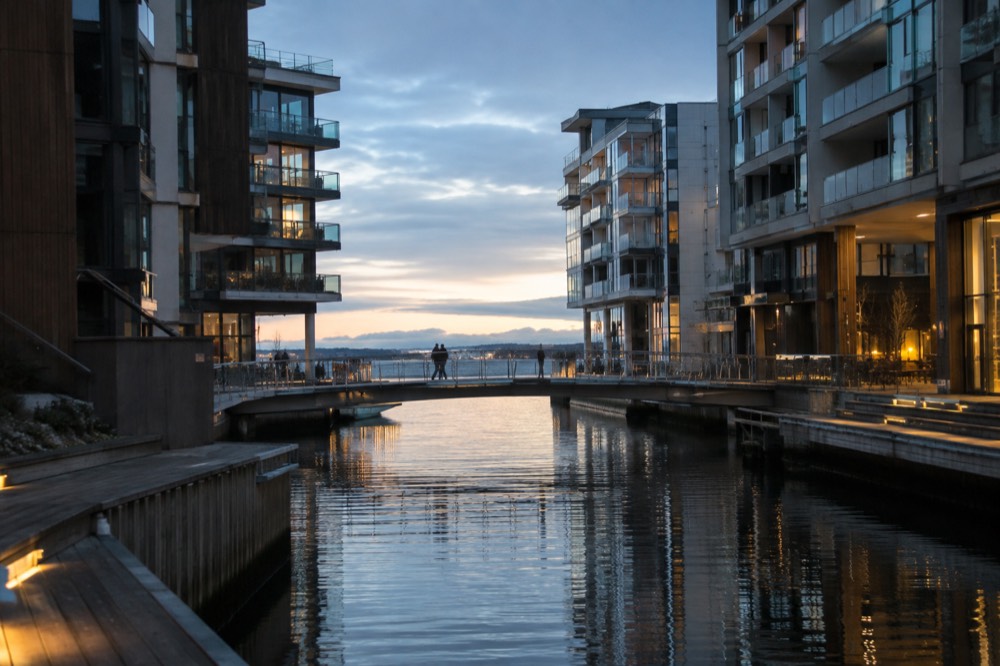
That last point is the one that surprises people. Oslo rebuilt its entire waterfront in a single generation, and Tjuvholmen is the newest and most deliberate chapter of it. Where Aker Brygge is the busy restaurant strip and Pipervika frames the City Hall, Tjuvholmen is the quiet, design-forward tip: narrow canals crossed by small footbridges, a beach facing the Oslofjord, and a contemporary art museum whose building is nearly as photographed as what hangs inside it.
The district divides naturally into three parts. Søndre Tjuvholmen, the outer tip, holds the Astrup Fearnley Museet, the Tjuvholmen Sculpture Park and the beach. The canal quarter behind it carries the footbridges and the smaller galleries. The inner section, facing Aker Brygge, is mostly apartments and offices with restaurants at street level. You do not need a plan to see it, but you do need to know which parts reward time, and this page exists to sort that out.
How Do You Get to Tjuvholmen?
Walking from the City Hall takes about eight to ten minutes along the waterfront promenade, and that is how most visitors arrive. By tram, lines 9 and 13 stop at Aker Brygge or Vika at the district's edge. In summer you can also arrive by boat: the Bygdøy ferry departs from Rådhusbrygge 3 nearby, though it serves the museum peninsula, not Tjuvholmen itself. There is no metro station on the peninsula. From Oslo Central Station, allow twenty-five minutes on foot or about fifteen by tram.
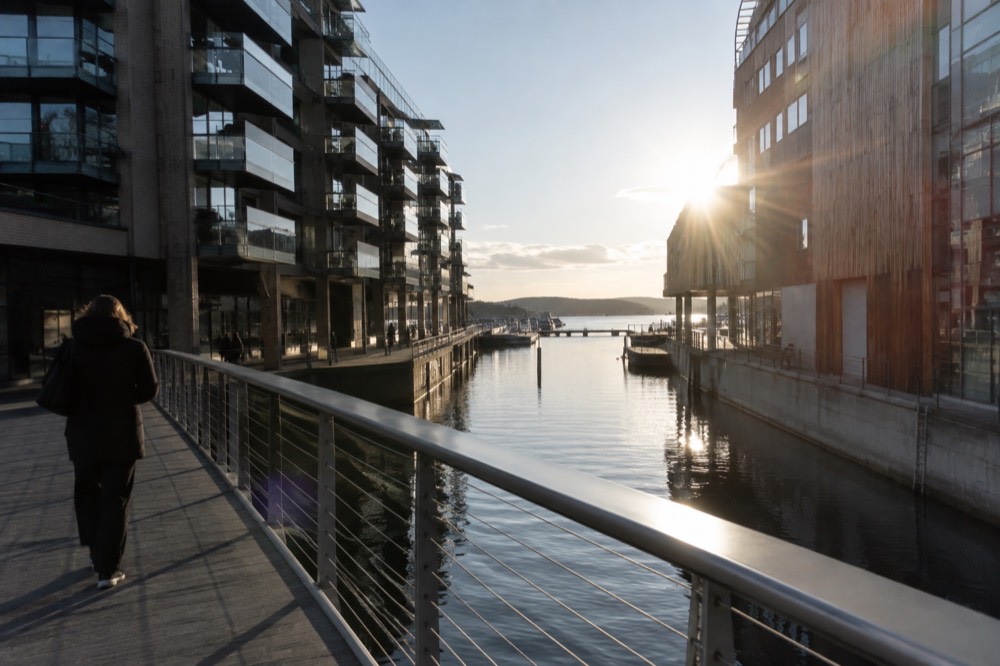
The walk is the point. The promenade from Rådhusbrygge past Aker Brygge and onto Tjuvholmen is one of the most pleasant ten minutes in central Oslo, with the fjord on one side and the glass facades on the other. Cyclists share parts of it, and in July it can feel busy, but it never stops being a harbor walk rather than a street.
Two practical notes from the transport facts worth carrying. First, if you are using public transport, Tjuvholmen sits inside Ruter zone 1, the central zone that also covers the entire metro network, so an ordinary central ticket covers any tram or bus you use to reach it. Second, if you are coming from the airport side of your trip, the Oslo Pass covers public trains operated by Vy to and from Gardermoen, plus buses, trams and the island ferries in zones 1, 2, 3, 4V and 4N, but not the Flytoget airport express. A pass holder can therefore reach the neighborhood door without spending anything extra.
| From | Best route | Time | Ticket needed |
|---|---|---|---|
| Oslo City Hall | Waterfront promenade on foot | 8-10 min | None |
| Oslo Central Station | Tram 9 or 13, or walk | ~15 min tram | Ruter zone 1 |
| Aker Brygge | Walk west past the restaurants | 3-5 min | None |
| The Oslofjord islands | Ferry B1 from Aker brygge, then walk | ~15 min | Ruter zone 1 |
| Bygdøy museums | Seasonal ferry from Rådhusbrygge 3 | 10 min crossing | Not a Ruter ticket; Oslo Pass accepted |
Note the last two rows carefully, because they are the most confused ferry topic in Oslo. The Bygdøy ferry and the island ferries are different systems with different ticket rules, and they leave from different piers: the Bygdøy boat from Rådhusbrygge 3, the island boats from the Aker brygge side. Ruter tickets are not valid on the Bygdøy ferry, though the Oslo Pass covers it. The island ferries B1, B1X and B2 are ordinary Ruter services. Getting this wrong costs you a fare or a wait.
If a guided introduction appeals before you explore on your own, these three walks all start from the center and pass within a few minutes of the peninsula:
What Is the Astrup Fearnley Museet?
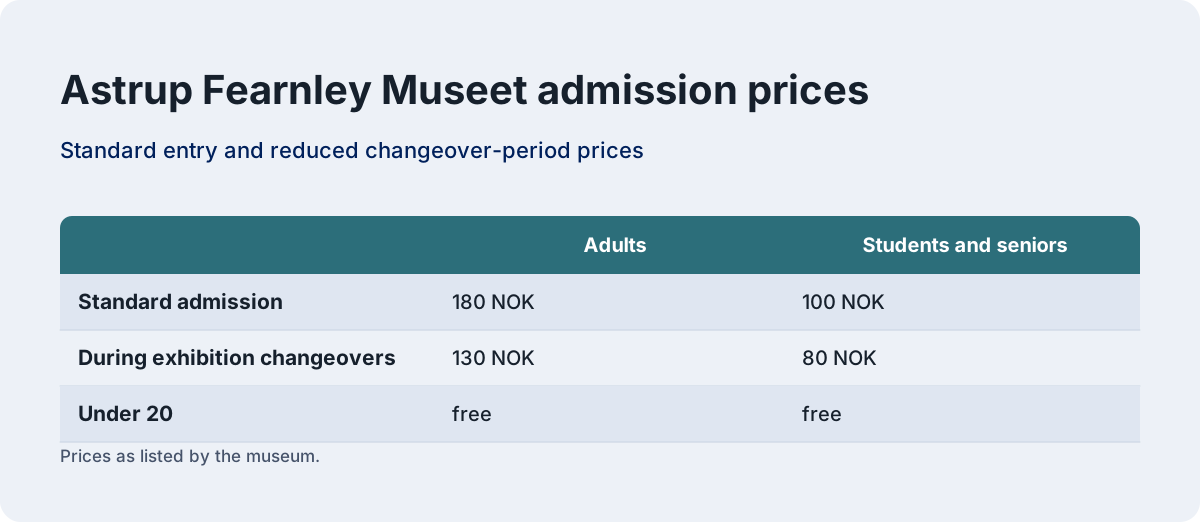
The Astrup Fearnley Museet is Oslo's museum of modern and contemporary art, housed in a landmark building at the tip of Tjuvholmen. Adult admission is 180 NOK, students and seniors pay 100 NOK, and everyone under 20 enters free. During exhibition changeovers the price drops to 130 NOK for adults and 80 NOK for students and seniors. The museum holds a significant private collection of international contemporary art, and it is the single biggest reason most visitors walk out onto the peninsula.
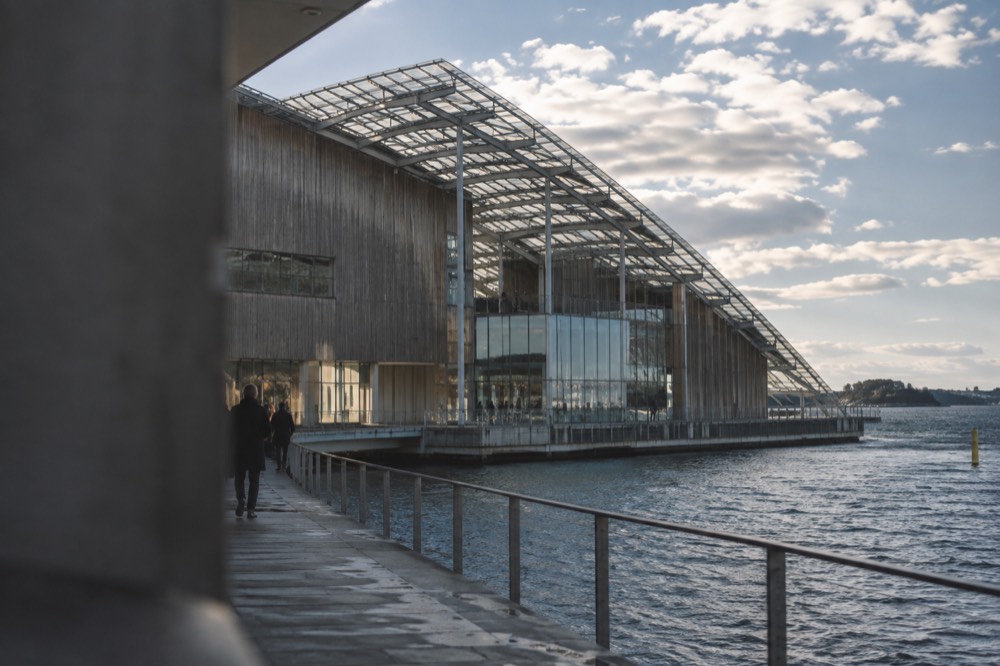
The building itself, with its sweeping glass roof, is the district's visual signature and the reason Tjuvholmen photographs the way it does. Inside, the collection leans toward American and European contemporary art, with rotating exhibitions drawn from the permanent holdings. The museum publishes its current program on its own site, and because shows change, it is worth checking what is on before you commit, especially if you have already visited on a previous trip.
The under-20 rule deserves emphasis for families: a family with teenagers pays only for the adults, which makes this one of the better value museum visits in the city. And if you are weighing the visit against the Oslo Pass, the pass covers the Astrup Fearnley along with more than thirty other museums and attractions, so a heavy museum day can pay for itself.
Is the Tjuvholmen Sculpture Park Free?
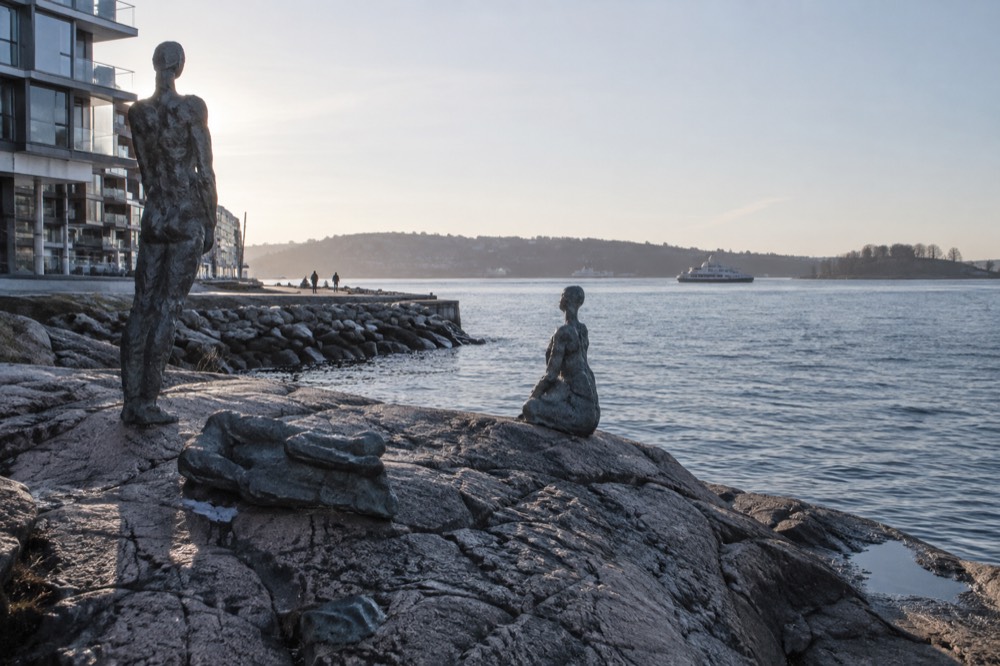
Yes, the Tjuvholmen Sculpture Park is completely free and open at all times. It wraps around the seaward side of the Astrup Fearnley Museet at the peninsula's tip, with international sculptors' works set on the rocks and boardwalk facing the Oslofjord. You can walk through it in twenty minutes or linger for an hour, and because it sits outdoors between the museum and the beach, it costs nothing to combine with either. It is one of the genuinely free sights in Oslo that most first-time visitors never hear about.
The setting does half the work. The sculptures stand against open water, with the fjord islands and the occasional cruise ship in the background, and at sunset the light across the installations is the kind of thing that fills camera cards. You do not need to know anything about the artists to enjoy it; the park functions as an extension of the waterfront walk.
If free outdoor art appeals, pair it with Vigeland Park in Frogner, which is also free, open 24 hours a day all year, and holds over 200 sculptures. Between the two, Oslo gives away an extraordinary amount of world-class art in public space, which is worth knowing in a country where so much else carries a premium. The Vigeland sculpture park guide covers that side of the city in full.
Can You Swim at Tjuvholmen?
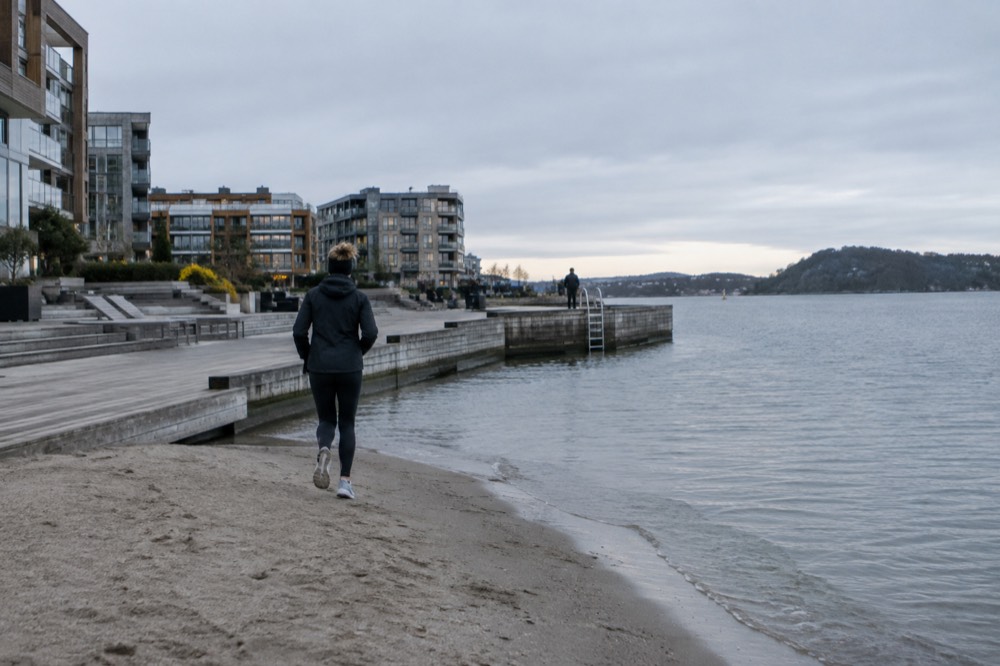
Yes. Tjuvholmen has its own small city beach at the peninsula's tip, with sand, rocks and a floating sun deck, and it is free and open to the public. It is one of Oslo's official swimming spots, listed alongside Sørenga, Huk and Paradisbukta. Realistic water temperatures in July and August run 15 to 20 °C, which is bracing rather than Mediterranean. Locals swim here on warm summer evenings straight from work, and the beach faces directly into the fjord sunset.
That last detail matters. Because the beach looks west-southwest across the inner Oslofjord, a warm July evening here delivers the sunset over the water, and in late June the sky never goes fully dark. On 21 June the sun sets at 22:43 and rises again at 03:53, so a late swim happens in deep twilight rather than night. There is no midnight sun in Oslo, the city is too far south at 59.91 N, but summer evenings feel endless all the same.
Facilities are minimal by southern European standards: this is a city beach, not a resort. Bring a towel, expect rocks in places, and check the water quality the way locals do, through the municipal bathing pages. For a fuller swimming day with more space, the island of Langøyene, reached by the seasonal B2 ferry from Aker brygge, has the best beaches in the inner fjord, and the Oslo beaches guide compares all the options.
| Swimming spot | Location | Character | Access |
|---|---|---|---|
| Tjuvholmen beach | Peninsula tip, central | Small sand and rock beach, sunset-facing | Walk from City Hall, 10 min |
| Sørenga | Søndre Bjørvika, east side | Seawater pool and boardwalk | Walk from the Opera House |
| Huk | Bygdøy | Classic sandy beach, family favorite | Bus 30 or summer ferry |
| Paradisbukta | Bygdøy | Quieter cove, more walking | Bus 30, then walk |
| Langøyene | Oslofjord island | Best beaches, free camping in season | Ferry B2, Ruter ticket |
Where Do You Eat and Drink on Tjuvholmen?
Tjuvholmen's restaurants cluster along the canal and the seaward boardwalk, and the district has quietly collected some of central Oslo's better waterfront tables. Expect Oslo prices: this is a destination dining strip, not a budget one, and alcohol is where the bill climbs. Statistics Norway's 2025 price comparison puts Norwegian food prices 33 percent above the European average, and alcohol and tobacco at more than double it. The honest strategy is a main meal here and drinks elsewhere, or a picnic on the beach.
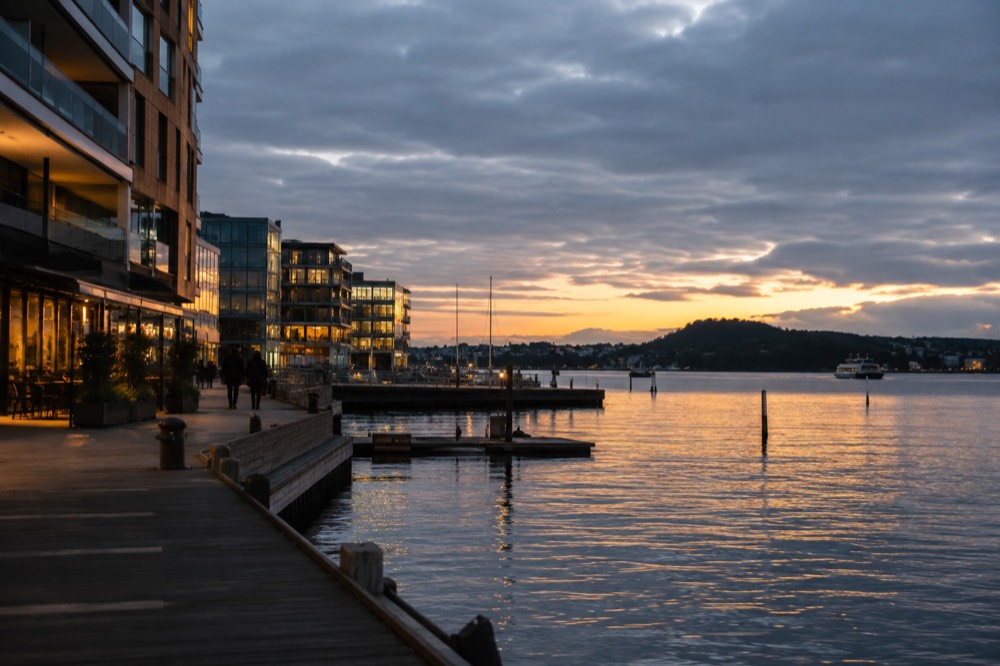
The canal-side tables in summer are among the most sought-after in the city, and the seaward side gets the sunset. The strip is short, so you can read the menus by walking it in ten minutes rather than choosing blind. For the same reason it books up in July; a reservation a day ahead is sensible for dinner in high season. The rest of the planning pages sit on Oslo Travel Guide. The rest of the planning pages sit on Oslo Travel Guide.
If you want the eating to be the point rather than the setting, two guided food walks cover different ground. The city-centre Norwegian food walk runs three hours through central Oslo's hidden gems, and the Grünerløkka food and culture walk covers the east-side neighborhood's food scene instead. The Grünerløkka neighborhood guide explains that district if you would rather eat your way around it independently.
For self-guided budget eating, the Oslo cheap eats guide is the practical companion, and one rule from it applies here: supermarkets sell beer only, up to 4.7 percent ABV, and wine and spirits exist only at Vinmonopolet, the state monopoly, which keeps short hours and closes all day Sunday. A beach picnic planned around those rules is the cheapest good evening on this peninsula.
Tjuvholmen or Aker Brygge: Which Is Worth Your Time?
Aker Brygge is the older, busier waterfront strip: restaurants, shops and people, with the fjord as a backdrop. Tjuvholmen is the quieter, newer tip: contemporary art, sculpture, swimming and architecture. They are three to five minutes' walk apart, so it is not really a choice, but if you only have one evening, Aker Brygge suits eating and people-watching while Tjuvholmen suits the sunset, the beach and the museum. Families with teens usually prefer Tjuvholmen; groups eating out usually prefer Aker Brygge.
The contrast is a deliberate result of how the two were built. Aker Brygge was converted from a shipyard in the late twentieth century into the city's outdoor dining room; Tjuvholmen was designed from scratch, a generation later, as a residential and cultural extension of it. One feels commercial, the other residential. That is also why Tjuvholmen empties a little on winter weekends while Aker Brygge never really does.
| Tjuvholmen | Aker Brygge | |
|---|---|---|
| Character | Quiet, design-led, cultural | Busy, social, commercial |
| Main draw | Astrup Fearnley, sculpture park, beach | Restaurants, shopping, harbor views |
| Eating | Waterfront tables, fewer venues | Oslo's densest restaurant strip |
| Cost to visit | Museum 180 NOK, everything else free | Free to walk, dining is the expense |
| Best time | Sunny afternoon into sunset | Lunch, dinner, any weather |
| Crowds | Moderate, quieter in winter | Heavy, especially summer weekends |
The Aker Brygge guide covers that side of the harbor in detail. The short version of the pairing: walk Aker Brygge on the way out, spend your time at Tjuvholmen's tip, and walk back through it for dinner.
What Is the Best Walk Through Tjuvholmen?
Start at the City Hall, walk the promenade past Aker Brygge's restaurants, cross onto Tjuvholmen by the inner canal, follow the footbridges through the canal quarter, and end at the peninsula tip: sculpture park, then Astrup Fearnley if it is open, then the beach. The whole route takes twenty minutes without stops, or a relaxed half day with them. Return the same way for the sunset, or loop back via the Vika side for tram connections.
The route works in every season, but it changes character completely. In summer the beach and the sculpture park are the destination, and the walk ends with bare feet on sand. In winter, when the sun is up for under six hours in late December and sets at 15:11, the same route becomes a short, bright-windowed stroll where the museum and a long lunch carry the visit. The Oslo walking route guide builds this segment into a full day's circuit of the harbor.
One detour worth making: the Barcode district and the Opera House lie on the opposite, eastern side of the inner harbor, and the best views in Oslo guide marks the Tjuvholmen tip as one of the best places to photograph the skyline across the water, with the Opera House roof visible at the far end of the bay. Photographers should be at the tip in the last hour before sunset.
How Much Time Should You Spend There?
Two to three hours covers Tjuvholmen properly: the sculpture park, the walk through the canal quarter and either the museum or a beach sit. Add a meal and it becomes a half day. In summer, with swimming weather, a half day is genuinely justified, and many locals treat the peninsula as an evening destination rather than a sightseeing stop. If you are short on time in Oslo overall, Tjuvholmen is the first thing to trim after the essentials, but it is a very pleasant last afternoon if your schedule allows.
The variable is the museum. A focused visit to the Astrup Fearnley takes about an hour; an engaged one takes two. The park and the beach are unbounded, in the sense that you can spend twenty minutes or three hours depending on the weather and your tolerance for sitting by water doing nothing, which in Norway is not idleness but a small cultural exercise.
For context on the wider itinerary question, the how many days in Oslo guide sets out what a first visit can realistically hold, and Tjuvholmen slots most naturally into the afternoon of a day that also includes Aker Brygge and the City Hall, or into a summer evening after the museums close.
Is Tjuvholmen Good in Winter?
Yes, but differently. The museum runs all year and is at its best as a dark-afternoon destination, the sculpture park is free and open regardless, and the canal quarter's bridges and facades photograph well under snow. The beach becomes a viewing platform rather than a swimming spot, and the water stays in the low single digits Celsius. Winter daylight is the real constraint: in late December the sun rises at 09:18 and sets at 15:11, so plan the outdoor part of the visit around midday.
Norwegians have a phrase for the winter mindset that this district suits well: there is no bad weather, only bad clothing. The peninsula is fully exposed to the fjord wind, which is bracing in January, so the windproof layer matters more here than in the sheltered city center. The reward is that on a clear winter afternoon, the low sun across the fjord and the snow on the sculptures make Tjuvholmen one of the most photogenic corners of central Oslo.
For the full cold-season picture, including what else holds up between November and March, see the Oslo in winter guide. If you want a winter evening activity with a warm center, the seasonal torchlit forest walks and snowshoe tours run from the city, though those head for Nordmarka rather than the harbor.
| Season | Daylight on the 21st | What Tjuvholmen is good for |
|---|---|---|
| Spring (Mar-May) | 11 h 45 m to 17 h 08 m | Museum, sculpture park, first warm terrace days |
| Summer (Jun-Aug) | Up to 18 h 50 m | Beach, swimming, sunset, outdoor dining |
| Autumn (Sep-Nov) | 12 h 54 m down to 5 h 53 m by Dec | Museum, walks, fewer crowds |
| Winter (Dec-Feb) | As little as 5 h 53 m | Museum afternoons, low-light photography |
Is Tjuvholmen Expensive?
The district itself is free to enjoy: the sculpture park, the beach, the canals and the waterfront walk cost nothing, and the only fixed admission is the Astrup Fearnley at 180 NOK for adults, 100 NOK for students and seniors, and free for under-20s. The expense is in the restaurants and the drinks. Norway is the sixth most expensive country in Europe on Statistics Norway's 2025 comparison, with food 33 percent above the European average and alcohol more than double. Budget the eating, not the seeing.
That split is the useful planning insight for this whole city, and Tjuvholmen is its clearest illustration. A day here can be a 180 NOK museum ticket plus a picnic, or it can be a long dinner for two that costs more than everything else in your Oslo budget combined. The is Oslo expensive guide breaks the city's costs down line by line, and the Oslo on a budget guide lists the free alternatives, several of which are on this peninsula.
One money note that applies to the whole country: Norway is in the Schengen Area but not in the European Union, it is in the EEA through EFTA, and it uses the krone, not the euro. Cards are accepted essentially everywhere, including at the museum and the beach kiosks, so cash is unnecessary. Non-EU visitors can also claim a VAT refund on qualifying purchases, which is worth knowing if the museum shop tempts you.
What Is Nearby Worth Combining?
Aker Brygge is three to five minutes away on foot, the City Hall and its pier about ten, and the Bygdøy museum peninsula is a ten minute seasonal ferry crossing from Rådhusbrygge 3. The Oslofjord island ferries leave from the Aker brygge side and run on ordinary Ruter tickets. This whole southwestern corner of the harbor is Oslo's most walkable cluster, and a single good day can cover the City Hall, Aker Brygge, Tjuvholmen and a museum on Bygdøy without ever needing a vehicle.
The classic combination is a summer Saturday: Tjuvholmen's beach in the afternoon, the sculpture park as the light drops, dinner at Aker Brygge, and the walk back past the City Hall while the harbor lights come on. In the museum-heavy version, the morning goes to Bygdøy, where the Kon-Tiki and Fram museums sit together at the Bygdøynes pier, and the afternoon comes back across the water to Tjuvholmen. The Bygdøy guide covers the peninsula side, and the one day in Oslo itinerary sequences the whole harbor without wasted steps.
If you would rather someone else hold the narrative, the small-group and budget guided walks of the center all pass along this waterfront, and the highest-rated bike tour in the city covers the harbor districts in three hours, which suits visitors who want the geography explained without committing a full day. The things to do in Oslo overview is the place to start if Tjuvholmen is one stop in a longer list.
Common Questions About Tjuvholmen
What is Tjuvholmen?
A redeveloped waterfront peninsula just southwest of Oslo City Hall, built on former shipyard land. It holds the Astrup Fearnley Museet, the Tjuvholmen Sculpture Park, a small city beach and a canal quarter of restaurants and apartments. It is the newest part of central Oslo's harbor and takes about fifteen minutes to walk end to end.
How do I get to Tjuvholmen from central Oslo?
Walk the waterfront promenade from the City Hall, about eight to ten minutes past Aker Brygge. Trams 9 and 13 stop at the district's edge, and the whole area sits inside Ruter zone 1, so an ordinary central ticket covers the tram. There is no metro station on the peninsula itself.
Is the Astrup Fearnley Museet worth visiting?
For anyone with an interest in contemporary art, yes. Adult admission is 180 NOK, students and seniors pay 100 NOK, and under-20s enter free. The building itself is one of Oslo's architectural landmarks, and the collection is one of Northern Europe's stronger private collections of international contemporary art.
Can you swim at Tjuvholmen?
Yes, there is a free public beach at the peninsula's tip with sand, rocks and a sun deck. July and August water temperatures typically run 15 to 20 °C. Locals swim here on warm summer evenings, and the beach faces the fjord sunset.
Is Tjuvholmen free to visit?
The district is free to walk through, and the sculpture park, beach and canals cost nothing. The only admission is the Astrup Fearnley Museet. The Oslo Pass covers the museum along with more than thirty other Oslo attractions.
How much time do you need at Tjuvholmen?
Two to three hours covers the sculpture park, the canal quarter and either the museum or the beach. With a meal or swimming, plan a half day. In winter, budget around two hours centered on the museum and a midday walk, since daylight can be under six hours.