Riding the Oslo Tram: Tickets, Zones and the Lines Worth Knowing
The tram is the slow, scenic way across Oslo, and it is also the network most visitors end up using without quite meaning to. Here is how the tickets, zones and passes actually work, and when a tram ride beats every alternative.

Short answer
The Oslo tram is part of the Ruter public transport system, so one ticket covers trams, buses, the metro and the island ferries inside the zones you pay for. Central Oslo is zone 1, a single ticket is valid for 60 minutes, and the cheapest way to buy is the Ruter app. An Oslo Pass, from 580 NOK for 24 hours, covers the tram plus museum entry.
The Oslo tram does the thing that a metro cannot: it stays on the surface. The T-bane tunnels under the city and drops you at a platform, while the tram rolls down Karl Johans gate, past Grünerløkka's brick walls and out toward the western hills with the whole street in the window. For a visitor, that makes it two things at once, a genuinely useful way to get around and a cheap sightseeing route that happens to accept an ordinary transit ticket.
This guide covers the practical side, how tickets and zones work, what the Oslo Pass actually covers, how the tram compares with the metro and the bus, and where the network's current construction works will slow you down. Everything here comes from the operators' own published material, and where a price is not confirmed, it says so rather than guessing.

What Is the Oslo Tram, and Who Runs It?
The Oslo tram network is the city's surface rail system, operated as part of Ruter's fare and zone structure alongside the metro, buses and ferries. One ticket is valid across all of them for the zones you have paid for, so a tram ticket is also a bus ticket and a metro ticket within the same zone. Ruter sets the fares, sells tickets through its app, and publishes the timetables, while the rolling stock and track are maintained by the city's transit company.
The practical consequence for a visitor is simple: you never buy a "tram ticket" as such. You buy a Ruter ticket for the zones you are crossing, and that ticket is then valid on the tram, the bus, the T-bane metro and the scheduled island ferries. A single ticket for one zone is valid for 60 minutes from activation, and validity increases by 30 minutes for each additional zone you buy. That is long enough to ride the tram across the center, do one thing, and ride part of the way back on the same ticket.
The trams themselves are the green-and-white vehicles you will see everywhere in the center. They run on fixed rails in the street, which means two things worth knowing before you board. First, they are slower than the metro but stop more often, so they are the right choice for short hops and for streets you actually want to see. Second, when something blocks the rails, a construction project, a parked car, an event, the whole line is disrupted rather than just delayed, and Ruter usually substitutes a bus. Check the Ruter app for live disruption notices on the day you ride.
If you are still building the skeleton of your trip, our one day in Oslo itinerary uses the tram and the waterfront as its spine, and the wider getting around Oslo guide puts the tram in context next to the metro and the buses.
Tickets, Zones and How to Pay
Buy your ticket in the Ruter app before you board, because a ticket bought on board the bus or boat is more expensive, and trams do not sell tickets at all. Central Oslo is zone 1, the entire metro network sits inside zone 1, and the airport at Gardermoen is zone 4N, so a trip from the center to the airport needs a ticket covering all the zones in between. Prices are set by the number of zones crossed, not by distance.
The zone system is the part visitors get wrong, so it is worth slowing down on. Oslo and the surrounding county are divided into numbered tariff zones. Zone 1 covers central Oslo and, importantly, the whole T-bane network, so metro rides to Holmenkollen or Sognsvann are still single-zone trips. The airport is a different matter: Gardermoen sits in zone 4N, and Ruter's own guidance is not to count zones by hand but to let the journey planner in the app do it for you.

On payment: the app is the cheapest channel. Ruter also sells through travel cards and retailers, and on-board cash purchase exists only on buses and boats, at a higher price, with small notes only. There is no ticket machine at every tram stop the way there is in some European cities, so the app is not just the cheapest option, for the tram it is effectively the only option you can rely on.
What about the actual prices? Here the honest answer is that Ruter's public price table renders through JavaScript and several of its published price pages have moved, so the single, 24-hour and 7-day fares are not reliably quotable here. What is confirmed from Ruter's own announcements is the 30-day picture and the direction of travel:
| Ticket | Zone | Price | Status |
|---|---|---|---|
| 30-day pass, adult | Zone 1 | 655 NOK | Confirmed, cut from 805 NOK on 3 May 2026 |
| 30-day pass, adult | Single zone outside 1 | 1019 NOK | Confirmed, January 2026 adjustment |
| Single ticket | Zone 1 | Check the Ruter app | Not independently confirmed |
| 24-hour ticket | Zone 1 | Check the Ruter app | Not independently confirmed |
| On-board purchase | Bus and boat only | Higher than app price | Confirmed by Ruter |
For most visitors on a short trip, the practical reading is this: a single zone 1 ticket lasts 60 minutes and covers a tram ride, a transfer and part of the return. If you plan three or more rides in a day, a day pass starts to make sense, and if you plan museum visits too, the Oslo Pass probably beats both, which is the next section. The full ticket mechanics, including the validity rules and the app walkthrough, are covered in our Ruter tickets guide.
For planning a trip that is more about seeing the city than commuting across it, there is a case for a different tool entirely. A hop-on hop-off bus covers the headline sights with commentary, and a full-day combination pairs the city loop with a fjord cruise:
The tram will move you cheaply, but it will not tell you what you are looking at, and for a first day in the city that difference is worth the fare gap.
Does the Oslo Pass Cover the Tram?
Yes. The Oslo Pass includes free public transport on Ruter's buses, trams, metro and ferries in zones 1, 2, 3, 4V and 4N, and it also covers the Vy trains to and from Oslo Airport Gardermoen. It does not cover Flytoget, the separate airport express train, and it does not cover the seasonal Bygdøy museum ferry's requirement for a Ruter ticket, because that ferry is not a Ruter service at all, though the pass is accepted on it.
The transport inclusion is what turns the Oslo Pass from a museum bundle into a complete mobility product. VisitOSLO's own wording is that public transport in zones 1, 2, 3, 4V and 4N is included, "including transport to and from Oslo Airport Gardermoen with public trains operated by VY". That airport sentence is the single most valuable line in the pass's terms, and most guides get it wrong by either omitting it or implying it covers every airport train. It covers Vy's trains, not Flytoget, and the difference is real money, Flytoget charges 268 NOK for an adult single.

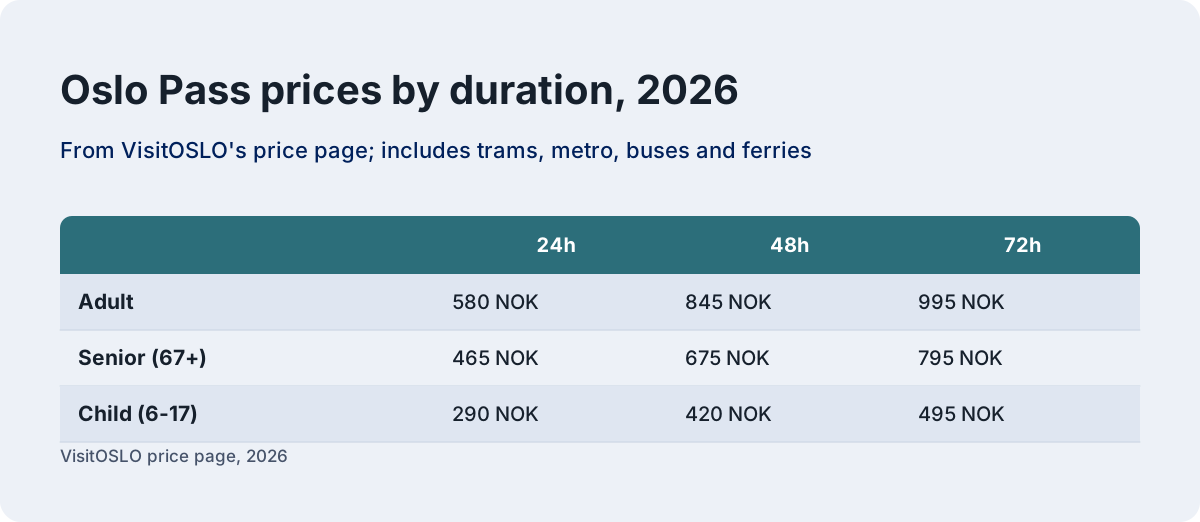
The 2026 pass prices, from VisitOSLO's own price page:
| Pass | 24h | 48h | 72h |
|---|---|---|---|
| Adult | 580 NOK | 845 NOK | 995 NOK |
| Senior (67+) | 465 NOK | 675 NOK | 795 NOK |
| Child (6-17) | 290 NOK | 420 NOK | 495 NOK |
Whether the pass pays off depends on your museum density. Three Bygdøy museums at full price, Kon-Tiki at 180 NOK, the Fram Museum at 180 NOK and the Norwegian Museum of Cultural History at 200 NOK, come to 560 NOK on their own, against a 580 NOK 24-hour pass that also carries you there and back on the tram, bus or ferry. Add a fourth stop, or the airport train on arrival or departure day, and the arithmetic tips decisively. The full breakdown, including which museums are covered and which are not, is in our is the Oslo Pass worth it guide.
If your arrival is late, your flight lands outside the Vy timetable's convenient window, or you are traveling with more luggage than a tram seat can absorb, a prebooked private transfer is the comfortable alternative. It costs more than any train, but it is door to door, and free cancellation means a delayed flight does not strand the booking.
Tram, Metro, Bus or Walking: Which Should You Actually Use?
Use the tram for surface journeys through the center and along streets you want to see, use the metro for speed and for the northern and western fringes, use the bus for the places neither rail mode reaches such as Bygdøy, and walk wherever the distance is under a kilometer, because central Oslo is compact and the tram's stop density makes it slower than your own feet for very short hops.
The division of labor is cleaner than most visitors expect. The T-bane is the express layer: fewer stops, tunnels in the center, and the whole network inside zone 1, which means Frognerseteren at the edge of Nordmarka and Sognsvann at the lake are both single-zone destinations. The tram is the local layer, stopping every few hundred meters and staying in the daylight. The bus network fills the gaps, and one gap matters more than the rest: Ruter bus 30 is the year-round service to the Bygdøy museums, because the seasonal ferry from Rådhusbrygge 3 only runs from mid-March to early October and does not accept ordinary Ruter tickets.

A rough guide to which mode wins, holding the verified facts about zones and coverage:
| Journey | Best mode | Why |
|---|---|---|
| Central Oslo to Grünerløkka | Tram or walk | Short surface distance, frequent stops |
| Central Oslo to Holmenkollen | Metro, line 1 | Entire metro network is inside zone 1 |
| Central Oslo to Bygdøy museums | Bus 30, or ferry in season | Ferry runs 14 March to 4 October 2026, Ruter tickets not valid on it |
| Central Oslo to the islands | Ferry from Aker Brygge | Ordinary Ruter ticket covers lines B1, B1X and B2 |
| Central Oslo to Gardermoen | Vy train | Zone 4N, covered by Oslo Pass, about 23 minutes |
| Anywhere under 1 km | Walking | Central Oslo is compact, trams stop often |
One warning about the islands, because it is the most confused topic in Oslo transport. The Bygdøy museum ferry and the Oslofjord island ferries are different systems with different ticket rules, leaving from different piers. The island ferries, lines B1, B1X and B2, are Ruter services departing from Aker Brygge, and an ordinary ticket covers them. The Bygdøy ferry leaves from Rådhusbrygge 3, is run by a private operator, does not take Ruter tickets, and does take the Oslo Pass. Our Oslo ferries guide untangles the whole thing.
For travelers who prefer a guided version of the same streets, the free walking tours cover the center on foot with a local explaining what the tram window only shows:
Where the Tram Actually Takes You
The tram network reaches most of the neighborhoods a visitor wants: the grid streets of Grünerløkka, the museum cluster around Frogner and Majorstuen, the waterfront at Aker Brygge and Tjuvholmen, and the eastern districts around Tøyen and Grünerløkka's edges. It does not reach Bygdøy, which is a bus or ferry peninsula, and it does not reach the northern forest, which belongs to the metro.
Thinking in neighborhoods rather than lines makes the network easier to use. In the west, trams serve the Frogner and Majorstuen side, which puts you within walking distance of the Vigeland sculpture park, and it is worth stating plainly that the park itself is free, open 24 hours a day, all year, with no ticket of any kind. The separate Vigeland Museum charges 120 NOK, and keeping the two apart in your planning saves genuine confusion at the gate. The rest of the planning pages sit on Oslo Travel Guide. The rest of the planning pages sit on Oslo Travel Guide.

In the east, the tram lines thread Grünerløkka, the former workers' district that is now the city's densest strip of cafes, bars and independent shops. It is the neighborhood most worth riding to rather than through, and our Grünerløkka area guide maps the blocks worth the trip. South of the center, the waterfront around Aker Brygge and Tjuvholmen connects to the island ferry piers, and the Aker Brygge guide covers the waterfront stretch.
A half-day pattern that uses the tram well: ride to Majorstuen, walk through Frogner to the Vigeland park, ride back toward the center, and finish on foot along the waterfront. A full-day pattern that mixes modes: the same morning, then bus 30 or the ferry to Bygdøy for Kon-Tiki and the Fram Museum in the afternoon. Both Kon-Tiki and Fram charge 180 NOK adult, children pay 70 at each, and a combined Kon-Tiki plus Fram ticket costs 325 NOK, so the Oslo Pass arithmetic from earlier applies again.
The Airport Question: Tram, Train or Transfer?
No tram runs to Gardermoen. The airport is 50 km north of the city in Ruter zone 4N, and the rail link is the train: Flytoget, the airport express, costs 268 NOK adult and takes about 20 minutes, while Vy's ordinary trains take about 23 minutes, cost roughly half as much, and are covered by both a multi-zone Ruter ticket and the Oslo Pass. A private transfer is the third option, door to door, at a premium.
The train choice is where visitors lose the most money per minute of research. Flytoget is the premium product: departures every 10 minutes, roughly 20 minutes to Oslo S, 268 NOK adult, with children under 16 free alongside an adult. Vy's regional and local trains call at the same airport station, take about 23 minutes, and Vy itself frames the trade as three to four minutes slower for usually about half the price. The mechanism most guides miss is that these are ordinary Ruter-zone trains: a Ruter ticket covering zone 1 through 4N is valid on them, and the Oslo Pass covers them outright. Buying Vy's own point-to-point fare at the machine is the expensive way to take the cheap train.

| Option | Adult cost | Time to center | Notes |
|---|---|---|---|
| Flytoget express | 268 NOK | About 20 min | Every 10 minutes, not on the Oslo Pass |
| Vy train | About half of Flytoget | About 23 min | Covered by Oslo Pass and multi-zone Ruter ticket |
| Flybussen coach | Confirm on the operator's site | 45-65 min, traffic dependent | Slower road option |
| Private transfer | From the operator's listing | About 1 hour | Door to door, bookable in advance |
Once you are at Oslo S or Nationaltheatret with your luggage, the tram network takes over, and that final leg is where a transfer earns its price. Changing from a long-haul flight to a train to a tram with suitcases is three friction points, and a prebooked car removes all of them. The full comparison, including the exact fare mechanics and where each train stops, is in our Oslo airport to city centre guide and the head-to-head in Flytoget vs Vy.
Construction, Disruptions and What Is Changing
Ruter reported continued infrastructure works into 2026, including upgrades on the Lilleakerbanen tram line on the west side, and the Nye Oslo S redevelopment of Oslo Central Station was in public consultation during 2026 with hearings in April and May. Fares rose with an annual adjustment on 25 January 2026, in line with an estimated 3.5 percent municipal-sector rise, before the 30-day pass was cut from 805 to 655 NOK on 3 May 2026.
For a visitor, two of those items matter. The west-side tram works can substitute buses for trams on affected stretches, so check the Ruter app on the day if your route runs west. And anything around Oslo S affects the interchange between the airport trains, the metro and the trams, so allow a few extra minutes for transfers there during the consultation and construction period.

None of this makes the network hard to use. It makes the app non-optional. Ruter's own journey planner is the source of truth for disruptions, and it is also the tool that counts your zones correctly, which, as covered earlier, is not something to do by hand.
When a Tram Ride Is Not Enough: Guided Alternatives
A tram ticket moves you but explains nothing, and for some visits that is a real loss. A guided walk covers the center's history at walking pace, a bike tour covers roughly three times the ground in the same hours, and a full-day bus and fjord combination packages the city's headline sights plus the water into one booked, timed product. The tram is the cheapest of these options and the only one that runs all day without a reservation.
The honest comparison is not price against price, it is structure against freedom. A tram day is improvised: you decide at each stop whether to get off. A guided day is fixed: someone else has already made the sequence work, and in a city where the sights are spread along a waterfront and up a hillside, a made sequence has genuine value. The bike tour is the middle case, structured but outdoors, and it suits Oslo's summer, when the long daylight, 18 hours 50 minutes at the summer solstice against 5 hours 53 minutes at the winter solstice, rewards being outside.

| Format | Duration | Best for |
|---|---|---|
| Tram with a day pass | Open ended | Independent travelers, repeat rides, tight budgets |
| Free walking tour | About 2 hours | First-time visitors who want the center explained |
| Bike tour | 3 hours | Warm-season visitors who want coverage plus guidance |
| Full-day bus and fjord combo | 7 hours 30 minutes | Cruise passengers and one-day visitors |
The bike option deserves its own word, because it is the closest thing to a tram alternative that adds something:
And the full-day combination is the answer for the visitor with exactly one day and no appetite for timetable research. It pairs the city's sights by bus with a fjord cruise, which is the other half of Oslo that the tram cannot touch, and the fjord products are covered in depth in our Oslofjord cruise guide.
For the airport leg specifically, the transfer remains the comfort answer:
Before you commit to any of these, the basics are worth one more pass: the Oslo Pass guide for the museum-and-transport bundle, and is Oslo expensive for the honest cost picture, where Norway ranks sixth in Europe on price level and alcohol and tobacco run at more than double the European average, while museums, transport and the outdoors are where the city is genuinely reasonable.
If your trip is still taking shape, these three cover the airport leg, the hop-on loop and the full-day package:
Common Questions About the Oslo Tram
Does one ticket cover the tram, bus and metro in Oslo?
Yes. A Ruter ticket is valid on trams, buses, the T-bane metro and the scheduled island ferries for the zones you have paid for. A single zone 1 ticket is valid for 60 minutes from activation, with 30 minutes added for each additional zone.
Can I buy a tram ticket on board?
No. Trams do not sell tickets, and on-board purchase exists only on buses and boats, costs more, and accepts small notes only. Buy in the Ruter app before you board; it is the cheapest channel.
Does the Oslo Pass cover the tram?
Yes. The Oslo Pass includes public transport in zones 1, 2, 3, 4V and 4N, covering trams, buses, the metro and the island ferries, plus Vy trains to and from Oslo Airport Gardermoen. It does not cover Flytoget or Flybussen.
Does the tram go to the Oslo airport?
No. Gardermoen is 50 km north in zone 4N and is served by train, not tram. Flytoget takes about 20 minutes at 268 NOK adult, and Vy trains take about 23 minutes at roughly half the price, covered by the Oslo Pass and by a multi-zone Ruter ticket.
Does the tram go to the Bygdøy museums?
No. Bygdøy is served by Ruter bus 30 year-round and by the seasonal museum ferry from Rådhusbrygge 3, which runs from 14 March to 4 October 2026. The ferry does not accept ordinary Ruter tickets but does accept the Oslo Pass.
Is the Oslo tram good for sightseeing?
Yes, as a cheap surface ride through the center and neighborhoods like Grünerløkka and Frogner. It is slower than the metro and stops often, so for very short hops walking is faster, and for commentary a guided walk or bus tour adds what a tram window cannot.