Oslo Torp and Sandefjord Airport: What It Actually Means for Your Trip
Oslo Torp is the airport that is not in Oslo. Knowing that before you book is the difference between a cheap flight and an expensive day.

Short answer
Oslo Torp is the marketing name for Sandefjord Airport Torp, a regional airport in Vestfold, well over an hour from Oslo by road. Budget airlines fly there, and the fare savings can be real, but the transfer is the trade-off. Compare the total door-to-door cost against Gardermoen before you book, not just the ticket price.
What Is Oslo Torp, and Why Is It Not in Oslo?
Oslo Torp is the commercial name for Sandefjord Airport Torp, a regional airport near the town of Sandefjord in Vestfold, southwest of Oslo, and the "Oslo" in its name is marketing geography rather than a description of where it sits. The airport serves the Vestfold region first and budget flights to Oslo second, and the transfer between the two is the single biggest decision your ticket buys you. That is not a reason to avoid it, because the fares that land there are often genuinely lower than anything into the main airport. It is a reason to price the whole journey, not the flight alone. Plenty of visitors have saved real money through Torp, and plenty have spent the saving on the road.
The naming convention confuses people every single day, and it is worth being blunt about it. Norway has two airports that sell themselves on Oslo while sitting a long way from the city, Torp near Sandefjord and Torp's east-coast counterpart further out along the same logic. When a search engine shows you "Oslo (TRF)", the code is honest even when the name is not. The main airport, Oslo Gardermoen, is the one that actually sits close to the capital, roughly 50 km north of the centre, with a dedicated airport express train covering the distance in about 20 minutes.
Torp's home region is not a consolation prize, either. Sandefjord is a coastal town with its own identity, and Vestfold is one of Norway's more accessible stretches of coastline. If your trip is actually about the south coast, or about splitting time between Oslo and the fjords of the west, Torp can be the more sensible airport even before price enters the equation. The problem is only ever the distance, and the distance is only a problem if you did not plan for it.
The honest framing for the rest of this guide is simple. Decide what your trip is, then decide which airport serves it, then decide whether the fare difference survives the transfer cost. Everything else is detail, and the detail follows.
Torp or Gardermoen: Which Airport Should You Fly Into?
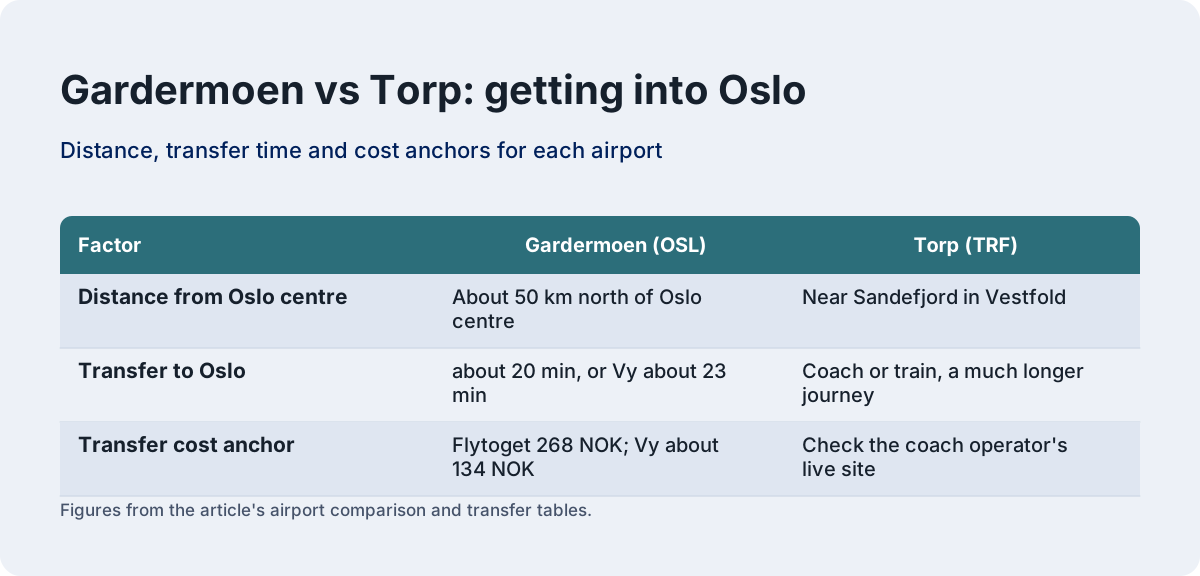
Choose Gardermoen if Oslo itself is your destination and your time is short, because it sits 50 km from the centre with a 20-minute airport train; choose Torp when the fare saving is large, when you are heading to Vestfold or the south coast, or when an extra hour or two each way is a fair price for a much cheaper ticket. The wrong answer is picking on ticket price alone, which is how people end up paying more in total for a "cheap" flight. The right answer is a two-minute comparison of the full door-to-door cost, and the table below is that comparison.
The two airports serve genuinely different travellers. Gardermoen is the main international hub, with the full range of full-service carriers, the airport express train, and the ordinary Vy regional trains that run on the same tracks. Torp is a base for low-cost carriers, and the aircraft that land there are the aircraft that made European city breaks affordable. Neither is a trap. Both are good at what they do, and what they do is not the same thing.

| Factor | Oslo Gardermoen (OSL) | Oslo Torp / Sandefjord (TRF) |
|---|---|---|
| Where it actually is | About 50 km north of Oslo centre | Near Sandefjord in Vestfold, far southwest of Oslo |
| Main carriers | Full-service and low-cost, the main hub | Mostly low-cost carriers |
| Transfer to Oslo | Airport express train about 20 min, or Vy trains about 23 min | Coach or train connections, a much longer journey |
| Transfer cost anchor | Flytoget 268 NOK adult single; Vy about half that | Check the coach operator's live site before booking |
| Best for | Short Oslo trips, first visits, tight schedules | Cheap fares, Vestfold, the south coast, flexible plans |
| Worst for | Paying full fare when Torp was half the price | A one-night Oslo whirlwind with no time to spare |
That last row is the one people skip. A one-night Oslo trip through Torp can spend more of its total budget on transfer than a Gardermoen arrival spends on its entire airport train leg, and it pays the cost in hours rather than kroner. Conversely, a family flying in for a week can bank a serious saving and use the transfer day as part of the trip rather than a delay before it starts. If you are still building the itinerary, our one day in Oslo planning guide shows what a short visit can realistically hold.
How Do You Get from Torp Into Oslo?
The standard route is an airport coach between Torp and Oslo, timed around flight arrivals, with rail connections via Sandefjord station as the practical alternative, and the whole journey is measured in hours rather than the minutes that Gardermoen travellers enjoy on their dedicated express line. Coaches meet the budget flights that dominate Torp's schedule, so the connection is designed for those arrivals rather than running to a fixed timetable you can rely on blind. Book the coach on the operator's own site, check the last departure of the day against your landing time, and treat any tight onward connection in Oslo as unwise rather than ambitious.
The rail option needs one more moving part. The train runs from Sandefjord towards Oslo along the Vestfold line, and the airport sits a shuttle or taxi ride away from the station itself. For a traveller with luggage and a schedule, the coach is usually the simpler answer precisely because it starts at the terminal. For a traveller with time, or one heading somewhere the coach does not go, the train is the more flexible leg, and it lands at the same central Oslo stations every other train uses.

Once you arrive in the capital, the transport system is the easy part. Oslo's buses, trams, metro and ferries run on one integrated ticket system, Ruter, with central Oslo in zone 1 and the whole metro network inside it. A single zone 1 ticket is valid for 60 minutes from activation, and validity grows by 30 minutes for each additional zone. Buy in the app, because tickets bought on board buses and boats cost more. Our getting around Oslo guide and the Ruter tickets explained page cover the details.
| Leg | What it is | What to know |
|---|---|---|
| Torp to Oslo coach | Airport coach timed to arrivals | Book on the operator's site; check the last departure of the day |
| Torp to Sandefjord station, then train | Shuttle plus the Vestfold line rail service | More flexible, more moving parts with luggage |
| Oslo arrival point | Oslo Bus Terminal or central rail stations | Central, walkable, on the Ruter network |
| Gardermoen comparison | Flytoget 268 NOK, about 20 min; Vy about 134 NOK, about 23 min | The benchmark your Torp saving has to beat |
One comparison worth making in advance: the airport transfer question at Gardermoen has a well-known answer, and the Flytoget versus Vy comparison explains why the ordinary Vy train costs roughly half the airport express for three extra minutes of journey. If your Torp fare saving is smaller than the transfer premium you pay for the longer road in, the arithmetic has already decided your airport.
There is a third option that removes the timetable from the equation entirely. A pre-booked private transfer meets you at arrivals and drives you door to door, which matters most on late landings, with children, or when the last coach of the day is a risk you would rather not run. The transfer product on our roster runs from Oslo's main airport, so Torp travellers should confirm the pickup area on the operator's live listing before relying on it, but the format itself is the stress-free answer to a long arrival day.
Is a Long Layover at Torp a Problem or an Opportunity?
A long wait at Torp is an opportunity only if you plan it, because the airport is small with limited amenities, while Sandefjord itself and the Vestfold coast are close enough that a half-day gap can become the best part of the journey. The airport's size cuts both ways: security is quick and walking distances are short, but there is not much to do airside, and a six-hour gap filled at the gate is a wasted afternoon by any standard. The honest advice is to leave the airport if your window allows and the logistics cooperate.
Sandefjord is a genuine coastal town, with a harbour, a waterfront, and the whaling heritage that shaped the region. The town centre is close enough to the airport that a taxi or local bus makes it practical for a half-day, and a walk along the water beats any airport lounge built. Further afield, Vestfold's coastline runs with small towns and beaches, and Tønsberg, Norway's oldest town, sits in the same region. If your trip has a spare day and a hire car or a willingness to ride local buses, the area rewards the detour.

The planning rule is the same one that governs the whole Torp question: build the wait into the trip instead of treating it as dead time. A morning landing with an evening connection is not a layover, it is a bonus day on the Norwegian coast. A two-hour gap is a coffee and a book, and the airport will serve that much comfortably. The failure mode is the middle case, the four-hour gap assumed away at booking and regretted at the gate.
Is Sandefjord Worth Visiting in Its Own Right?
Yes, if your interests run to coastal towns, maritime history and an unhurried pace, and no, if you came for the things Oslo is famous for, because Sandefjord is a regional destination that complements the capital rather than substituting for it. The town's identity was built on whaling and the sea, its museum tells that story, and its waterfront is the pleasant kind rather than the tourist-trap kind. It is a place to slow down, not a place to sightsee at speed.
The practical case for pairing the two is decent. Fly into Torp, spend a night or two on the coast, then take the train or coach into Oslo for the city half of the trip, and you have seen two Norways for the price of one airport. The train line connects the region to the capital, so the pairing does not require a car. Travellers who do this tend to describe the coast portion as the surprise of the trip, which is what a well-chosen second stop is supposed to feel like. The full index of guides sits on Oslo Travel Guide. The full index of guides sits on Oslo Travel Guide.

What Sandefjord cannot do is replace the capital's headline sights. The Vigeland sculpture park is in Oslo's Frogner district, free to enter and open 24 hours a day all year, with over 200 sculptures. MUNCH, the National Museum with The Scream, the Opera House roof you can walk on for free, the Akershus Fortress, all of it is in the city. If those are why you are flying to Norway, budget your Oslo days first and treat the coast as the bonus, not the other way round.
What Does an Oslo Trip Through Torp Actually Cost?
The flight may be cheap, but Norway itself is not: Statistics Norway's 2025 price level survey puts the country sixth in Europe, with household-facing prices 28.6% above the EU average, food 33% above, and alcohol and tobacco more than double the European average. Those are the numbers that should shape your budget, because they apply identically whether you land at Gardermoen or Torp, and they dwarf the transfer arithmetic. The airport choice saves or costs you a few hundred kroner each way. The country costs what it costs.
The places the money goes are predictable once you know the pattern. Restaurants and alcohol are the expensive line items; the SSB survey's finding on alcohol and tobacco is the single number that explains every Norwegian bar tab. Museums, public transport and the outdoors are where Oslo is genuinely reasonable, and several of the best sights cost nothing at all. The Opera House roof, the Vigeland park, the harbour islands on an ordinary Ruter ticket: the free and cheap end of Oslo is unusually strong for a capital with this price level.

| Cost item | Typical level | Notes |
|---|---|---|
| Alcohol and tobacco | More than double the EU average | SSB 2025 price level survey |
| Food and non-alcoholic drinks | 33% above the European average | SSB 2025 price level survey |
| Overall price level | 28.6% above the EU, sixth in Europe | SSB 2025 price level survey |
| Museums | Moderate by Norwegian standards | e.g. Fram 180 NOK, Kon-Tiki 180 NOK, MUNCH 280 NOK adult |
| Public transport | Reasonable | Zone 1 covers central Oslo and the whole metro |
| The outdoors | Free | Vigeland park, Opera House roof, harbour islands |
The Oslo Pass is the one tool that turns the museum line in your favour, and its 2026 prices are 580 NOK for 24 hours, 845 NOK for 48 hours and 995 NOK for 72 hours at adult rate. It covers entry at over 30 museums and attractions, plus public transport in zones 1, 2, 3, 4V and 4N, including the Vy trains to and from Oslo Airport Gardermoen, though not the Flytoget airport express. Three Bygdøy museums at full price already come to 560 NOK, so a museum-heavy day can break even on the 24-hour pass before you count a single tram ride. Our is the Oslo Pass worth it guide runs the full break-even maths.
How Should You Plan Your First Day Arriving Through Torp?
Treat the transfer as the first act of the trip rather than a delay before it, arrive in Oslo by early afternoon, and spend the first evening on the things that cost nothing and stay open late: the harbour, the Opera House roof, and the long summer light. A Torp arrival that reaches the city centre by mid-afternoon still leaves a full evening, and Oslo is unusually kind to evening arrivals because so much of its best material is outdoors and un-ticketed. The mistake is planning a museum-heavy first half-day that the road has already eaten.
The seasonal dimension matters more here than at most airports, because Oslo's daylight swing is extreme. On 21 June the sun rises at 03:53 and sets at 22:43, giving 18 hours 50 minutes of daylight and no true darkness in between, while on 21 December the day lasts 5 hours 53 minutes, from 09:18 to 15:11. A winter arrival through Torp that reaches Oslo at 16:00 has already run out of daylight, and the plan should shift to indoor sights and dinner. A June arrival at the same hour has an entire golden evening ahead of it.

For the first full day in the city, the choice is between doing it yourself and letting someone else drive. A hop-on hop-off bus covers the headline sights at your own pace, and the Gray Line product on our roster is the credible version of that format, rated far above the rival city-sightseeing operation. For a single compressed day, the full-day bus and fjord combination tour bundles the city overview with a fjord cruise, which is the classic first-timer package and a sensible fit for a trip that spent its first hours on a coach from Vestfold.
If your Oslo time is genuinely one day, be realistic about geography. The Bygdøy museum peninsula alone can absorb a full morning, and the Bygdøy guide explains the seasonal ferry and the year-round bus 30. The Oslo in one day itinerary sequences the city for exactly this situation, and the how many days in Oslo page is the honest answer to whether one is enough. For most people arriving through Torp, it is not, and two or three days repay the transfer.
What About Money, Phones and the Practical Basics?
Norway is in the Schengen Area but not in the European Union, it is an EEA state through EFTA, and it uses the Norwegian krone, not the euro, so budget in NOK and expect card payments everywhere but euros nowhere. That sentence covers the three questions that catch visitors off guard, and it matters at both airports equally. Schengen arrivals from within the area face no routine passport check, the 90/180 rule applies, and because Norway sits outside the EU customs union and EU VAT, duty-free allowances apply even arriving from EU countries and non-resident visitors can claim a VAT refund on qualifying purchases.
Practical Norway is otherwise friendly to the unprepared. English is close to universal in Oslo, tap water is excellent, and card terminals are the default everywhere from museum desks to market stalls. Cash is close to unnecessary, though a little never hurts in a pinch. Tipping is not expected, service is included in prices, and rounding up or leaving something for genuinely good service is a voluntary norm rather than an obligation.

Two Norwegian quirks are worth knowing before your first evening. Wine and spirits are sold only through Vinmonopolet, the state monopoly, which closes on Sundays and public holidays and shuts early on Saturdays, while supermarkets sell only beer and cider up to a low strength limit and stop selling at a fixed evening time. If your Torp arrival day ends with a plan of buying a bottle for the hotel room, that plan needs to survive contact with Norwegian opening hours. Our Oslo currency and cash guide covers the money side in full.
Torp, Gardermoen or a Different Airport Altogether?
For most trips centred on Oslo, Gardermoen wins on time and simplicity, Torp wins on fare whenever the saving is large or the trip touches Vestfold, and the decision should always be made on total cost and total hours, never on the ticket price alone. The third option, Torp's east-coast rival serving the same "Oslo" branding logic from the other direction, belongs in the same calculation, and the full Oslo airports guide covers all of them side by side. The airport is a means, and the means should serve the trip you actually planned.
The pattern across everything in this guide is that Norway rewards planners and quietly taxes improvisers. The Torp transfer, the Vinmonopolet hours, the winter daylight, the museum combination tickets: none of it is hidden, but all of it punishes the assumption that Norway works like the country you flew from. A traveller who read this far has already done the planning that matters, and the rest, as the Norwegians would say if they were the sort to say things like that, is just the road.
Whichever airport wins your booking, the first hours in the city set the tone for everything after them. The full-day bus and fjord combination is the product that compresses the most Oslo into a single ticket, and it pairs naturally with a Torp arrival that has already spent its morning on the road.
Common Questions About Oslo Torp and Sandefjord
Is Oslo Torp actually in Oslo?
No. Oslo Torp is the commercial name for Sandefjord Airport Torp, a regional airport near Sandefjord in Vestfold, well over an hour from Oslo by road. The "Oslo" in the name is marketing geography, and the transfer time is the trade-off for the cheaper fares that land there.
How far is Torp from Oslo city centre?
Torp sits near Sandefjord, far southwest of Oslo, and the transfer is measured in hours rather than the roughly 20 minutes the airport train needs from Gardermoen. Check the coach operator's live timetable for exact journey times on your travel date, and plan onward connections with that margin in mind.
Is it cheaper to fly into Torp than Gardermoen?
The flight usually is, and the total journey sometimes is. Price the ticket plus the transfer plus your time before deciding, because the saving can disappear into the longer road. Gardermoen's cheapest rail option, the Vy train at about 134 NOK, sets the benchmark your Torp saving has to beat.
How do I get from Torp to Oslo?
The standard route is the airport coach timed around flight arrivals, with rail connections via Sandefjord station as the alternative. Book the coach on the operator's own site, check the last departure of the day against your landing time, and consider a pre-booked private transfer for late arrivals or heavy luggage.
Is Sandefjord worth visiting before or after Oslo?
Yes, if coastal towns, maritime history and a slower pace appeal. Sandefjord's harbour and whaling heritage make it a genuine destination, and pairing a coast night with your Oslo stay splits the trip into two Norways without needing a car.
Does the Oslo Pass cover the Torp transfer?
No. The Oslo Pass covers public transport in Ruter zones 1, 2, 3, 4V and 4N, including the Vy trains to and from Oslo Airport Gardermoen, but the Torp transfer runs outside that system. The pass is for your days inside Oslo, not the road to it.