Norway in a Nutshell: The Full Fjord Day Trip from Oslo
Norway in a Nutshell is the famous round trip that strings a scenic rail line, a descent into the fjords and a boat ride on the Sognefjord into one very long day from Oslo. Here is how the route works, what it costs, and when a shorter Oslofjord trip is the smarter call.
Short answer
Norway in a Nutshell is a self-assembled round trip from Oslo using scheduled trains, the Flåm Railway and a Sognefjord boat. It takes about 15 hours door to door and the fully guided private version runs from $1060.98 per person. The route is genuinely spectacular, but it is a long day, so plan the season and the booking route before committing.
The name "Norway in a Nutshell" is not a single ticket or a single tour. It is a route, stitched together from ordinary scheduled trains, the famous Flåm Railway and a boat on the Sognefjord, that VisitOSLO and the rail operators have packaged and promoted for decades as the one-day answer to seeing the fjords from Oslo. The result is a day that runs roughly 15 hours from your hotel door back to the same spot, and it is the single most asked-about excursion in the city.
This page walks the route leg by leg, prices it honestly, and tells you when to take it and when the Oslofjord outside your hotel window is the better fjord answer. If you want the short version first: the route works, the scenery is real, and the main decision is whether you book it as a self-guided string of tickets or as one guided package.
What Exactly Is the Norway in a Nutshell Route?
Norway in a Nutshell is a marketed round trip combining the Bergen Railway from Oslo or Bergen, the steep branch line down to Flåm, a boat on the Aurlandsfjord and Nærøyfjord arms of the Sognefjord, and a connecting bus and train back to your starting point. It is not one product: you buy the legs yourself or buy a package that assembles them. Most travellers start and finish in Oslo, which makes it a very long but doable day trip.
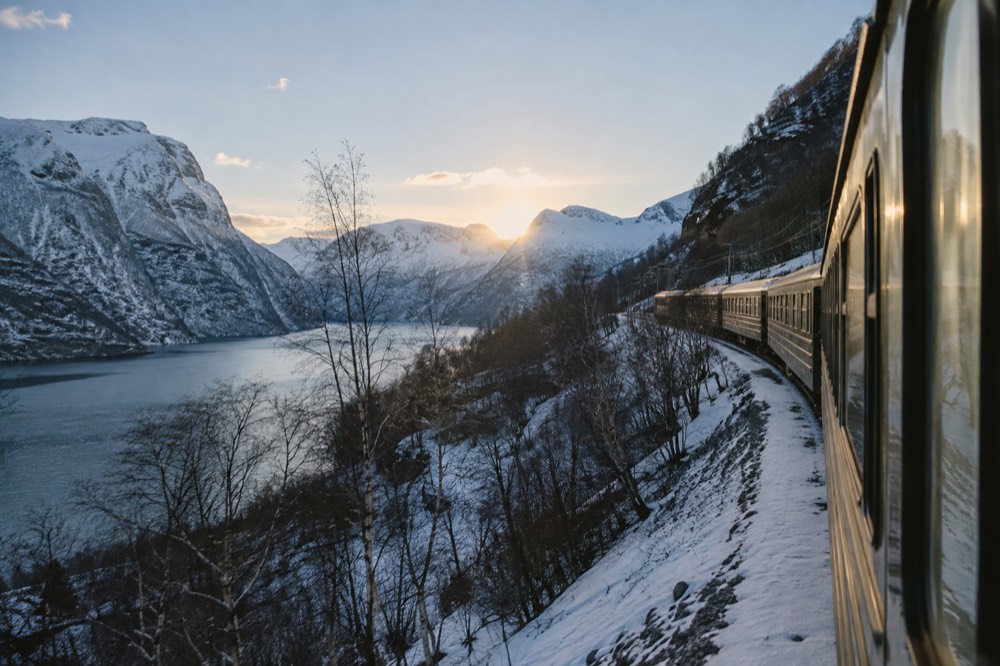
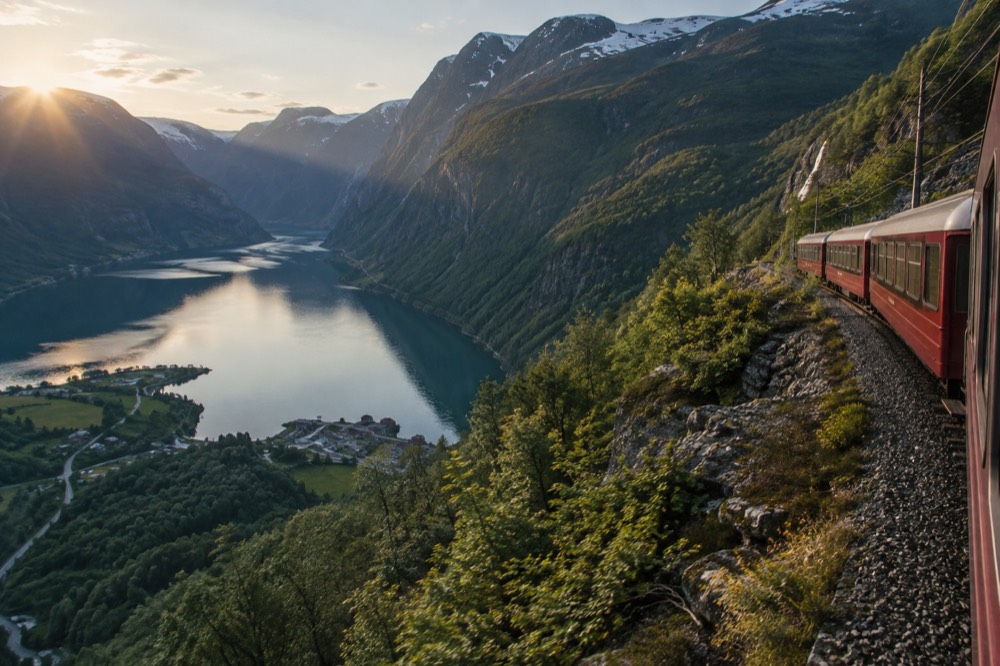
The classic Oslo version runs like this. You leave Oslo on the Bergen Railway in the early morning, riding the mountain stretch across the Hardangervidda plateau to the junction station at Myrdal, which sits high in the mountains. At Myrdal you change to the Flåm Railway, a 20 km branch line that drops steeply from the mountain station down to sea level at the village of Flåm, at the head of the Aurlandsfjord, through tunnels, past waterfalls and along cliff ledges. From Flåm you board a fjord boat through the Aurlandsfjord and the UNESCO-listed Nærøyfjord, the narrowest of the big fjord arms, to Gudvangen. A bus climbs the Stalheimskleiva road up from Gudvangen to Voss, and from Voss a train carries you back toward Bergen or, on the Oslo loop, back east the same evening.
The genius of the concept, and the reason it has survived since the era of package tourism, is that every leg is a scheduled public service. Nothing runs only for tourists. The Bergen Railway is a mainline train, the Flåm boats are ordinary fjord ferries, and the Stalheim bus is a public route. That also means the connections are tight by design, and a delay on one leg can ripple through the whole chain, which is the honest argument for letting someone else own the logistics.
For the full detail on the branch line that most people call the highlight, read our Flåm Railway guide, and for the wider picture of every fjord option reachable from the capital, start with fjord day trips from Oslo.
Is Norway in a Nutshell Worth It as a Day Trip from Oslo?
For most first-time visitors with only Oslo as a base, yes, with two caveats. The scenery on the Flåm Railway and the Nærøyfjord is genuinely world class and cannot be seen from Oslo itself. The caveats are the length, about 15 hours door to door, and the fact that you see it mostly through windows and from decks rather than on foot, which suits some travellers far better than others.
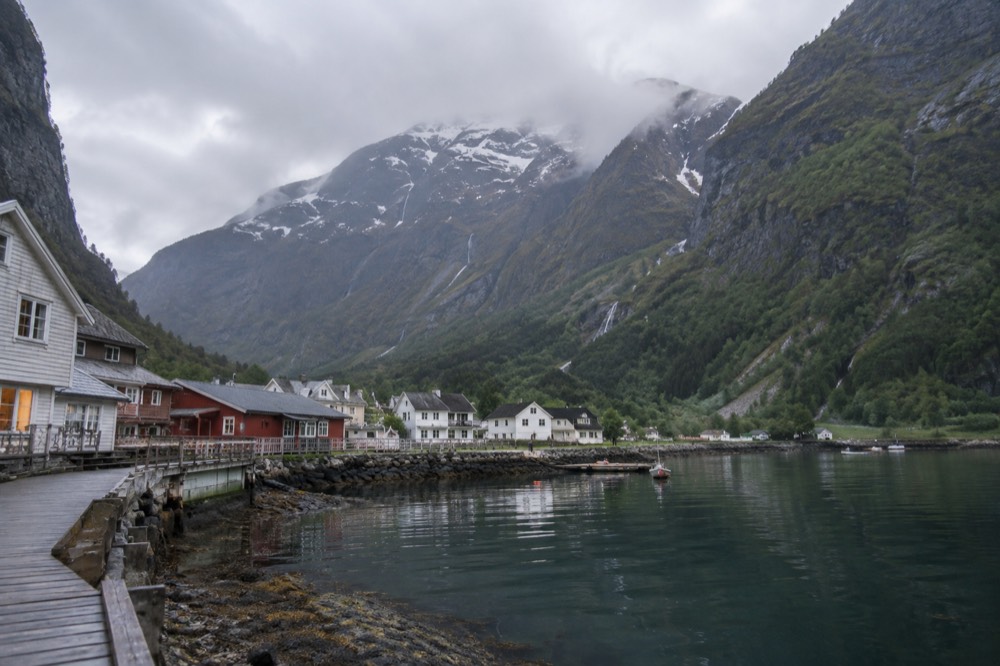
The honest case for it is simple: the Sognefjord system is the deepest and longest fjord reach in the country, and the Nærøyfjord is the fjord that UNESCO inscribed, the one the postcards are drawn from. Nothing within a day trip of Oslo in any other direction matches it. The Oslofjord is a low, wooded, island-studded inlet, pleasant and swimable, but it is not the cliff-walled fjord of the brochures. If the dramatic fjord landscape is the reason you came to Norway, this route is the most efficient way to stand in front of it without relocating to Bergen.
The honest case against is the pace. You spend the overwhelming majority of the day in transit. Stops are short, the Myrdal connection can be minutes, and by the time you are back in Oslo it is late evening. Travellers who like to linger, photograph slowly, or eat a real lunch often come back feeling they saw a highlights reel rather than a place. Families with small children and anyone who hates early starts should think hard before committing.
There is also a season question. The route runs year round, but the experience changes completely with the light and the weather, and midwinter means doing the most scenic stretches in the dark at both ends. Our Oslo daylight hours guide has the month-by-month numbers, and the short version is brutal: around the winter solstice Oslo sees well under six hours of daylight, and the mountains see less.
How Do You Book Norway in a Nutshell from Oslo?
You have three realistic routes: buy each leg separately from the operators, buy a packaged version from a tour reseller, or book a fully guided private round trip that handles every connection. Self-booking is cheapest and most flexible, the package removes the connection risk, and the private guided version, from $1060.98 per person for the full day, is the only option where a guide manages the whole chain for you.
Self-booking means buying the Bergen Railway ticket from Vy, the Flåm Railway ticket from its own operator, the fjord boat from the fjord cruise operator, and the bus from the county transport authority, then trusting the published timetables to connect. It works, thousands of people do it every summer, and the savings can be real. The risk is concentrated in one place: if the train from Oslo is late reaching Myrdal, the Flåm Railway will not wait, and rebooking the rest of the day is your problem, in Norwegian, by phone.
Packaged versions, sold through resellers and the official travel trade, bundle the same legs into one booking with a fixed itinerary. You still travel on the same trains and boats as everyone else, but the operator owns the connections and sorts out any disruption. For most visitors who are not confident with Norwegian rail booking sites, this is the pragmatic middle path.
The third route is the one this site can actually point you at. A private guided round trip from Oslo to the Sognefjord and back, including the Flåm Railway, is the highest-rated fully guided version of the day available from the capital. It is not cheap, it is a private day with a driver-guide, and that is precisely the point: nothing is left to a missed connection.
One practical note that belongs here and nowhere else in this article: check what your payment and cancellation terms are before you book any version. Fjord itineraries are weather- and disruption-sensitive, and knowing whether you can cancel or move the day is worth more than a small saving on the fare.
What Does a Fjord Day Trip from Oslo Look Like Hour by Hour?
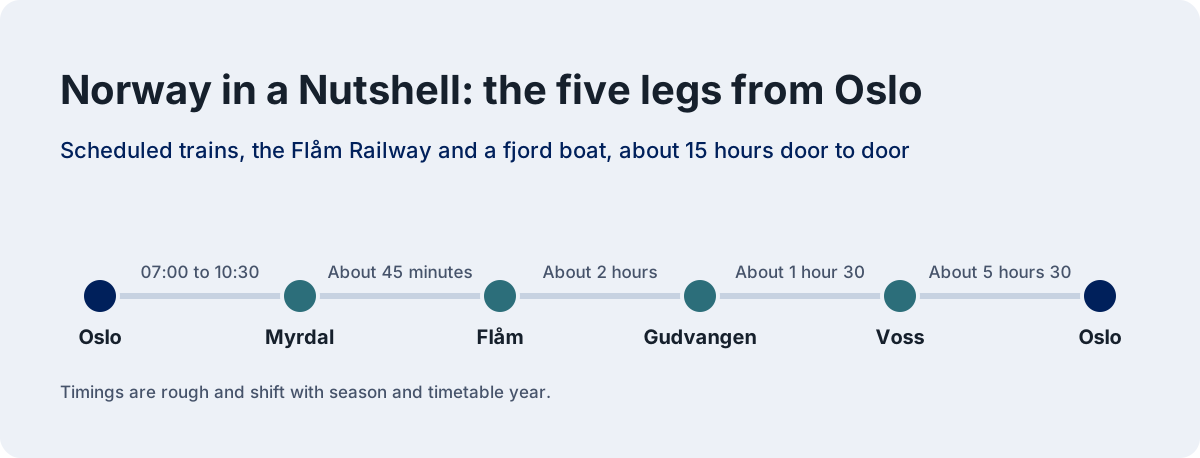
A fjord day trip from Oslo on the Nutshell route starts before 07:00 with the Bergen Railway from Oslo Central Station, changes at Myrdal onto the Flåm Railway by mid-morning, boards the fjord boat at Flåm around noon, reaches Gudvangen by mid-afternoon, and returns through Voss and the mountains to arrive back in Oslo between 22:00 and 23:00. The exact times shift with the season and the timetable year, so treat the shape, not the clock, as the plan.
The table below is the shape of the day. Confirm exact departure times against the current timetable when you book, because the first train out of Oslo and the last train home are the two fixed anchors everything else hangs on.
| Leg | Transport | Rough timing | What you see |
|---|---|---|---|
| Oslo to Myrdal | Bergen Railway | 07:00 to about 10:30 | Hardangervidda plateau, mountain lakes, snow fence |
| Myrdal to Flåm | Flåm Railway | About 45 minutes | Steep descent, waterfalls, cliff ledges, Kjosfossen stop in season |
| Flåm to Gudvangen | Fjord boat | About 2 hours | Aurlandsfjord and Nærøyfjord, cliff walls, abandoned farmsteads |
| Gudvangen to Voss | Bus via Stalheim | About 1 hour 30 | Stalheimskleiva switchbacks, valley views |
| Voss to Oslo | Train via the mountains | About 5 hours 30 | Return crossing of the plateau, evening light |
The Flåm Railway leg deserves its own sentence of warning and praise. It is one of the steepest standard-gauge railway lines in Europe, and the engineering alone, twenty tunnels in 20 km, most of them hand-cut, justifies the detour. It is also the most crowded leg: in high summer the carriages are full and the photo stops are quick. If you want the full history and the practical booking detail for that leg alone, our Flåm Railway page covers it in depth.
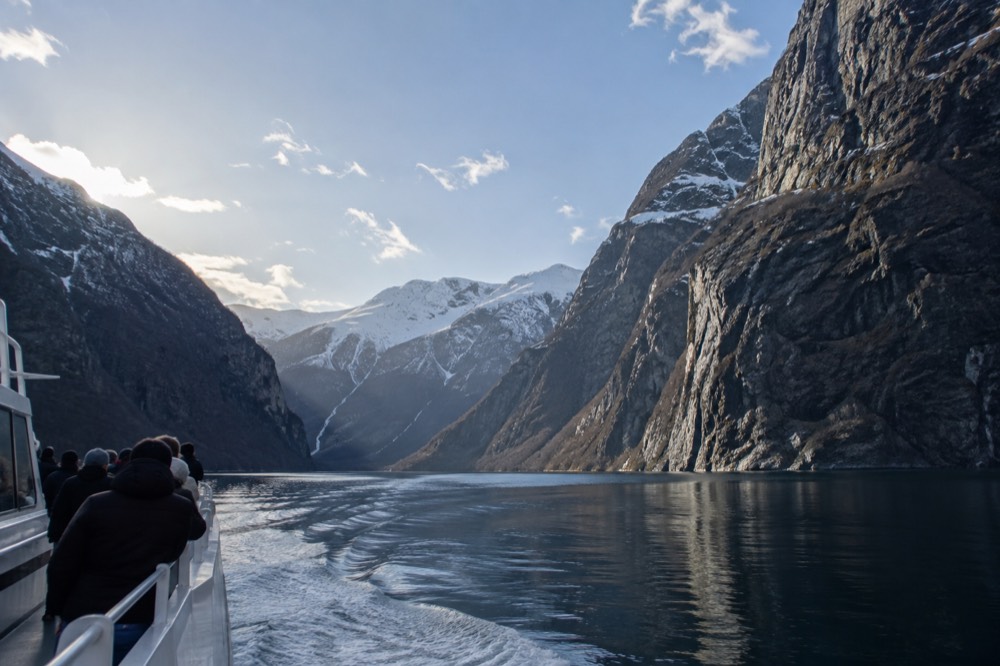
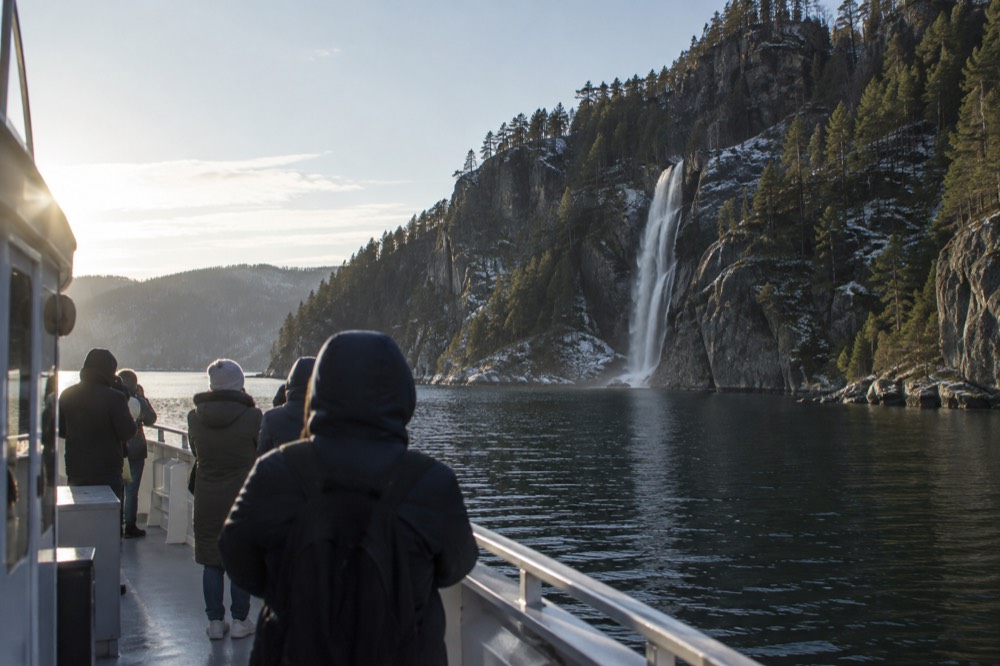
The boat leg is the emotional centre of the day for most people. The Nærøyfjord narrows to a few hundred meters between rock walls that rise over a thousand meters, and the boat slows in the most dramatic stretches. Dress for it: even in July the wind on deck through a fjord is cold, and the inside cabins have windows that photograph badly.
The private guided version of this exact day is the option to look at if the timetable juggling above reads as stress rather than adventure. It runs the same geography with a driver-guide who manages every change.
How Much Does Norway in a Nutshell Cost?
Counting every leg, a self-booked adult day from Oslo on the Nutshell route is a four-figure day in Norwegian kroner, with the fjord boat and the Flåm Railway the two largest fixed components and the long rail legs varying widely with how early you book. A packaged or guided version costs more, and the private guided round trip from Oslo runs from $1060.98 per person. Food on the route is extra and is not cheap.
The honest accounting needs the rail caveat first: Vy's long-distance fares are yield-priced, so the Oslo to Myrdal leg can cost anything from a modest early-booking fare to a painful walk-up one, and the same applies to the Voss to Oslo return. The two fjord legs, the Flåm Railway and the boat, are fixed-price tourist services and change little. The numbers below are the structure of the spend, not a quote. The full index of guides sits on Oslo Travel Guide. The full index of guides sits on Oslo Travel Guide.
| Cost component | Ballpark share of the day | Notes |
|---|---|---|
| Bergen Railway, Oslo to Myrdal | Varies most | Yield-priced, book early, cheapest in low season |
| Flåm Railway, Myrdal to Flåm | Fixed tourist fare | Largest single fixed cost, seat reservations matter in summer |
| Fjord boat, Flåm to Gudvangen | Fixed tourist fare | Second largest, often bundled with the bus leg |
| Bus, Gudvangen to Voss | Small fixed fare | County service, cheap |
| Voss to Oslo train | Varies | Same yield pricing as the morning leg |
| Food and drink | A real extra cost per person | Station and boat café prices, bring snacks if budget matters |
For context on whether this is expensive by Norwegian standards, it is not unusual. Norway is the sixth most expensive country in Europe on Statistics Norway's 2025 price-level comparison, with food about a third above the European average and alcohol more than double, so a day built from tourist rail services and fjord boats sitting well into the thousands of kroner is exactly in line with the rest of the country. Our is Oslo expensive page has the full breakdown of where the money goes in Norway and where it does not.
One genuine saving worth knowing: if you are doing the Bergen Railway as part of a longer rail itinerary rather than a same-day loop, rail passes and minipris-style advance fares change the arithmetic completely, and the Oslo to Bergen train guide covers those options in detail.
When Is the Best Time of Year to Do It?
Late June through August gives you full daylight for every leg, running boats at full frequency and the best weather odds, at the price of peak crowds. May and September are the sweet spot for most people: full schedules, fewer people, and snow still on the heights in May or autumn color in September. From October to April you are trading crowds for short days, closed viewing stops and a real chance of doing the scenic legs in the dark.
The daylight math is the deciding factor and it is stark. Oslo's day length swings from 18 hours 50 minutes at the summer solstice to under six hours at the winter solstice, and the mountain plateau the route crosses is darker earlier and lighter later than the capital. A 15-hour day that starts and ends in darkness is a different product from the same day in July. MET Norway's normals put July's mean temperature in Oslo at 17.7 °C and January's at −2.3 °C, and the mountains are colder than the city in both directions.
| Period | Daylight for the route | Boats and buses | Trade-off |
|---|---|---|---|
| Late June to August | 18+ hours, bright until late | Full summer timetable | Crowds on train and boat, book well ahead |
| May to mid June | 16 to 18 hours | Summer timetable from late spring | Snow on the peaks, fewer people |
| September to early October | 13 to 16 hours, shortening fast | Reduced but running | Autumn color, cooling weather |
| November to March | Under 10 hours, often under 7 | Winter timetable, some stops closed | Dark at both ends, weather risk, lowest prices |
August deserves a specific warning that surprises people: it is statistically Oslo's wettest month on the 1991 to 2020 normals, at 103 mm, wetter than November. Fjord weather is its own microclimate and a wet Nærøyfjord in mist is still atmospheric, but if you have one day only and a choice of weeks, do not assume August is the safe summer option.
What If You Cannot Give the Day 15 Hours?
If a full Nutshell day is too long, the honest substitute is the Oslofjord itself: a silent electric fjord cruise of an hour and a half, a two-hour wooden sailing ship trip, or a half-day of island hopping on the public ferries, all leaving from piers in the city center. They are a different landscape, low islands and wooded shores rather than cliff fjords, but they cost a fraction of the price and keep your evening free.
The comparison is worth making plainly, because the marketing blurs it. The Sognefjord trip is the dramatic fjord landscape people picture when they say "Norway". The Oslofjord is a gentler, urban-adjacent archipelago that you can ride on an ordinary Ruter ticket. If your goal is the postcard fjord, no Oslofjord trip replaces the Nutshell. If your goal is water, islands and a couple of hours off your feet, the Oslofjord does it for a tenth of the time commitment.
| Option | Time from Oslo | Landscape | Best for |
|---|---|---|---|
| Norway in a Nutshell route | About 15 hours door to door | Cliff fjords, plateau, waterfall railway | The one big fjord day |
| Five-island Oslofjord boat tour | 6 hours | Oslofjord islands, swimming beaches | A whole easy day on the water |
| Silent electric Oslofjord cruise | 1 hour 30 | City waterfront and inner fjord | A first evening or a tight schedule |
| Island hopping on public ferries | Half day, self-paced | Hovedøya, Gressholmen, Langøyene | Budget travellers and swimmers |
The full-day five-island boat tour is the closest thing the Oslofjord has to a proper day trip, and it pairs ferry legs with walking on the islands, which the Nutshell route never offers. Our Oslofjord cruise guide compares every boat option on the city's own water in detail.
If your constraint is the evening rather than the day, the shrimp-buffet evening cruise is the classic Norwegian answer: three hours on the fjord with food included, back in port before a late bedtime. It is the format locals themselves book for summer birthdays, which is usually a good sign.
What Should You Pack and Know Before You Go?
Pack layers and a windproof outer layer even in July, shoes that grip wet decks and platform edges, water and snacks for the long rail legs, and your ticket confirmations somewhere that works without signal. Know your connection times at Myrdal before you travel, carry the operator's customer service number, and plan your return to Oslo without assuming the last train will wait for anything.
The layers advice is not boilerplate. The route crosses a high mountain plateau where the temperature sits well below the city's, and the fjord boat moves through cold air even on warm days. Rain is a planning reality in every month: the driest month on Oslo's normals is March at 41 mm and the wettest is August at 103 mm, and the fjord country is wetter than the capital. A cheap poncho beats an expensive wet jacket.
Food is the other quiet cost. Flåm in high season is a village that exists to serve a few thousand daily visitors, and prices reflect that. A packed lunch from an Oslo supermarket before the 07:00 departure is the standard local move, and it saves both money and the queue. On the way back through Norwegian alcohol rules: supermarkets sell only beer and cider up to 4.7% ABV and stop at a fixed evening cut-off, and wine and spirits are sold only by the state monopoly Vinmonopolet, which closes early on Saturdays and all day Sunday, so buy anything you want for the hotel room the day before, not on the way home at 23:00.
The last practical point is the one experienced travellers repeat: build slack into the Oslo end. The return train lands you at Oslo Central Station late, and the metro, trams and buses run reduced late-evening frequencies, so know your last connection home before you leave in the morning. Our getting around Oslo guide covers the night network, and the Oslo Central Station page is worth a read for the layout you will be moving through at both ends of a long day.
Norway in a Nutshell Versus Moving Your Base to Bergen
If you have three or more days and the fjords are the point of the trip, basing yourself in Bergen and doing the Nutshell loop from there is the better structure: the legs are shorter, the light is on your side, and you can add a second fjord day without repeating the plateau crossing. If Oslo is your only base, the same-day round trip is the only way to see the Sognefjord system without changing hotels, and that convenience is exactly what you are paying for.
The geography is blunt about this. Oslo sits at the eastern end of the mountain crossing, Bergen at the western end, and the fjords are on Bergen's side. From Bergen, the Nutshell legs are a comfortable half-day to full-day loop with daylight to spare. From Oslo, every fjord view costs you five and a half hours of plateau each way. The Oslo vs Bergen comparison page works through the whole decision, including the cost and time trade-offs, and the Oslo to Bergen train guide covers the crossing itself if you decide to travel one way by rail and fly back.
For travellers who want the fjord country but cannot face the Sognefjord day at all, there is a third answer: spend the fjord time inside Oslo itself. The city's own water, the islands, the forest lakes at Sognsvann and the marked trails of Nordmarka give you a nature day with zero hours of rail, and the hiking near Oslo guide maps the best of them.
Whatever you choose, decide it before you book accommodation, because the two structures, Oslo-based day trip versus Bergen-based loop, lead to different hotels, different train bookings and different days. That is the real decision on this page, and it is worth an evening with a map before it is worth a credit card.
Common Questions About Norway in a Nutshell
What is Norway in a Nutshell?
It is a marketed round-trip route combining the Bergen Railway, the Flåm Railway, a boat on the Aurlandsfjord and Nærøyfjord, and connecting bus and rail, usually done from Oslo or Bergen. It is not a single ticket: you buy the legs yourself or as a package.
Can you do a fjord day trip from Oslo?
Yes. The Norway in a Nutshell route is the standard fjord day trip from Oslo, running about 15 hours door to door on scheduled trains, the Flåm Railway and a Sognefjord boat. Shorter Oslofjord cruises of one to six hours also leave from the city center piers.
How long does Norway in a Nutshell take from Oslo?
About 15 hours door to door, typically departing Oslo before 07:00 and returning between 22:00 and 23:00. The exact times depend on the season's timetable, so confirm the first and last trains when you book.
Is Norway in a Nutshell worth the money?
For a first visit with Oslo as your only base, most travellers find it worth it: the Nærøyfjord and the Flåm Railway are genuinely world-class scenery unreachable from the city otherwise. If you have three or more days, basing in Bergen and doing the loop from there is better value per hour.
What is the best month for Norway in a Nutshell?
May through September, with late June to August giving full daylight and full schedules at the cost of crowds. May and September are quieter with good light. From November to March the days are short enough that the scenic legs can run in darkness at both ends.
Can you do Norway in a Nutshell without a tour package?
Yes, every leg is a scheduled public service you can book directly from the operators. The trade-off is that you own the connections: if the morning train is late into Myrdal, rebooking the rest of the day is your problem. Packages and guided versions remove that risk.