What Is the Cheapest Month to Fly to Oslo?
The cheapest months to fly to Oslo are January, February and early March, when demand drops after the holidays. Here is how to time a low-season Oslo trip.

What Is the Cheapest Month to Fly to Oslo?
The cheapest months to fly to Oslo are January and February, with early March close behind. Demand collapses once the Christmas and New Year travel rush ends, the weather is at its coldest, and the days are at their shortest, so airlines drop fares to fill seats. Late autumn, especially November, is the runner-up window: grey, quiet, and cheap. The most expensive months are June, July and August, plus the December holiday rush.
That is the short answer, and it holds across the pattern of every Oslo booking calendar: price tracks daylight and school holidays more than anything else. Norwegians travel abroad themselves in July, and the whole world wants Norway in midsummer. Nobody wants Oslo in the third week of January, which is exactly why that week is cheap.
What the bare answer misses is that a cheap flight in the wrong month can still buy you an expensive or disappointing trip. A January fare saves money on the plane and then hands you 6 hours 45 minutes of daylight, a mean temperature around −2.3 °C (28 °F), and a city that runs very much on its own schedule. The smart move is to match the cheap month to what you actually want from Oslo, and this page walks through that match in detail.
Before the season-by-season breakdown, it helps to see the year as a whole. The table below pairs each stretch of the calendar with what Oslo is actually like then, using MET Norway's 1991 to 2020 normals for the Blindern station as the weather reference. Prices of flights are not published per month by any single authority, so treat the season column as the demand signal that drives them.

| Stretch of the year | Normal mean temp | What drives fares | Verdict for cheap flights |
|---|---|---|---|
| Early Jan to late Feb | −2.3 to −2.0 °C | Post-holiday demand collapse | Cheapest window of the year |
| March to mid-April | 1.3 to 6.2 °C | Easter week spikes; shoulder otherwise | Cheap outside Easter |
| Late Apr to May | 11.4 °C | Spring demand builds; 17 May crowds | Moderate |
| June to August | 15.3 to 17.7 °C | Peak season, cruise calls, midnight light | Most expensive |
| September to October | 12.2 to 6.6 °C | Shoulder, schools back | Good value |
| November | 2.2 °C | Low season, grey and quiet | Second-cheapest window |
| December | −1.4 °C | Christmas market and holidays | Expensive, spikes near holidays |
Why January and February Are the Cheapest Months
January and February are the cheapest months to fly to Oslo because every demand driver points the wrong way at once: the holidays are over, Norwegian schools are back in session, the weather is at its coldest of the year, and daylight bottoms out at under six hours. Airlines face empty seats in the darkest weeks of winter and cut fares to fill them. If your only goal is the lowest possible airfare, the third and fourth weeks of January are reliably the floor.
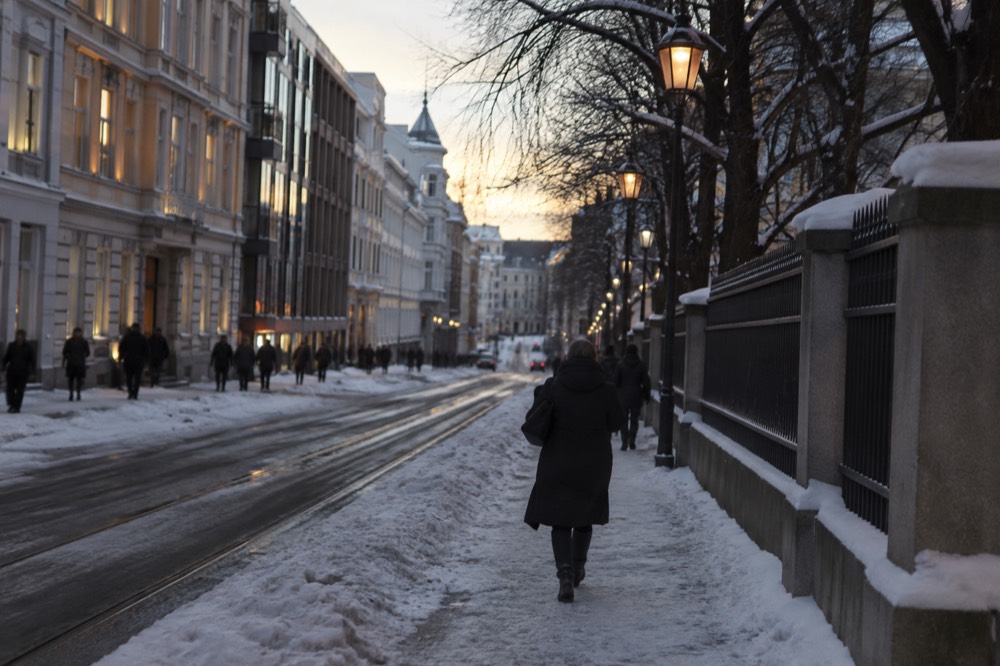
The daylight point deserves a number, because it is the single fact that shapes a winter Oslo trip most. MET Norway's sunrise data puts the winter solstice at 5 hours 53 minutes of daylight in Oslo, with the sun rising at 09:18 and setting at 15:11. By 15 January the day has already stretched to 6 hours 45 minutes, and by mid-February it is 9 hours 14 minutes. The city is not shut, far from it, but you plan around the light rather than through it: museums and cafés in the middle of the day, and the evening given over to indoor life.
The cold is real but manageable, and it is honest to say so. The normal mean for January is −2.3 °C and for February −2.0 °C, which is cold for a European capital but nowhere near extreme, and Oslo's winter is dry-ish rather than wet: 58 mm of normal precipitation in January, less than half of August's 103 mm. Recent winters have swung hard in both directions, with an observed low of −17.2 °C one January at Blindern, so pack for the range, not the average.
What you get in exchange is a completely different city from the summer one. Prices on the ground soften outside peak season, queues at the big museums shrink to nothing, and the winter products Oslo genuinely does well, the torchlit forest walks, the snowshoeing in Nordmarka, the evening myths-and-legends walks built for the dark months, are all running. If you want to go deeper on that trade, our guide to Oslo in winter breaks down what the cold months actually deliver.
One honest caveat: cheap months are cheap partly because daylight is short, and there is no way around that at 59.91 N. There is no midnight sun in Oslo even in summer, and there is certainly no endless winter day. Our page on Oslo daylight hours by month has the full table if you want to plan hour by hour.
Which Months to Avoid If You Want a Cheap Flight
Avoid June, July and August, the December holiday fortnight, and whichever week Easter falls in. Midsummer is the peak: everyone wants Oslo's 18 hours 50 minutes of June daylight, the Oslofjord boats run at full tilt, and cruise ships add thousands of day visitors. December looks cheap until you get near the holidays, when the Christmas market and family travel send fares up sharply. Easter is a Norwegian travel week and prices follow.
The summer premium is the most predictable thing in Norwegian travel. The 21 June day runs from 03:53 to 22:43, the fjord islands are at their swimmer-friendly best, and the whole country takes its holiday in July. Airlines know all of this. If you want summer light but lower fares, the edges of the season are the compromise: late May or the first half of September still give you long evenings, 17 hours of daylight in mid-May against 12 hours 54 minutes by mid-September, without the peak pricing or the peak crowds.
August carries a specific trap worth flagging, because it surprises people: it is Oslo's wettest month on the 1991 to 2020 normals at 103 mm, ahead of November's 85 mm. Visitors assume late summer is the dry, reliable end of the season and book accordingly, and the numbers say otherwise. You are paying peak-adjacent fares for the statistically rainiest month of the Oslo year. If a summer trip matters to you, our best time to visit Oslo guide weighs the whole year against what you want to do.
December deserves its own sentence or two. The city is genuinely lovely in the weeks before Christmas, the market along Karl Johans gate draws big crowds, and the dark is softened by lights everywhere. But that charm is priced in. Fares climb steeply from mid-December, and the period between Christmas and New Year is one of the most expensive windows of the whole year, not just to fly into Oslo but to sleep in it. Early December, before the market rush peaks, is a different animal and often fares much better.
17 May, Norway's Constitution Day, is a smaller spike but a real one: it is the country's biggest celebration and hotels fill around it. Our 17 May in Oslo page explains what the day involves if you are tempted to aim for it deliberately, which some travelers absolutely should.

Does Flying Into Oslo's Other Airports Save Money?
Sometimes, but often not once you count the transfer. Oslo's main airport, Gardermoen, sits in Ruter zone 4N and is connected to the centre by train in about 20 to 23 minutes. Torp Sandefjord, the secondary airport used by some low-cost carriers, is much farther from the city, and the coach transfer costs both money and an hour or more of your day. A cheaper fare into Torp can be a worse deal overall, so always price the door-to-door journey, not the flight alone.
The arithmetic at Gardermoen is straightforward and worth knowing before you land. The Flytoget airport express runs about 20 minutes to Oslo S at 268 NOK adult single. Vy's regional trains cover the same distance in about 23 minutes and cost roughly half as much, and the mechanism most guides miss is that these are ordinary Ruter-zone trains: a multi-zone Ruter ticket covering zone 1 through 4N is valid on them, and the Oslo Pass covers them outright. The full breakdown, including where Flytoget is and is not worth it, is in our Oslo airport to city centre guide.
Torp's problem is structural, not hidden. It was built as a regional airfield and pressed into London-style budget service, and every passenger pays the distance back. If a fare into Torp is dramatically lower than the same dates into Gardermoen, the saving can still be real, but a modest difference usually evaporates in the transfer. Our Oslo Torp and Sandefjord page covers the airport in full for anyone weighing it.
There is a second, quieter way the airport choice matters in the cheap months: winter weather. Gardermoen handles snow as a matter of routine, and the rail link is largely immune to road conditions. A long coach transfer from a distant secondary airport in January is a different experience from the same transfer in July, and not in a good way. If you are chasing the January fare floor, flying into the main airport with a 23-minute train behind you is the low-stress version of the same cheap trip. The rest of the planning pages sit on Oslo Travel Guide. The rest of the planning pages sit on Oslo Travel Guide.
How Much Does the Rest of an Oslo Trip Cost in the Cheap Months?
The flight is only the first line of the budget, and Oslo's ground costs are real: Norway is the sixth most expensive country in Europe on Statistics Norway's 2025 price-level survey, with household prices 28.6 percent above the EU average and food 33 percent above. But the cheap months help you here too, because Oslo's best sights are disproportionately cheap or free. Vigeland Park is free and open 24 hours a day, the Opera House roof is free, and the free walking tours cost only a tip.
The honest way to budget Oslo is to know where the money actually goes. Alcohol and tobacco run at more than double the European average, which is why the state monopoly Vinmonopolet closes on Sundays and why visitors stock up at duty-free on arrival. Restaurants are expensive; museums, public transport and the outdoors are not, by Norwegian standards. A family that plans around the free layer and the museum layer can spend surprisingly little on the ground even in one of Europe's dearest countries.
The museum layer is where the Oslo Pass earns its keep, and the 2026 prices are published by the city tourist board: 580 NOK for 24 hours, 845 NOK for 48 hours, 995 NOK for 72 hours, adult. What makes it work is that the pass covers public transport in zones 1 through 4N including the Vy trains to and from the airport, the Bygdøy ferry, and entry to more than 30 museums. Three Bygdøy museums at full price, Kon-Tiki at 180 NOK, Fram at 180 NOK and the cultural history museum at 200 NOK, already total 560 NOK before you have travelled anywhere. Our is the Oslo Pass worth it page runs the full break-even maths.
| Cost item | Cheap-season reality | Notes |
|---|---|---|
| Vigeland Park | Free, 24 hours | Over 200 sculptures, always open |
| Opera House roof | Free | Walk on it any time |
| Free walking tour | Tip-based | About 2 hours, central highlights |
| Oslo Pass, 24h adult | 580 NOK | 2026 price, covers transport and 30+ museums |
| Kon-Tiki Museum | 180 NOK | Family ticket 400 NOK |
| Fram Museum | 180 NOK | Kon-Tiki combo 325 NOK |
| MUNCH | 280 NOK | 200 NOK after 18:00, under-25s 100 NOK |
The cheap months also change what the city itself costs in softer ways. Hotel rates outside peak season are the quiet saver here, and the same room that commands summer prices in Aker Brygge can be markedly cheaper in February. Winter is also when Oslo's genuinely distinctive products run: the torchlit forest walk with a campfire, guided snowshoeing in Nordmarka, and the dark-season evening walks. They are not free, but they are experiences the summer crowd cannot buy at any price.
Tips for Booking a Cheap Flight to Oslo
Book the January or February dates, fly midweek, and price the whole journey rather than the flight alone. Beyond that, the reliable levers are flexibility on nearby dates, checking whether a secondary airport's transfer erases its fare advantage, and remembering that Norway is in Schengen but not in the EU, so duty-free allowances apply even when you arrive from another Schengen country, and non-residents can claim a VAT refund on qualifying purchases. The krone, not the euro, is what you will be spending.
A few practical points in no particular order. First, the currency: Norway uses the Norwegian krone, and euros are not generally accepted, so a card with no foreign transaction fee matters more here than in euro-zone capitals. Second, the Schengen point above is worth internalizing because it surprises American visitors in particular: you clear no routine passport check arriving from another Schengen country, yet you are outside the EU customs union, so the duty-free shop on arrival is a genuine option rather than a museum piece.
Third, think about what you will do with the money you save on the fare. Oslo rewards travelers who spend on one or two structured things rather than dribbling money across a dozen small ones. A single well-chosen guided product, a fjord cruise or a food walk, anchors a day and keeps the rest of the budget on the free layer: the parks, the harbor edge, the islands on an ordinary Ruter ticket.
Fourth, if your cheap month is a winter month, build the short day into the plan rather than fighting it. Front-load the outdoor sightseeing into the 10:00 to 15:00 window, keep museums for the late afternoon, and give the evenings to the things winter Oslo does best. The Oslo on a budget guide has a fuller treatment of the free and cheap layer, including the islands and the swimming spots for anyone brave in August.
Finally, book with the calendar rather than against it. The pattern is stable enough to plan around: dark weeks cheap, light weeks expensive, Easter mobile, Christmas priced in. Travelers who can take Oslo in its quiet season get the same city, the same museums, the same fjord, and a materially cheaper way in.
Common Questions About Flying to Oslo Cheaply
what is the cheapest month to fly to oslo?
January and February, with early March close behind. Demand drops sharply once the holiday travel period ends, and the combination of cold weather and under six hours of daylight keeps fares at their yearly floor through the darkest weeks. November is the second-cheapest window.
Is Oslo expensive once I land?
Parts of it are. Norway is the sixth most expensive country in Europe, with food 33 percent above the EU average and alcohol more than double. But museums, public transport and the outdoors are reasonably priced, and top sights like Vigeland Park and the Opera House roof are free.
Does the Oslo Pass cover the airport train?
It covers the Vy trains to and from Oslo Airport Gardermoen, but not the Flytoget airport express and not the Flybussen coach. The Vy trains take about 23 minutes to central Oslo versus Flytoget's 20, at roughly half the price.
Is summer a bad time to visit Oslo?
Not at all, it is simply the most expensive. June through August brings 15 to 19 hours of daylight, swimming in the Oslofjord and the full boat season. If you want long days at lower cost, late May or early September are the compromise windows.
What is the rainiest month in Oslo?
August, at 103 mm of normal precipitation on MET Norway's 1991 to 2020 normals. It surprises visitors who assume late summer is the driest stretch; November is wetter-feeling but totals less at 85 mm.
Should I fly into Torp to save money?
Only if the fare saving is large. Torp Sandefjord is much farther from the city than the main Gardermoen airport, and the coach transfer adds both cost and well over an hour each way. Price the door-to-door journey before deciding.