What Is the Coldest Month in Oslo?
January is the coldest month in Oslo, with a normal mean of -2.3 C. Here is what that actually feels like, how much daylight you get, and what is worth doing in the coldest months.
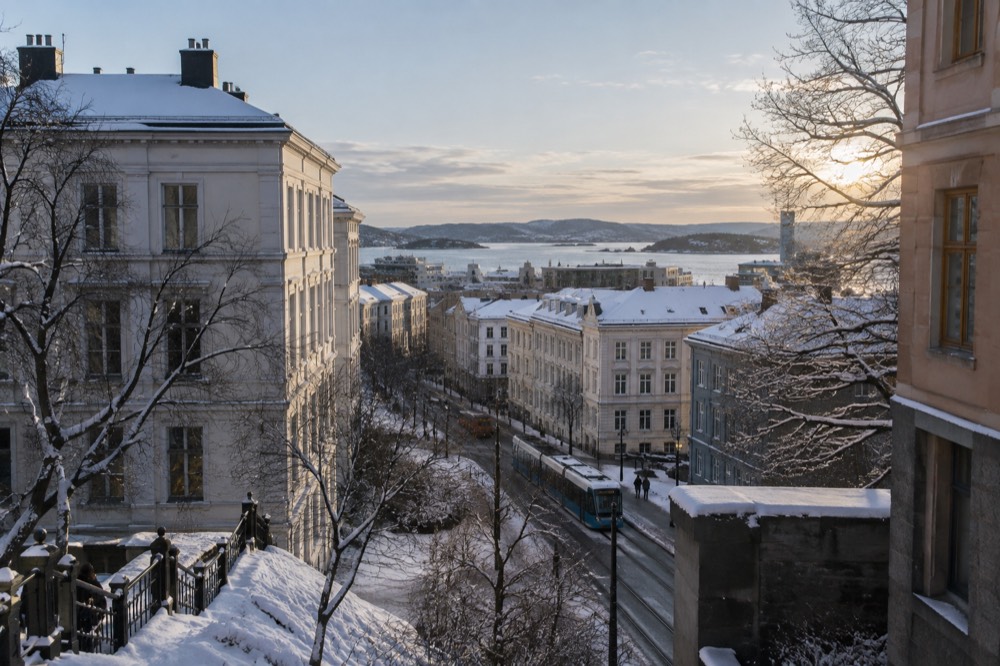
What Is the Coldest Month in Oslo?
January is the coldest month in Oslo, with a normal mean temperature of -2.3 C (28 F) on the official 1991 to 2020 normals from MET Norway's Blindern station. February is a very close second at -2.0 C, and December is the third coldest at -1.4 C. In practice, the deep-cold snaps that visitors remember tend to land between late December and mid-February, and the winter that matters for planning stretches from November through March.
Those normals come from MET Norway, the national meteorological institute, measured at the Blindern station in the city, so they describe Oslo as a city rather than a mountain valley somewhere inland. A normal is a 30-year average, which means it smooths out the extremes in both directions. The winter of 2025/26 is a good illustration: January 2026 came in with an observed mean of -4.9 C, more than two degrees colder than the normal, and the station recorded its lowest reading of the thirteen months to August 2026 at -17.2 C on 11 January 2026.
That is the honest picture. January is the answer to the question, but the number on its own does not tell you what to pack, because Oslo's winter cold is a dry, continental cold sitting next to a fjord, not the damp chill of a maritime city like Copenhagen. The same week can give you -12 C under clear blue skies at 14:00 and a wind off the Oslofjord that makes the waterfront feel ten degrees worse at 16:00. The fjord rarely freezes in the inner harbor these days, and that open water keeps the air a few degrees milder than the forested hills to the north.
If you are planning a winter trip and wondering what the cold months actually look like month by month, the deeper planning picture is in the Oslo winter guide, and the month-by-month comparison lives in Oslo weather by month.
How Cold Does Oslo Actually Get in January?
The January normal is -2.3 C, but the observed range is much wider than that average suggests. In the thirteen months to August 2026, Blindern recorded a low of -17.2 C on 11 January 2026, and the January 2026 mean came in at -4.9 C, well below the normal. Expect January days between -10 C and +2 C, with cold snaps that go lower.
The table below is the full set of monthly normals from MET Norway, with the observed 2025/26 means alongside for comparison. Two things stand out. First, the three coldest months are close together, so a trip in early March can easily be colder than one in early January. Second, the observed figures show how much a single year can deviate from the normal in either direction.
| Month | Normal mean temp | Normal precip | Observed 2025/26 |
|---|---|---|---|
| Jan | -2.3 C | 58 mm | -4.9 C |
| Feb | -2.0 C | 46 mm | -5.0 C |
| Mar | 1.3 C | 41 mm | 3.5 C |
| Apr | 6.2 C | 48 mm | 8.0 C |
| May | 11.4 C | 60 mm | 11.7 C |
| Jun | 15.3 C | 80 mm | 16.7 C |
| Jul | 17.7 C | 87 mm | 18.5 C |
| Aug | 16.5 C | 103 mm | 16.2 C |
| Sep | 12.2 C | 82 mm | 13.5 C |
| Oct | 6.6 C | 93 mm | 7.9 C |
| Nov | 2.2 C | 85 mm | 3.8 C |
| Dec | -1.4 C | 54 mm | 2.4 C |
Notice that February 2026 was fractionally colder than January 2026 in the observed column, -5.0 C against -4.9 C, even though January wins on the 30-year normals. Anyone who has spent a February in Oslo will tell you the difference is academic. Both months belong to the same winter, and the practical difference between them is daylight, not degrees: February gains almost two and a half hours of it.
One expectation worth correcting before it forms: Oslo is not the Arctic. The city sits at 59.91 N, well south of the Arctic Circle, and there is no midnight sun here in summer, just as there is no polar night in winter. The coldest weather Oslo records is cold by European standards but ordinary by Nordic ones, and the city keeps running through all of it. Trams, the metro and the island ferries on line B1 run year-round, and the ski trails in Nordmarka are groomed through the whole season.
Is February Colder Than January in Oslo?
On the long-run normals, no: January is colder at -2.3 C against February's -2.0 C, a gap of three tenths of a degree. In any single year the order can flip, and in 2026 it did, with February 2026 observed at -5.0 C against January's -4.9 C. The honest answer is that the two months are statistically tied, and February often feels colder because the snow has been on the ground for weeks and the cold has settled in.
What February does have over January is light, and a lot of it. The daylight table below is calculated from MET Norway's sunrise and sunset data for Oslo's coordinates, and the change between mid-January and mid-February is one of the sharpest in the year. In mid-January the sun rises at 09:04 and sets at 15:49. Four weeks later it rises at 07:54 and sets at 17:08, a gain of two hours and 29 minutes.
| Date | Sunrise | Sunset | Day length |
|---|---|---|---|
| 15 Jan | 09:04 | 15:49 | 6 h 45 m |
| 15 Feb | 07:54 | 17:08 | 9 h 14 m |
| 15 Mar | 06:34 | 18:19 | 11 h 45 m |
| 21 Dec | 09:18 | 15:11 | 5 h 53 m |
| 21 Jun | 03:53 | 22:43 | 18 h 50 m |
The swing across the year is enormous, from 5 h 53 m on 21 December to 18 h 50 m on 21 June, a factor of more than three. That is the real winter constraint in Oslo, and it shapes itineraries more than the thermometer does. A December visitor has roughly six hours of sightseeing light; a February visitor has nine. If you are choosing between the two months for a city break, February buys you three more usable hours a day for almost the same temperature, and the full picture of that trade-off is in the Oslo daylight hours guide.
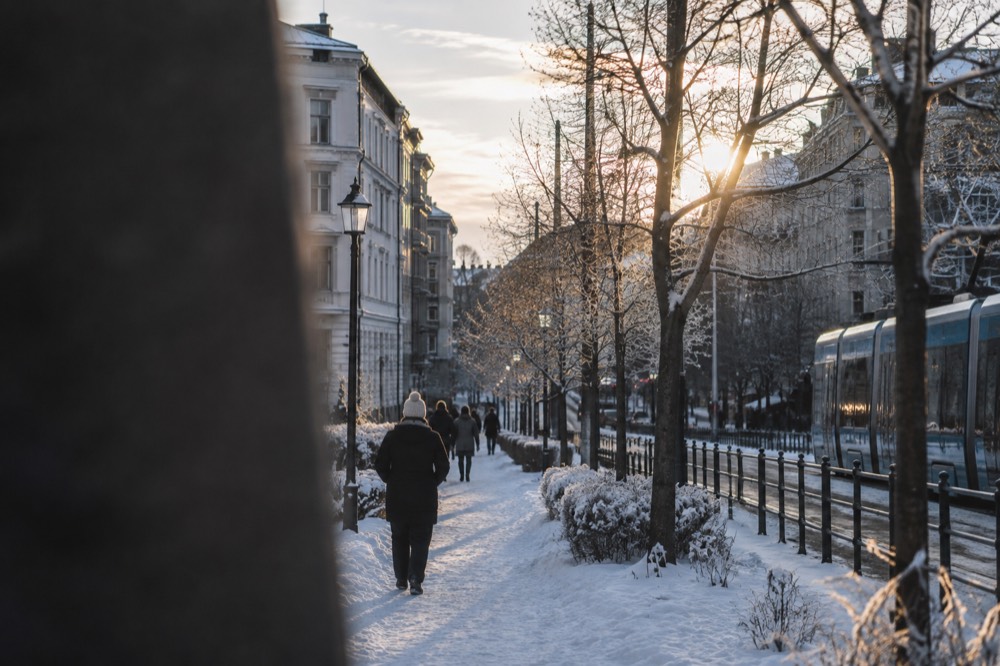
February also has a practical advantage that the numbers do not show: it is after the January sales crowds and before the March ski-week school holidays, so hotels and museum queues are often at their winter quietest. The winter that Norwegians themselves treat as the season for the best time to visit Oslo on a cold-weather budget is late January through February.
What Is the Best Way to Enjoy Oslo in the Coldest Months?
The best cold-month days in Oslo combine one outdoor activity in the short daylight window with museums, food and indoor culture in the long dark evening. The city is built for this rhythm: ski trails and torchlit forest walks inside the city limits, a metro line that drops you at the trailhead, and world-class museums clustered close enough together to move between them without standing in the cold. Fighting the season is the mistake; using the darkness is the strategy.
The outdoor half of that plan is easier than most visitors expect. Oslo is one of very few capitals where you can be on groomed cross-country trails within half an hour of the main street, because metro Line 1 runs up to Frognerseteren at the edge of Nordmarka, where Skiforeningen maintains the trail network through the winter. You do not need to be a skier to use the forest in winter, and you do not need a car to reach it. Everything else covered here is indexed on Oslo Travel Guide. Everything else covered here is indexed on Oslo Travel Guide.
The signature cold-season experience sold as a bookable product is the torchlit forest walk with a campfire, a three-and-a-half-hour evening trip that leans into the darkness rather than fighting it. The listing carries a 4.7 rating across 280 reviews, and it is the product that most directly turns the coldest months into the point of the trip rather than an obstacle to it. You can see the winter forest walk here, and check availability on the operator's live listing.
For visitors who want to learn rather than watch, Oslo is the only European capital where a learn-to-ski half-day is a genuine bookable product, with a perfect 5.0 rating across its review base. It runs about three and a half hours and covers the basics on gentle terrain. The skiing near Oslo guide covers the full picture, including Oslo Vinterpark at Tryvann, reached by the same Line 1 metro.
The indoor half of the plan is where the coldest months quietly shine. Bygdøy's museums are the obvious cluster, and the Kon-Tiki Museum is the best-reviewed museum ticket in the city on either platform, at 4.5 across more than a thousand reviews. Fram next door holds the polar ship itself, and the two pair naturally: Kon-Tiki is the warm-weather expedition story, Fram is the cold-weather one, which makes it the more fitting museum for a January week. A practical pairing table:
| Cold-month activity | Where | Time needed | Why it suits the cold months |
|---|---|---|---|
| Torchlit forest walk, campfire | Nordmarka forest edge | 3 h 30 m | Runs in the dark, built for the season |
| Learn-to-ski half-day | Oslo winter venues | 3 h 30 m | Capital-city novelty, gentle terrain |
| Kon-Tiki Museum | Bygdøynes pier, Bygdøy | 1 h | Best-reviewed ticket in the city |
| Fram Museum | Bygdøynes pier, Bygdøy | 1 to 3 h | The polar-ship museum, thematically perfect |
| Cross-country trails | Frognerseteren, Line 1 | Half day | Groomed all winter, metro access |
| Vigeland Park | Frogner | 1 h | Free, open 24 hours, striking under snow |
One caution that belongs here rather than buried further down: the Museum of the Viking Age on Bygdøy is closed for rebuilding and is not scheduled to reopen until 2027, and no bookable ticket to it exists. Any listing still selling one should be treated with suspicion. The honest Viking-age substitute is Viking Planet in the city center, and the closure is covered in full on the Museum of the Viking Age page.
How Much Daylight Does Oslo Get in the Coldest Months?
In the coldest months, Oslo gets between 5 h 53 m and about 9 h 30 m of daylight per day: 5 h 53 m on 21 December, 6 h 45 m in mid-January, and 9 h 14 m by mid-February. The sun rises after 09:00 in December and January and sets before 16:00, which means the working day is largely dark. There is no polar night, the sun does rise every day of the year in Oslo, but the window is short.
Planning around that window is the single biggest adjustment for visitors from lower latitudes. The mistake is scheduling outdoor sights for the late afternoon, which in January is after dark. The workable pattern is the reverse of a summer itinerary: museums and indoor sights in the morning before opening light, outdoor sightseeing in the 11:00 to 15:00 band, then dinner, drinks or an evening activity once the dark arrives, and Oslo has genuinely good options for that last slot, from the evening myths-and-legends walk to the shrimp-buffet fjord cruise in the summer half of the year.
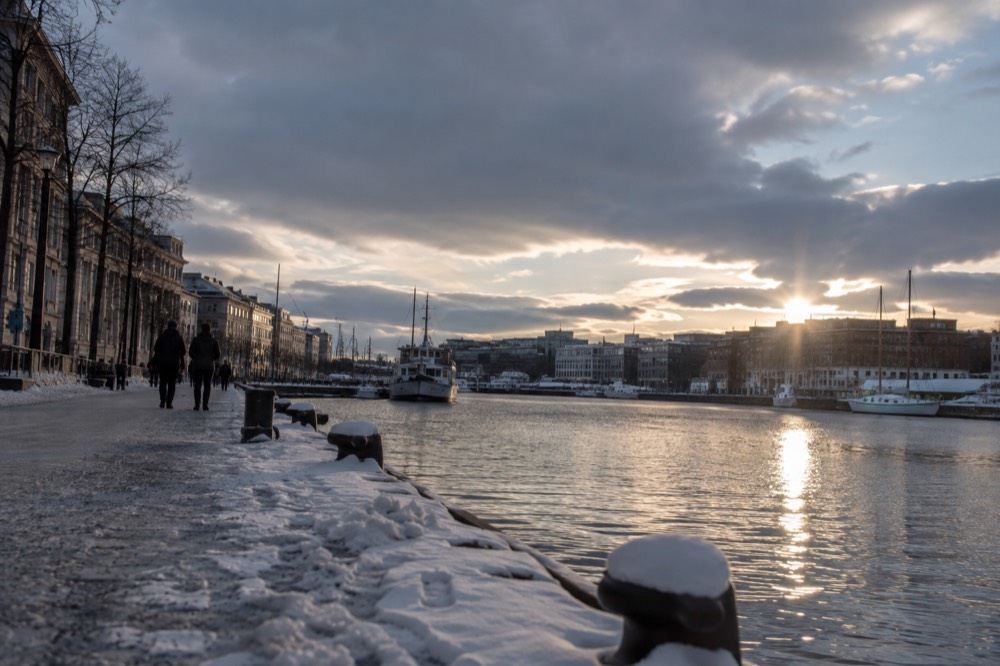
The cold months are also the dark months, and the two facts reinforce each other. Clear winter days in Oslo are often the coldest ones, because the cloud cover that traps warmth is gone, so the brightest days for photography tend to be the days you need the most layers. The Oslo photography spots guide notes which viewpoints work in the short light, and the harbor at blue hour, roughly 15:30 in January, is one of the reliable winter shots.
Should You Visit Oslo in the Coldest Month Anyway?
Yes, if you go for the right reasons: January in Oslo is cheaper, quieter and more atmospheric than the city at any other time of year, and the cold itself powers the experiences that make the city distinctive, from groomed ski trails inside the city limits to a fjord that steams in the cold air. The trade is daylight and temperature, roughly six hours of light and a mean of -2.3 C, and both are manageable with the right itinerary shape.
The economics favor the cold months in ways that matter on a Norway budget. Norway is the sixth most expensive country in Europe on Statistics Norway's 2025 price-level survey, with household prices 28.6 percent above the EU average, so any seasonal discount on accommodation in Oslo is worth taking. January and February are the quietest months for hotel demand in the capital, and the city's cost profile is uneven rather than uniformly high: museums, public transport and the outdoors, including the always-free Vigeland Park, are not unusually expensive, while alcohol and restaurants are where the money goes.
Transport is also at its cheapest in one specific way. Ruter cut the 30-day zone 1 pass from 805 to 655 NOK from 3 May 2026, and the Oslo Pass, at 580 NOK for 24 hours, covers the metro, trams, buses and the island ferries, plus entry to more than 30 museums. A cold-month itinerary built on the pass and the metro reaches the forest trailheads and the Bygdøy museums for less than most visitors expect. The Oslo Pass worth-it breakdown runs the numbers.
What the coldest months ask of you in return is honest winter clothing. The site's own packing advice is simple: real boots with grip, wool base layers rather than cotton, and a hat you will actually keep on. Norwegians dress for the forecast, not for the season, and the city does not shut down for cold that would close schools elsewhere. Shops, museums, restaurants and public transport all run as normal through January, and the swimming saunas by the harbor do their best business precisely when the air is at its coldest.
If the torchlit forest walk is the one product that has sold you on a cold-month trip, it is worth checking its live listing early in your planning. The winter slots fill fastest in the deep-cold weeks of late January and February, when the torchlight and the campfire are at their most atmospheric, and the operator's listing shows the current departure calendar and the free-cancellation terms before you commit.
The same logic applies to the other two winter picks in that band: the learn-to-ski half-day is weather-dependent and runs a smaller group size, and the Kon-Tiki ticket is the reliable indoor fallback for the days the forecast turns. Booking the museum days around the forecast, rather than the other way round, is how Norwegians themselves structure a cold week.
Common Questions About the Coldest Month in Oslo
what is the coldest month in oslo?
January, with a normal mean of -2.3 C on the 1991 to 2020 normals from MET Norway's Blindern station. February is statistically tied at -2.0 C, and in the winter of 2025/26 February was marginally the colder of the two in the observed figures. The coldest single reading in the thirteen months to August 2026 was -17.2 C on 11 January 2026.
How cold does Oslo get in winter?
The normal mean for the three winter months sits between -2.3 C and -1.4 C, but the observed range is much wider. Cold snaps push temperatures to between -10 C and -17 C, while mild, wet spells can lift a January day above freezing. Oslo's cold is a dry continental cold moderated by the open fjord, not the damp chill of a maritime city.
Is February colder than January in Oslo?
On the 30-year normals, no: January averages -2.3 C against February's -2.0 C. In any individual year the order can flip, and in 2026 February was the colder month by a tenth of a degree. The practical difference between the months is daylight, with February gaining more than two hours over January.
How many hours of daylight does Oslo get in winter?
The shortest day of the year, 21 December, gives Oslo 5 h 53 m of daylight, with sunrise at 09:18 and sunset at 15:11. By mid-January the day is 6 h 45 m, and by mid-February it is 9 h 14 m. There is no polar night in Oslo: the sun rises every day of the year at the city's latitude of 59.91 N.
Does it snow a lot in Oslo in January?
January's normal precipitation is 58 mm, falling as snow when the temperature is below freezing, but Oslo is not a heavy-snow city by Norwegian standards. Snow lies through the winter more reliably in the hills of Nordmarka than at sea level, and the groomed ski trails there are maintained by Skiforeningen through the season regardless of what the city streets look like.
Is Oslo worth visiting in the coldest months?
Yes, if the itinerary is shaped for the season: outdoor activity in the short daylight window, museums and food in the long evening. January and February are the quietest and often cheapest months for hotels, the ski trails and torchlit forest walks are at their best, and the cold itself is what makes the distinctive Oslo winter products possible.