Is Norway Worth Visiting with Kids?
Yes, Norway works surprisingly well for families: Oslo's museums are child-priced or free, transport is simple, and the outdoors is the main attraction. Here is the honest planning picture.
Is Norway Worth Visiting with Kids?
Yes, Norway is genuinely worth visiting with kids, and Oslo is the easiest place to test that claim. Children under 18 get free entry at the Norsk Folkemuseum and the Nobel Peace Center, the Vigeland sculpture park is free and open around the clock, and the Oslofjord islands ride on an ordinary metro ticket. The costs that give Norway its scary reputation, mainly alcohol and restaurants, mostly do not apply to a family travelling with children.
The hesitation parents usually have is about price, and it is a fair worry in a country where Statistics Norway's 2025 price-level survey puts household prices 28.6% above the EU average. But that headline number hides a very uneven picture. Food and non-alcoholic drinks run about a third above the European average, and alcohol and tobacco cost more than double, which is brutal for a couple on a night out and close to irrelevant for an eight-year-old.
What families actually spend money on in Norway behaves differently. Museum tickets for children are free or heavily reduced at most major venues. Public transport is a single zoned system with child discounts and free travel for under-6s. The things Norwegians themselves build their family weekends around, the forest, the fjord islands, the sculpture parks and the swimming spots, carry no ticket at all.
There is also a safety and simplicity argument that rarely appears in the brochures. Norway is in the Schengen Area but not in the European Union, an EEA state that uses the krone rather than the euro, and it is a country where an unsupervised ten-year-old on a tram is a normal sight rather than a cause for alarm. Cities are compact, tap water is excellent, and English is close to universal in Oslo. For a first international trip with children, that combination removes a surprising amount of stress.
If you are building an Oslo itinerary around this, our Oslo with kids guide goes deep on day-by-day planning, and the free things to do in Oslo page lists the no-ticket sights that work best with children.
Is Oslo a Good City for Families?
Oslo is one of the more family-friendly capital cities in Europe, mainly because its headline attractions double as everyday Norwegian family life. The fjord islands, the forest edge at Nordmarka and Sognsvann, the harbour baths and the sculpture park are not tourist products, they are where local families spend their weekends, so the infrastructure, toilets, kiosks, ferry schedules and swimming ladders, is built for children rather than for coach tours.
The compactness matters more than anything. The city centre is walkable end to end in under an hour, the metro reaches the forest in about twenty minutes, and the ferry to Hovedøya takes roughly ten minutes from Aker Brygge. A family can do a museum morning, a forest afternoon and a harbour swim in one day without a car or a complicated transfer. Very few capitals offer that mix at that distance.
The museum layer is unusually strong for children too, and unusually cheap at the child end. The Fram Museum lets you walk onto the actual polar ship, the Kon-Tiki Museum has the balsa raft that crossed the Pacific, and the Norsk Folkemuseum has a stave church and open-air farm buildings. The Paradox Museum, an interactive illusion museum in the centre, is the strongest pure rainy-day ticket for families in the city.
For the bookable side, three products fit families particularly well, and they cover the range from a cheap museum ticket to a full outdoor day:
The Kon-Tiki ticket is the anchor of a Bygdøy museum day and works for children who can read an expedition story. The island-hopping tour is ferry-and-foot, which is exactly how local families use the fjord. And the climbing park day ticket is the one that answers the question every parent gets asked on day three: can we do something active?
What Can Kids Actually Do in Oslo?
More than most cities of its size, and the honest answer splits into three layers: museums with genuine child pricing, free outdoor sights, and bookable active days. The free layer alone can fill two days: the Vigeland sculpture park is open 24 hours with no ticket, the Opera House roof is a public walkway, and the Oslofjord islands ride on an ordinary Ruter ticket with ferries from Aker Brygge.
Start with the free layer, because it is the layer that surprises visitors. Vigeland Park, the sculpture park in Frogner, holds over 200 sculptures by Gustav Vigeland, is open all year at all hours, and charges nothing. Toddlers run between the monolith and the fountains, and it is one of the city's most visited sights precisely because nobody has to queue or pay. The Opera House roof slopes straight down to the water and is designed to be walked on.
The island layer is the Oslo-specific one. The Ruter ferry lines B1 and B2 run from Aker Brygge to Hovedøya, Gressholmen, Langøyene and the other islands, on an ordinary public transport ticket. Hovedøya has a ruined Cistercian abbey to scramble around and swimming coves; Langøyene is the island Norwegians treat as their beach. The water in July and August typically sits between 15 and 20 °C, which is cool but swimmable for children used to northern European seas.
The active layer is where a booked product earns its place. The climbing park day ticket is the family-outdoor slot in this city: a full day of treetop courses graded by age and height, inside Oslo's own limits, reachable by public transport. It is not a guided tour but a day ticket, so it suits families who want to arrive, climb until everyone is tired, and leave on their own schedule.
For families who want the fjord with a structure around it, the guided island-hopping tour covers the same geography with a guide and a plan, which helps when the children are too young to make a ferry timetable interesting by themselves. And the Kon-Tiki Museum ticket pairs naturally with the Fram Museum next door for a museum day that is genuinely about adventure rather than glass cases.
Here is what the museum layer costs at the child end, using each venue's own published prices:
| Venue | Adult | Child | Notes |
|---|---|---|---|
| Norsk Folkemuseum | 200 NOK | Free (0-17) | Open-air museum, stave church |
| Nobel Peace Center | 180 NOK | Free (0-17) | Central, good for a half-day |
| Kon-Tiki Museum | 180 NOK | 70 NOK (6-17) | Family ticket 400 NOK (2 adults + 5 children) |
| Fram Museum | 180 NOK | 70 NOK | Walk aboard the polar ship |
| MUNCH | 280 NOK | Free (0-17) | Under 25s pay 100 NOK |
That table is the quiet argument for Norway with kids: at three of the five biggest museums in the capital, children pay nothing or close to it. A family of four can spend a full museum day for the price of two adult tickets, and the Kon-Tiki family ticket caps five children behind two adults at a fixed price. If you want to go wider than the family picks, the full sight-by-sight overview of everything the city offers is on our complete Oslo attractions list, and the rainy day in Oslo page covers the indoor layer that families lean on when the weather turns.
How Expensive Is Norway with Children?
Expensive where adults spend, and much less so where children do. Statistics Norway's 2025 comparison puts overall household prices 28.6% above the EU average, food about 33% above, and alcohol and tobacco more than double the European level, but children's museum entry, public transport and the entire outdoor layer are either free or modestly priced. The honest budget answer is that the pain concentrates in restaurants and drinks, not in sightseeing.
The restaurant line is the one to plan around. Eating out in Oslo with a family is the single biggest avoidable cost in a Norwegian trip, and the standard local workaround is the supermarket and the sausage stand. Supermarkets sell beer and cider up to 4.7% ABV and nothing stronger, wine and spirits sit behind the Vinmonopolet monopoly with its early Saturday closing and Sunday closure, and the whole alcohol layer is priced to discourage rather than to accompany a family dinner. None of that touches a child's plate.
Transport is the opposite story. A Ruter ticket covers the metro, trams, buses and the island ferries in one zoned system, children under six travel free, and the 30-day zone 1 pass was cut from 805 to 655 NOK in May 2026, a signal of where the city's pricing politics sit. The Oslo Pass, at 580 NOK for 24 hours for an adult and 290 NOK for a child aged 6 to 17, bundles over 30 museums with all public transport in zones 1 through 4N, including the Vy trains to and from Gardermoen airport, though not the Flytoget airport express.
One structural point saves families real money and is worth stating plainly: the Oslo Pass covers the Bygdøy museum ferry, which ordinary Ruter tickets do not. The two boat systems are separate, the Bygdøy ferry from Rådhusbrygge 3 is a commercial seasonal service running from mid-March to early October, while the island ferries from Aker Brygge are ordinary Ruter lines. Families who mix up the piers or the ticket rules either overpay or get turned back at the gangway.
What About the Weather and Daylight?
Norway's weather is manageable with children if you plan around the season rather than against it. Oslo's July normal is a mild 17.7 °C, winter means the 1991 to 2020 normals sit around minus 2 °C in January and February, and the daylight swing is extreme: from 18 hours 50 minutes of daylight on 21 June to 5 hours 53 minutes on 21 December. There is no midnight sun in Oslo, it sits at 59.91 N, far south of the Arctic Circle.
Summer is the obvious family season, and the long evenings are the part that changes the trip. The sun sets at 22:43 in late June and rises at 03:53, and the gap between is twilight rather than true darkness, so playground time does not end at dinner. The trade-off is that August, not November, is Oslo's wettest month on the official normals at 103 mm, so pack rain gear even for the warm half of the year.
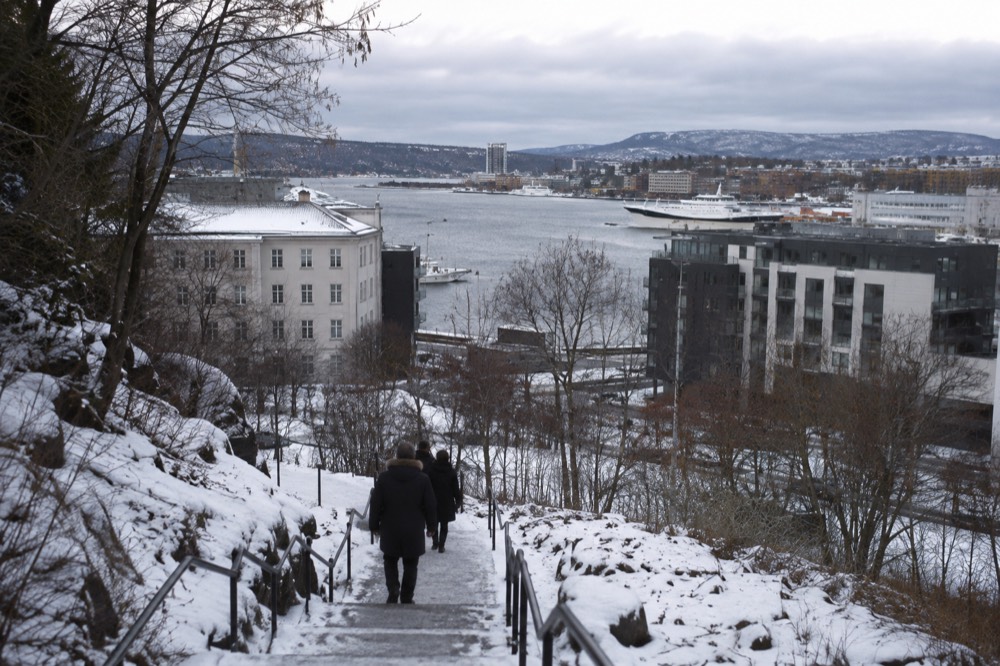
Winter is a real option for families, and Norwegians treat it that way. The snow and the dark are handled with infrastructure: the metro's line 1 climbs to Frognerseteren at the edge of Nordmarka, where the ski trails are groomed and the forest is the city's winter playground. Cold snaps are real, the observed low at Blindern in the 13 months to August 2026 was minus 17.2 °C, but the normals are close to minus 2, and the standard advice is layers and a proper snowsuit for small children rather than cancellation.
The honest seasonal planning table, built on MET Norway's official normals for the Blindern station:
| Season | Normal mean temp | Daylight range | Family verdict |
|---|---|---|---|
| Summer (Jun-Aug) | 15.3 to 17.7 °C | 15 h 38 m to 18 h 50 m | Best season: islands, swimming, long evenings |
| Autumn (Sep-Oct) | 6.6 to 12.2 °C | 10 h 13 m to 12 h 54 m | Museums plus forest color, fewer crowds |
| Winter (Nov-Feb) | -2.3 to 2.2 °C | 5 h 53 m to 9 h 14 m | Short days, but snow play and ski trails |
| Spring (Mar-May) | 1.3 to 11.4 °C | 11 h 45 m to 17 h 08 m | Unpredictable, cheap flights, thaw season |
The one thing not to promise children is the northern lights. Oslo sits well south of the auroral zone, and a sighting from the city needs a strong geomagnetic storm, a clear sky and a dark spot, a combination that arrives a handful of times a year and cannot be booked. If the aurora is the point of the trip, that is a Tromsø trip, a separate flight north, not an Oslo add-on.
Is Norway with Kids Easier Than It Sounds?
Yes, on three practical fronts: transport, language and safety. The metro-tram-bus-ferry system is one ticket, one app and one zone map, English is spoken so widely in Oslo that a phrasebook is dead weight, and the country's baseline safety level means the normal parental calculations run lower than in most European capitals. Norway is in Schengen but outside the EU, so border formalities for most European visitors are minimal, and the krone is the currency, not the euro.
Getting around with children deserves a specific word because it is where city trips usually break down. The Ruter system is fully integrated: the same ticket that carries the tram to Grünerløkka carries the ferry to Hovedøya and the metro to Sognsvann, children under six are free, and the app handles everything, which matters when you are holding a small hand and a stroller. The airport connection has a family-relevant wrinkle: the Flytoget express costs 268 NOK for an adult, while the Vy trains cover the same run in about 23 minutes versus 20, and the Oslo Pass covers the Vy trains outright.
The safety point is not about crime statistics, it is about ambient expectations. Norwegian cities are calm, children move around them independently by local custom, and the hazards parents actually manage are the weather and the water temperature rather than traffic or crowds. The fjord swimming is in supervised or designated spots, the harbour baths at Sørenga and Tjuvholmen among them, and July and August water temperatures of 15 to 20 °C mean swimming is a brisk pleasure rather than a given.
Food is the last practical worry, and it has a Norwegian answer. Restaurant meals for a family are the expensive line, so locals lean on supermarket picnic lunches, bakery items and the hot-dog stands that anchor Norwegian everyday eating. Service is included in prices, tipping is voluntary and modest, and card terminals accept contactless everywhere, so nobody in the family handles cash at all. The krone is the only currency you will meet, and cards handle it.
For readers weighing Norway against its neighbors, the Oslo vs Copenhagen and Oslo vs Stockholm comparisons cover the rival family-city options, and Oslo Travel Guide keeps the full planning layer, including seasonal and cost pages, under one roof.
Before the practical questions, the three bookable family picks one more time:
Common Questions About Visiting Norway with Kids
is norway worth visiting with kids?
Yes. Children enter most major Oslo museums free or for a small fee, the outdoor layer from the sculpture park to the fjord islands costs nothing beyond a transport ticket, and the costs that make Norway expensive, mainly restaurants and alcohol, mostly apply to adults. The main planning constraints are the winter daylight and the price of eating out.
What is the best age to take children to Norway?
Roughly five and up gets the most from it. Younger children still enjoy the ferries, the forest and the animals at the open-air museum, but school-age children can engage with the polar ships at the Fram Museum, the Kon-Tiki story, the climbing park courses and island swimming, which is where the trip becomes memorable rather than merely manageable.
Is Oslo expensive for families?
Only in the places families can avoid. Museum child tickets are free or around 70 NOK, under-6s travel free on public transport, and the outdoor sights cost nothing. Restaurants are the expensive line, so the standard family approach is supermarket and bakery food with one restaurant meal a day at most.
Do children need tickets for the Oslofjord island ferries?
The island ferries from Aker Brygge are ordinary Ruter lines, so child discounts and free travel for under-6s apply exactly as on a bus or tram. The Bygdøy museum ferry is a separate commercial service from Rådhusbrygge 3, where Ruter tickets are not valid, though the Oslo Pass does cover it.
Can you see the Viking ships in Oslo with kids?
Not yet. The former Viking Ship Museum on Bygdøy is closed and will reopen as the Museum of the Viking Age in 2027, with no month confirmed. Viking-age objects are on display at the Historical Museum in central Oslo, and Viking Planet, an interactive Viking experience with a VR movie, is the bookable family substitute.
Is Norway safe for family travel?
Yes, Norway is among the safer destinations in Europe for families, with calm cities, excellent tap water and widespread English. The realistic hazards are environmental rather than social: cold snaps in winter, cool swimming water in summer, and early darkness from November to February, all of which are planning matters rather than safety threats.