What Is the Best Way to Go from Copenhagen to Oslo?
Train, plane or overnight ferry from Copenhagen to Oslo: how the three routes compare, what each one costs at the Oslo end, and which suits your trip.

What Is the Best Way to Go from Copenhagen to Oslo?
The best way to go from Copenhagen to Oslo is the train if you want scenery and a city-centre-to-city-centre journey, the flight if you are short on time, and the overnight ferry if you want to arrive rested with a cabin and a sea view. There is no single winner. The train ride north through Sweden is the journey most travelers remember, the flight is the practical choice for a short trip, and the ferry turns travel into a night of rest. Your decision comes down to time, budget and how much of the journey itself matters to you.
All three routes land you in the same compact capital, and Oslo rewards arriving without a car. The city center is walkable, the public transport system covers everything else, and the airport is connected by two competing trains. That means the choice between Copenhagen departures matters less than what you plan to do once you step off at Oslo S.
This page walks through each option honestly: what the train actually gives you, what flying involves at both ends, and what the overnight ferry does well and badly. It also covers the practical Oslo end, borders, currency and the cheapest way from the airport into town, because that is where the avoidable costs sit. The site behind this page, oslotravelguide.com, exists precisely to answer the questions a first Copenhagen to Oslo trip raises.
Is the Train from Copenhagen to Oslo Worth It?
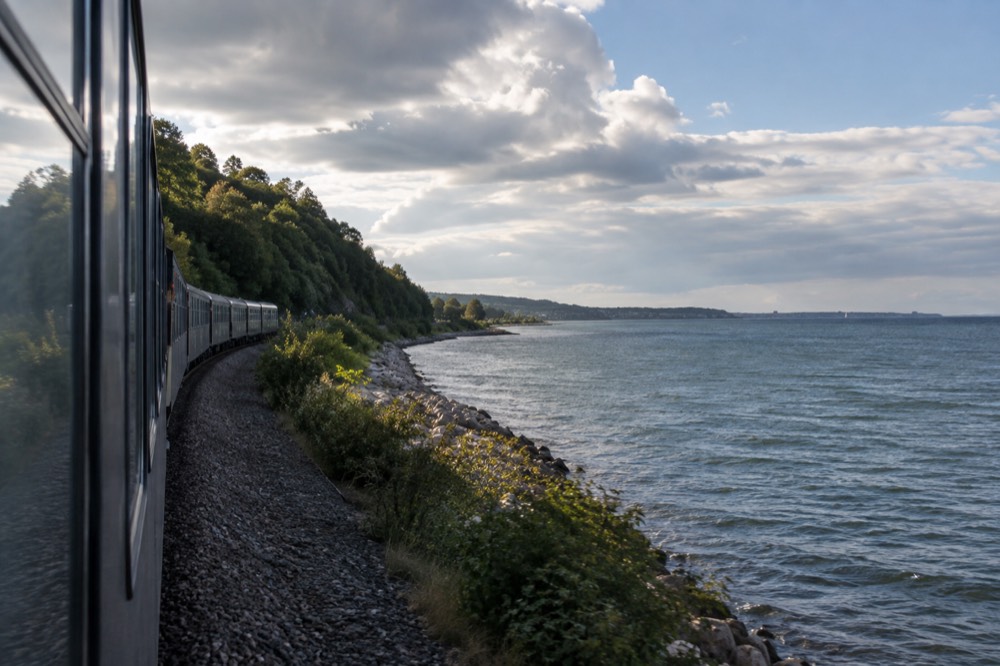
Yes, for most leisure travelers the train is the best way to go from Copenhagen to Oslo, because it runs city centre to city centre, removes two airport transfers and two security queues, and turns the journey itself into part of the trip. The route runs north through Sweden, changing at Gothenburg or riding a direct connection depending on the departure, and the final stretch along the Oslofjord approaches the city through water, forest and small Norwegian towns. You watch the landscape change from Danish farmland to Swedish lakes to Norwegian coastline without ever showing a boarding pass twice.
The honest trade-off is time. The train takes most of a day where a flight takes an hour or so in the air, so it only makes sense if you have the hours to spend and want to spend them this way. Travelers who sit by the left-hand window heading north generally report the better views in the final approach, and the Swedish leg has a quiet, unhurried rhythm that flying cannot reproduce.

Booking advice is straightforward. Swedish and Danish rail operators release tickets on a rolling basis and the cheapest fares disappear first, so book as early as your dates allow and check whether a change in Gothenburg is forced or optional. Seat reservations are worth having on the busier departures in summer. If your dates are fixed, lock them in early; if they are flexible, midweek departures are usually quieter than Friday and Sunday trains full of weekend travelers.
If you are already thinking about what the journey north looks like, our guide to the Oslo to Bergen train ride covers Norway's most spectacular rail route, which pairs well with this one if you are building a longer Scandinavian rail trip.
Once the train pulls into Oslo S you are a short walk from the Opera House, the Barcode district and the waterfront, which is exactly why the rail option feels so civil. There is no transfer, no baggage belt and no airport bus. You step off the train and the city starts immediately.
Is Flying from Copenhagen to Oslo the Fastest Option?
Flying is the fastest way between the two cities once you count only the flight itself, but the door-to-door gap narrows sharply once you add the transfers, security and waiting time at both airports, so the plane wins on total time but by less than the timetable suggests. Copenhagen's airport is close to the city it serves, and Oslo's airport is roughly 50 km from the center, so the "one hour flight" becomes a half-day project in practice. For a short trip where every hour in Oslo counts, flying still wins. For anyone who dislikes airports, the train wins the experience.
The route is a busy business corridor, which means frequent departures across the day and real competition on fares if you book ahead. Prices move with demand, so check the live listings rather than trusting any number printed in a guide, including this one. Morning and late-afternoon departures fill with business travelers; midday flights are often the calmer, cheaper ones.
The part most guides underplay is the arrival end. Oslo Airport Gardermoen is well connected but not cheap by habit, and the choice of train from the airport is a genuine decision with real money attached. That deserves its own section below, because it is the single most avoidable cost on a Copenhagen to Oslo trip.
One practical note on the ground at each end: both cities handle luggage and family travel efficiently, and both airports are compact by major-hub standards. If you are weighing a similar question for the Swedish capital, our piece on the train from Oslo to Stockholm covers that corridor in detail.
Is the Overnight Ferry from Copenhagen to Oslo a Good Way to Arrive?
The overnight ferry is the best way to go from Copenhagen to Oslo if you want to arrive rested, because you sleep through the journey and wake up at the Oslo waterfront with the city already in front of you. The overnight boat between Denmark and Norway is a genuine Scandinavian institution rather than a budget compromise: you get a cabin, a sea passage and a morning arrival, effectively folding a night of accommodation into the travel cost. For slow travelers and families it often beats both alternatives on enjoyment.
The trade-offs are real. You spend a night at sea that weather can make lively, the crossing uses a full evening and a full morning, and cabin quality varies with the fare you pick. Solo travelers sometimes find the cabin markup stings compared with a train seat. Check the operator's live listing for current sailings and cabin grades, because schedules and pricing shift seasonally and no honest guide should print them from memory. More of these guides are collected on Oslo Travel Guide. More of these guides are collected on Oslo Travel Guide.
Arriving by ferry has one underrated advantage: you come into Oslo by water, which is the city's own geography. The Oslofjord is the reason Oslo exists where it does, and arriving on it sets up the obvious first activity. The silent electric fjord cruise with audio guide is the city's single best-reviewed activity on either platform, and it departs from the central piers within walking distance of where the ferry and the train both deliver you.
If a water arrival appeals, our Oslofjord cruise guide covers every way to get out on the water once you are here, from electric boats to traditional sailing ships.
What About Driving from Copenhagen to Oslo?
Driving is the flexible option, and it makes sense only if the route itself is the trip, because a direct Copenhagen to Oslo drive takes most of a day and the two capitals are better connected by rail and air. The car earns its keep when you want to stop: the Swedish coastline north of Gothenburg, the Bohuslän fishing villages and the border towns are genuinely lovely, and a car lets you set the pace. As pure transport between the two cities it is the weakest of the options.
Costs stack up quietly. Fuel in both countries is expensive by European standards, motorway tolls and bridge crossings add up, and Oslo itself charges congestion-style road tolls on entry, which surprises drivers who expect a free ring road. Parking in central Oslo is scarce and costly. If your plan is city-to-city, leave the car behind and rent one locally for a specific day trip instead; our day trips from Oslo guide shows what is reachable once you are based in the city.
What Should You Know About Borders, Currency and Cards?
Norway is in the Schengen Area but is not a member of the European Union, and it uses the Norwegian krone, not the euro, so a Copenhagen to Oslo crossing involves no routine passport check but does involve a currency change. Norway is an EFTA state and a party to the EEA Agreement, which means free movement of people through Schengen's separate association agreement, but a customs border with the EU in practical terms. Travelers arriving from Denmark can generally cross without a passport stop, though carrying ID is standard practice and operators can check it.
The krone point catches people out. Denmark uses the Danish krone and Norway the Norwegian krone, and neither is the euro, so do not assume a wallet that worked in the Eurozone will work unchanged. Cards are accepted almost everywhere in Oslo, including buses, ferries and street food stalls, and contactless payment is the norm, so most visitors never need cash at all. Tap-to-pay on Oslo's public transport is available, though the app is the cheapest way to buy tickets.
Tipping is another small difference. Service is included in Norwegian prices, and rounding up or leaving something for good service is voluntary rather than expected, which visitors from tipping cultures often over-correct on. Card terminals may prompt for a tip; declining the prompt is completely normal.
What Is the Cheapest Way from Oslo Airport Into the City?
The cheapest way from Oslo Airport into the city is the Vy train on an ordinary Ruter ticket, not the Flytoget airport express, because Flytoget costs 268 NOK adult single while the Vy regional trains cover the same run in about 23 minutes at roughly half the point-to-point price. This is the single most avoidable cost on the whole Copenhagen to Oslo journey. Both trains leave from the same airport station and both reach Oslo S; the difference is about three minutes of journey time and a lot of kroner.
The mechanism most guides miss: the Vy trains are ordinary Ruter-zone trains, so a Ruter ticket covering zone 1 through zone 4N is valid on them, and the Oslo Pass covers them outright. You do not need a separate airport supplement; you need a multi-zone Ruter ticket bought in the app. Buying Vy's own point-to-point fare at the machine is the expensive way to take the cheap train. Oslo Airport is Ruter zone 4N, not 2Ø, a detail some automated sources get wrong.
| Option from Gardermoen | Adult single | Journey time | Notes |
|---|---|---|---|
| Flytoget airport express | 268 NOK | about 20 min | Departs every 10 minutes; child under 16 free with adult |
| Vy regional train (R10/R11/R12) | about half the Flytoget fare | about 23 min | Covered by a multi-zone Ruter ticket or the Oslo Pass |
| Flybussen coach | check the operator's live listing | 45-65 min, traffic dependent | Slower; confirm current fares before booking |
| Taxi | varies by operator | traffic dependent | Regulated per operator; agree the fare in advance |
If you hold an Oslo Pass, the airport transfer decision disappears: the pass includes Vy trains to and from Gardermoen alongside buses, trams, the metro and the ferries in zones 1, 2, 3, 4V and 4N. The pass prices below are the current VisitOSLO figures, and the pass also covers entry at over 30 museums and attractions, which is where the arithmetic gets interesting for a short trip.
| Oslo Pass | 24h | 48h | 72h |
|---|---|---|---|
| Adult | 580 NOK | 845 NOK | 995 NOK |
| Senior (67+) | 465 NOK | 675 NOK | 795 NOK |
| Child (6-17) | 290 NOK | 420 NOK | 495 NOK |
Three Bygdøy museums at full price, for instance, total 560 NOK on their own against a 580 NOK 24-hour pass that also carries you there and back and covers the airport train. Our is the Oslo Pass worth it guide runs the full break-even sums if you want the detail.
What Should You Do First Once You Arrive in Oslo?
Start with the waterfront, because every arrival route except the flight delivers you within walking distance of the Oslofjord piers, and the fjord is the city's defining geography, so the harbor is the natural place to get your bearings before anything else. The Opera House roof is free to walk on and sits between the ferry terminals and the central station, so it works as a first orientation stop whichever way you arrived. From there the harbor promenade runs west to Aker Brygge and Tjuvholmen, past the piers where the fjord boats leave.
If you only book one thing for your first day, the fjord cruise is the one most visitors choose, and the electric boat version is the city's best-reviewed activity on either platform, with thousands of reviews behind it. It runs about an hour and a half, which leaves the rest of the day free. Check availability if that sounds like your kind of arrival.
For a free first orientation instead, the big highlights walking tour is tip-based and covers the city center in about two hours, which pairs well with an afternoon museum. The Kon-Tiki Museum on Bygdøy is the best-reviewed museum ticket in the city and anchors a museum afternoon if the weather turns. Between the three, a first day in Oslo costs very little beyond lunch, and lunch is the one place where Oslo's prices will genuinely surprise you: Norway's food prices run about a third above the European average on Statistics Norway's own comparison.
Common Questions About Traveling from Copenhagen to Oslo
what is the best way to go from copenhagen to oslo?
The train is the best option for most leisure travelers, because it runs city centre to city centre and turns the journey into part of the trip. Flying is best if time is short, and the overnight ferry is best if you want to arrive rested with a cabin. All three land you in central Oslo within a short walk of the waterfront.
How long does the train from Copenhagen to Oslo take?
The train takes most of a day, with a change in Gothenburg on many departures. The final stretch runs along the Oslofjord into Oslo S. Book early for the cheapest fares, and reserve seats on busy summer departures.
Is there a direct ferry from Copenhagen to Oslo?
An overnight ferry service connects Denmark and Norway with cabins and a morning arrival at the Oslo waterfront. Schedules and cabin grades shift seasonally, so check the operator's live listing for current sailings and prices rather than a printed figure.
Do you need a passport to travel from Copenhagen to Oslo?
Norway is in the Schengen Area, so there is no routine passport check crossing from Denmark, though carrying ID is standard practice and operators can check it. Norway is not in the EU, so customs and duty-free rules differ from an intra-EU trip.
Does Norway use the euro?
No. Norway uses the Norwegian krone (NOK), not the euro. Cards are accepted almost everywhere in Oslo, including on public transport, and most visitors never need cash. Denmark, for its part, uses the Danish krone.
What is the cheapest way to get from Oslo Airport to the city centre?
The Vy train on a multi-zone Ruter ticket, which covers zone 1 through zone 4N and costs roughly half the Flytoget fare of 268 NOK for a journey only about three minutes slower. The Oslo Pass also covers Vy trains to and from the airport.