Is Oslo Colder Than Chicago?
Oslo's winter temperatures are milder than most people expect, while Chicago's are harsher than its latitude suggests. Here is how the two cities actually compare.
Is Oslo Colder Than Chicago?
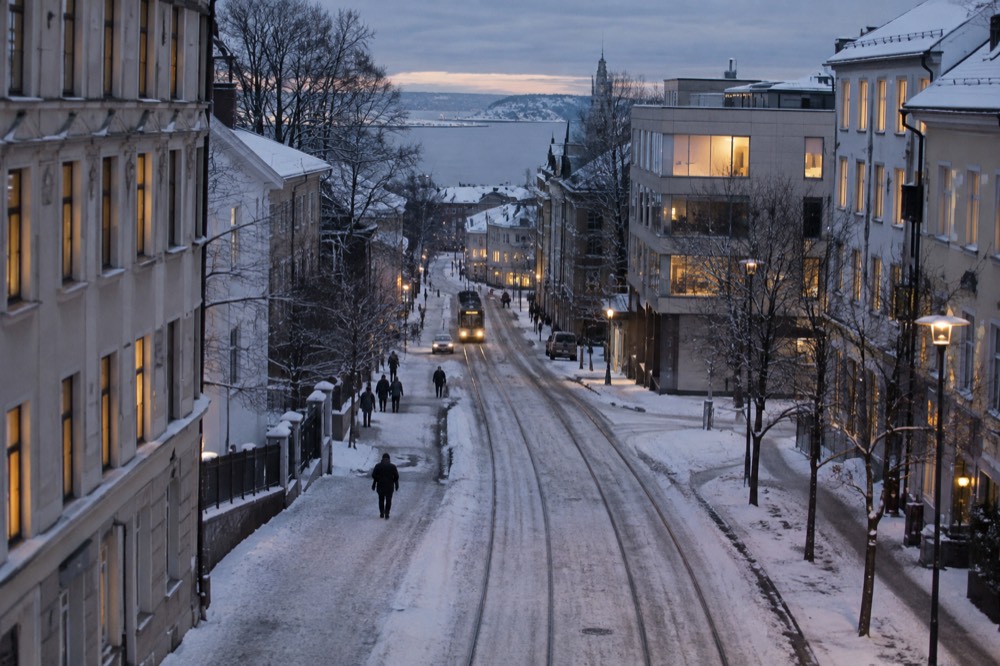
No, Oslo is not colder than Chicago in winter, and by a clear margin. Oslo's normal January mean is −2.3 °C (−4.9 °F in the January just measured at Blindern), while Chicago's winters are famously harsher than its mid-latitude position suggests, with more extreme cold snaps and a raw wind off the lake that Oslo rarely experiences. What Oslo has instead is darkness: barely six hours of daylight in late December. The cold is milder, the winter feels longer.
The comparison surprises people because it inverts the map. Chicago sits far south of Oslo on the globe, closer to the latitude of northern Spain than to Norway, and yet its winters are harsher than Oslo's more often than not. The reason is the North Atlantic Current, the extension of the Gulf Stream that keeps Norway's coast, and Oslo with it, far milder than its latitude deserves. Chicago, by contrast, sits on a flat lake plain with nothing between it and the Arctic air that drains south out of Canada.
So the honest answer splits in two. On the thermometer, Oslo wins, or loses, depending on how you look at it: the city's winter temperatures are milder than most visitors expect, and its summer temperatures are far cooler than Chicago's. On the experience of winter, the two cities trade blows in a way that raw numbers hide. This site has covered what winter in Oslo is actually like in depth, and the short version is that Oslo's winter is a dark, manageable, often snow-dusted season rather than an endurance test.
One note on sources before the numbers. Everything about Oslo below comes from MET Norway's official 1991 to 2020 climate normals for the Blindern station, which is the national weather service's own data, plus real observed readings from the past two winters. Where a claim about Chicago is made, it stays qualitative, because this site only publishes figures it can source, and the honest comparison does not need invented numbers to make its point.
How Do Oslo's Winter Temperatures Actually Compare?
Oslo's coldest months are January and February, with normal mean temperatures of −2.3 °C (−4.9 °F is a recent real reading, not the normal) and −2.0 °C respectively, and December averages −1.4 °C. These are mild numbers for 59.91 degrees north. Chicago's winters run colder than that on average, and its cold snaps plunge far deeper, because Oslo's maritime influence caps its extremes while Chicago's continental position amplifies them.
The key word in that answer is "normal." MET Norway's standard normals for Oslo Blindern, the 1991 to 2020 reference period, put January at −2.3 °C and February at −2.0 °C on the mean. Those are daytime highs and nighttime lows averaged together. Real winters swing around that mark: in the thirteen months to August 2026, the coldest reading at Blindern was −17.2 °C on 11 January 2026, which is genuinely cold, but it was a single night, not a season.
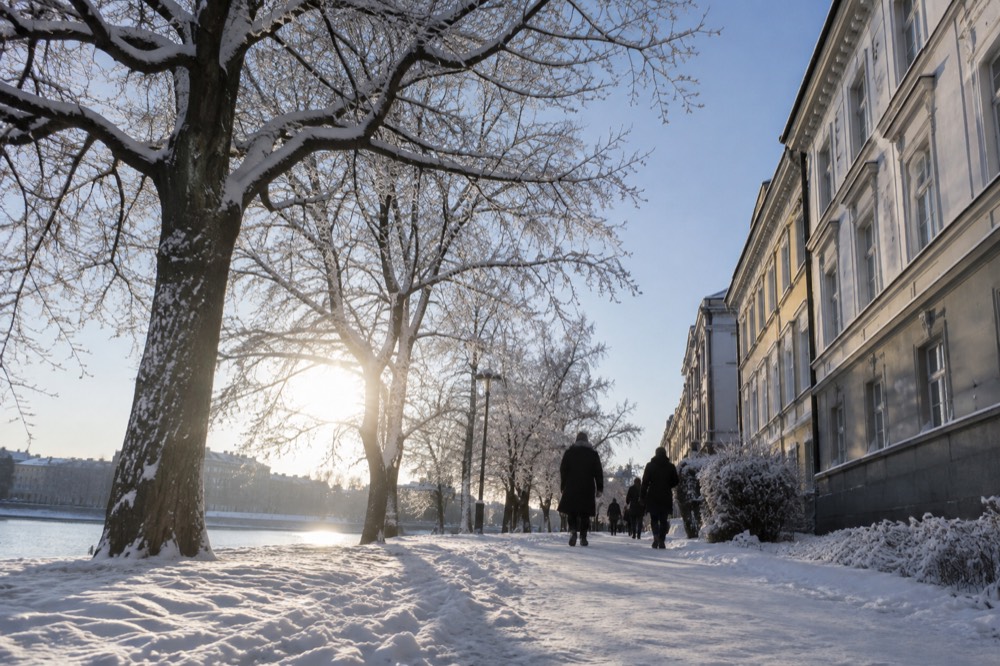
Chicago's relationship with cold is different in kind. The city is famous for wind chill for a reason: air masses sweep off Lake Michigan and across a downtown built along the shoreline, and the combination of damp wind and sub-zero air makes the felt temperature far lower than the thermometer says. Oslo's winter air is typically drier and calmer. A −5 °C afternoon in Oslo, with low sun on the snow and no wind, can feel pleasant in a way a −5 °C afternoon on a Chicago lakefront almost never does.
Here is Oslo's full monthly picture, from MET Norway's normals plus the observed readings of the most recent season:
| Month | Normal mean temp | Observed 2025/26 | Normal precip |
|---|---|---|---|
| Jan | −2.3 °C | −4.9 °C | 58 mm |
| Feb | −2.0 °C | −5.0 °C | 46 mm |
| Mar | 1.3 °C | 3.5 °C | 41 mm |
| Apr | 6.2 °C | 8.0 °C | 48 mm |
| May | 11.4 °C | 11.7 °C | 60 mm |
| Jun | 15.3 °C | 16.7 °C | 80 mm |
| Jul | 17.7 °C | 18.5 °C | 87 mm |
| Aug | 16.5 °C | 16.2 °C | 103 mm |
| Sep | 12.2 °C | 13.5 °C | 82 mm |
| Oct | 6.6 °C | 7.9 °C | 93 mm |
| Nov | 2.2 °C | 3.8 °C | 85 mm |
| Dec | −1.4 °C | 2.4 °C | 54 mm |
Two details in that table deserve a second look. First, Oslo's July normal of 17.7 °C is mild, not hot: this is a city where the recent summer high of 32.9 °C, recorded on 15 July 2026, was a genuine headline event. Chicago's summers are routinely warmer and far more humid. Second, the December just observed came in at +2.4 °C against a −1.4 °C normal, a reminder that Oslo winters are variable and that recent ones have trended mild.
If a winter trip is on your calendar, the cold is the part you need to worry about least. Oslo has built an entire winter culture around the season, and the experiences worth booking are the ones that use it: the torchlit forest walk with a campfire, the learn-to-ski half-day, and the museums for the dark afternoons in between.
Why Does Latitude Lie? The Ocean Current Behind Oslo's Mild Winters
Oslo sits at 59.91 degrees north, roughly the same latitude as Anchorage, Alaska, and hundreds of kilometers north of Chicago, yet its winters are milder than both. The North Atlantic Current carries warm water from the Gulf Stream across to the Norwegian coast, releasing heat into the air that sweeps over the whole region. Chicago has no such ocean buffer; it gets continental air straight off the Canadian plains and a wind tunnel of a lakefront instead.
That is the whole explanation in one paragraph, and it is one of the most useful pieces of Nordic travel knowledge there is. Latitude is a poor predictor of climate in the North Atlantic world. The same current that keeps Oslo mild keeps the whole Norwegian coast ice-free in winter, at latitudes where harbors in Canada and Russia freeze solid.
It also means Oslo's cold is different in texture. It arrives in clear, still, high-pressure spells: dry air, blue twilight, squeaky snow underfoot. Chicago's cold arrives on wind, often with damp, and the wind chill is the thing locals talk about rather than the thermometer. Visitors from the American Midwest consistently report that Oslo's −5 °C feels more manageable than Chicago's −5 °C, and they are not imagining it.
The flip side, and it is a real one, is that the same geography that warms Oslo also darkens it. The city is far enough north that winter daylight collapses, and that, not the temperature, is what visitors from Chicago find hardest. If you are planning around the season, the site's guide to Oslo's daylight hours by month has the full breakdown, and it is worth reading before you book anything.
Daylight: The Difference Between the Cities That Actually Matters
Oslo gets 5 hours 53 minutes of daylight on 21 December, with sunrise at 09:18 and sunset at 15:11, against 18 hours 50 minutes on 21 June. Chicago's winter days are several hours longer, because it sits far south of Oslo. In practical terms, an Oslo winter trip means planning your outdoor sightseeing into a narrow midday window and accepting that the city lights up early.
This is the honest trade, and no amount of Gulf Stream warmth changes it. MET Norway's sunrise data for Oslo, at 59.9139 N, puts the winter solstice sun above the horizon for under six hours. By mid-January it is 6 hours 45 minutes, by mid-February 9 hours 14 minutes, and the recovery accelerates from there. By the summer solstice the sun sets at 22:43 and rises at 03:53, and the gap between is deep twilight rather than true night, so it never gets properly dark. Everything else covered here is indexed on Oslo Travel Guide. Everything else covered here is indexed on Oslo Travel Guide.
| Date | Sunrise | Sunset | Day length |
|---|---|---|---|
| 15 Jan | 09:04 | 15:49 | 6 h 45 m |
| 15 Feb | 07:54 | 17:08 | 9 h 14 m |
| 15 Mar | 06:34 | 18:19 | 11 h 45 m |
| 15 Apr | 06:00 | 20:34 | 14 h 34 m |
| 15 May | 04:40 | 21:48 | 17 h 08 m |
| 21 Jun | 03:53 | 22:43 | 18 h 50 m |
| 15 Jul | 04:21 | 22:23 | 18 h 02 m |
| 15 Aug | 05:31 | 21:09 | 15 h 38 m |
| 15 Sep | 06:44 | 19:38 | 12 h 54 m |
| 15 Oct | 07:55 | 18:08 | 10 h 13 m |
| 21 Dec | 09:18 | 15:11 | 5 h 53 m |
A note on a myth that follows this latitude around: there is no midnight sun in Oslo. Midnight sun requires being north of the Arctic Circle at roughly 66.5 degrees north, and Oslo is nearly seven degrees south of it. Late June evenings are endless twilight, bright enough to read outdoors at midnight, but the sun does set. Anyone promising you a midnight sun experience from Oslo is selling you something that does not exist, as this site's northern lights and midnight sun pages explain plainly.
The practical consequence for a winter visitor is schedule, not suffering. Oslo in December means museums and cafés after 15:00, and the outdoor hours before it. Locals structure their whole winter this way, and the city does too: the waterfront lights up, the bars and restaurants fill early, and the darkness becomes the backdrop rather than the obstacle.
What Should You Pack for an Oslo Winter?
Pack for dry cold around freezing, not for a Chicago deep freeze: a proper windproof coat, warm boots with grip, wool layers, and something reflective or bright, because you will be walking in the dark by late afternoon. Oslo's temperatures hover near zero rather than plunging far below it, so the trap is overdressing for a city that is milder than you feared and then sweating on public transport.
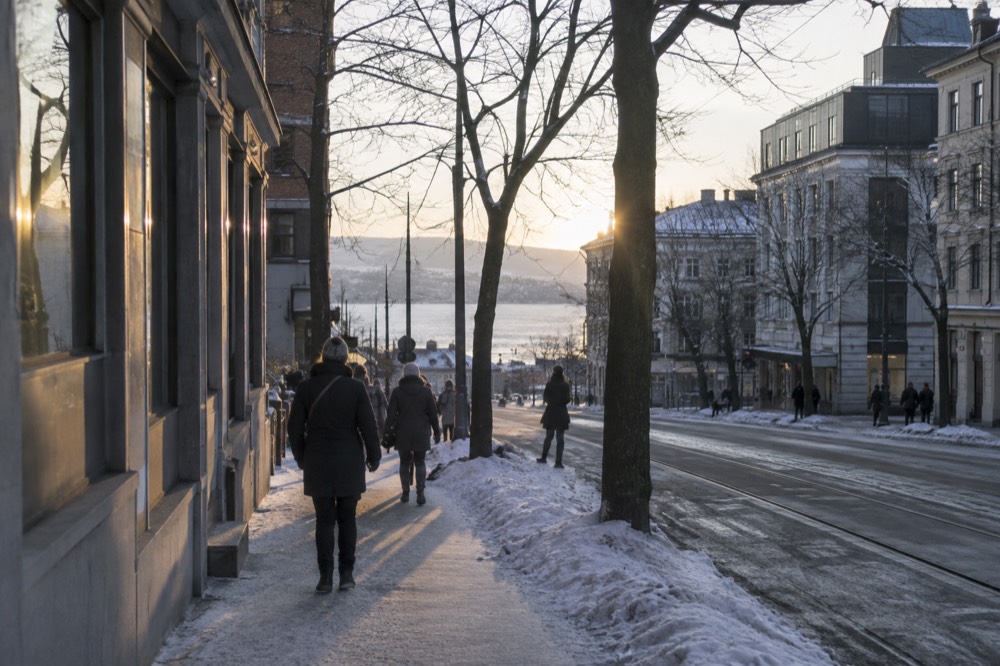
The single most common mistake visitors from North America make is bringing expedition gear for a city whose January mean is −2.3 °C. That is a mild winter by continental standards. What Oslo does have is ice: freeze-thaw cycles around zero mean sidewalks and paths can be slick, and traction matters more than insulation. Locals wear studded soles from December through March.
The second most common mistake is planning a summer wardrobe for July. Oslo's July normal of 17.7 °C is pleasant, but the same normals show 87 mm of rain in that month, and August is the city's wettest month at 103 mm. Pack layers and a rain shell for summer, serious grip and a warm hat for winter, and you have both seasons covered. The site's month-by-month Oslo weather guide carries the full detail, including the rainfall pattern that catches out visitors who assume the Nordic summer is dry.
One more thing worth knowing, because it shapes how a cold day in Oslo actually runs: Norwegians do not retreat indoors in winter, they head out. The metro line to Frognerseteren runs year-round into the Nordmarka forest, the cross-country trails are groomed by Skiforeningen through the whole season, and the city's winter experiences are built around the cold rather than in spite of it.
The torchlit forest walk with a campfire is the clearest example on the roster. It runs three and a half hours, rated 4.7 across 280 reviews, and it exists precisely because an Oslo winter evening is something you can be out in, comfortably, by torchlight, with a fire at the end of it.
Which City Should You Visit in Winter?
Choose Oslo for a gentler cold, a dramatic dark season, and winter culture built around the outdoors; choose Chicago for bigger city energy, deeper cold snaps, and longer winter days. Oslo's winter is more atmospheric and easier on the body, Chicago's is more intense on the thermometer and easier on the sleep schedule. Neither is a bad pick, but they are different products, and the daylight swing is the deciding factor for most people.
If the idea of walking a torchlit forest path to a campfire, skiing inside the city limits on a metro ticket, or sitting in a warm café while blue twilight settles at 15:30 appeals to you, Oslo in winter is close to unbeatable. The season runs from November through March, and the city is built for it in a way few capitals are. The learn-to-ski half-day, rated a perfect 5.0 across its review base, is the kind of product that simply does not exist in Chicago, and it exists in Oslo because the terrain, the transit, and the culture all support it.
If instead you want a dense downtown winter, theater and shopping packed into a compact loop, and daylight that lasts past five o'clock, Chicago delivers that and Oslo does not. The honest framing is not which city is colder but which winter you want to be inside. For planning the Oslo side, the site's best time to visit guide walks through the trade-offs month by month, and as the publisher of this whole site we would point you there next.
One budget note, because cost always plays into this comparison: Norway is the sixth most expensive country in Europe on Statistics Norway's 2025 price-level survey, with household prices 28.6 percent above the EU average and alcohol and tobacco more than double the European average. Chicago is not a cheap city either, but Oslo's restaurant and bar prices are on a different scale. The cold will be milder than you expected; the bill may not be.
Common Questions About Oslo vs Chicago Winters
is oslo colder than chicago?
No. Oslo's normal January mean is −2.3 °C and February's is −2.0 °C, milder than Chicago's typical winter, because the North Atlantic Current warms Norway's coast while Chicago sits exposed to continental Arctic air. Oslo's cold is real but moderate; its winter extremes, like the −17.2 °C night recorded on 11 January 2026, are the exception rather than the season's baseline.
Does Oslo get a lot of snow?
Oslo gets regular snow through the winter months, and the city is set up for it, with groomed cross-country trails in the surrounding Nordmarka forest and a metro line that runs to the trailheads year-round. The snow sits alongside temperatures hovering around freezing, so it comes and goes in the city center while lasting longer in the hills above it.
Is Oslo dark in winter?
Yes, and that is the real difference from Chicago. Oslo gets 5 hours 53 minutes of daylight on 21 December, with sunrise at 09:18 and sunset at 15:11. Chicago's winter days are several hours longer because it sits far south of Oslo's latitude of 59.91 degrees north.
Does Oslo have a midnight sun in summer?
No. Midnight sun requires latitude north of the Arctic Circle, roughly 66.5 degrees north, and Oslo is nearly seven degrees south of that. In late June the sun sets at 22:43 and rises at 03:53, and the gap between is bright twilight rather than true night, so it never gets properly dark, but the sun does set.
What is the coldest month in Oslo?
January, with a normal mean of −2.3 °C, closely followed by February at −2.0 °C. December's normal is −1.4 °C. These are MET Norway's official 1991 to 2020 normals for the Blindern station, and recent observed winters have swung both above and below them.