Is the Train Ride from Oslo to Bergen Worth It?
An honest answer to whether the Oslo to Bergen railway is worth the time and money, with real cost context, daylight planning facts and the fjord alternatives.
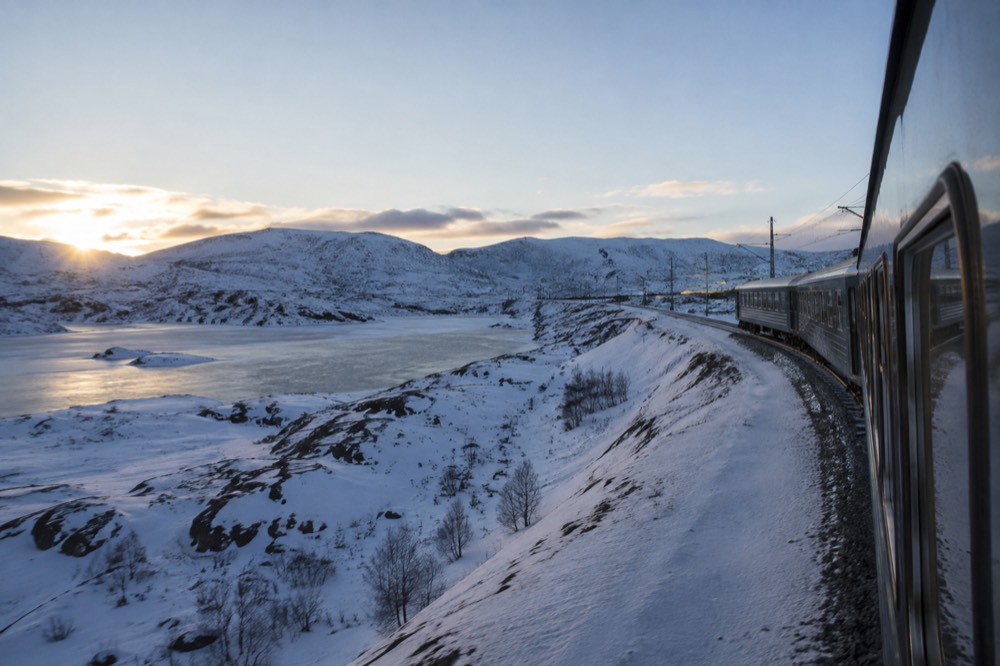
Is the Train Ride from Oslo to Bergen Worth It?
Yes, for most travelers the Oslo to Bergen train is worth it, with one condition: you should want the journey itself to be part of the trip, not just the transport. The line climbs from the Oslo valley onto a bare high mountain plateau and drops back down to the coast, and the middle stretch is the part people remember. If you are simply trying to get between the two cities as cheaply and quickly as possible, a flight does that job better.
The question is worth asking carefully, because the answer has changed shape over the last few years. Norway is the sixth most expensive country in Europe on Statistics Norway's 2025 price-level comparison, with household prices sitting 28.6 percent above the EU average, so a long-distance rail ticket here is not a small purchase. At the same time, the railway between Norway's two biggest cities is genuinely one of the continent's great rides, and it crosses terrain that no road and no flight can show you.
This page walks through what the journey actually involves, what it costs in the context of Norwegian prices, when it beats flying, and when the fjord alternatives, including the famous Flåm Railway branch line, are the smarter use of a day. The site covers the full route in detail in the Oslo to Bergen train guide, so this page stays on the decision itself.
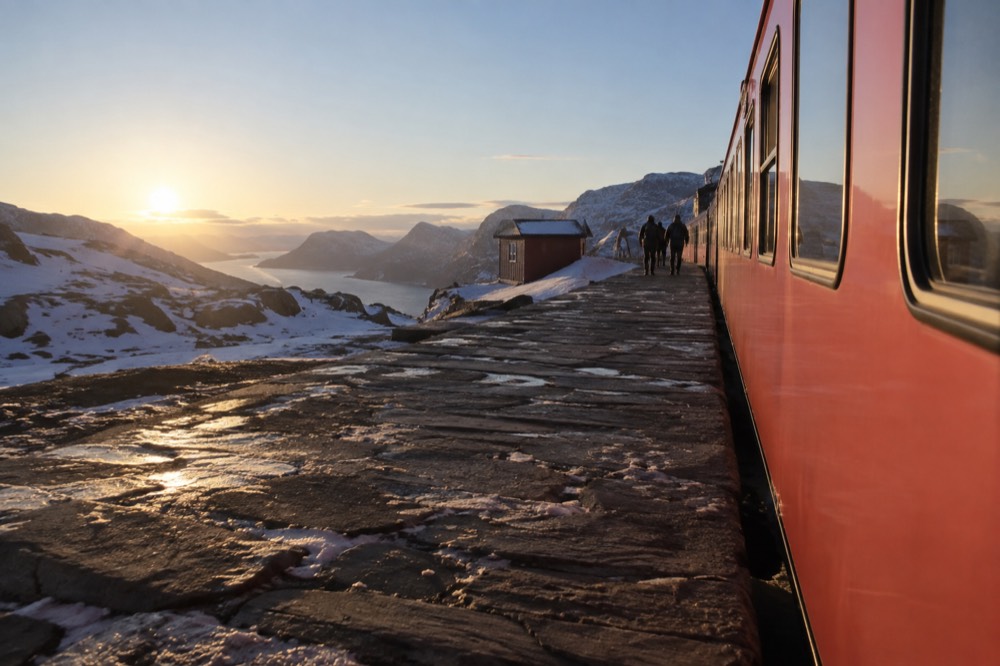
What Is the Journey Actually Like?
The route crosses the Hardangervidda, a high mountain plateau that sits above the tree line for a long stretch in the middle of the ride, and this is where almost all of the scenery that gives the line its reputation lives. The eastern half climbs out of the Oslo region through forests and lakes, the plateau section is open and windswept, and the western half descends through steep valleys toward the coast at Bergen. Weather decides most of what you see.
A few practical points shape the experience more than most write-ups admit. The first is daylight. Oslo's day length swings from 5 hours 53 minutes on 21 December to 18 hours 50 minutes on 21 June, per MET Norway's sunrise data, and the mountain stretch is where a winter departure can mean you see almost nothing of the plateau. A ride in January and a ride in June are, in practical terms, two different journeys. There is no midnight sun anywhere in Norway this far south, but in late June the evening light stretches long past 22:00, which is ideal for a westbound arrival into Bergen.
The second is where you sit. The line's most photographed section, the descent toward the western fjords, rewards a seat on the correct side of the carriage, and the descent includes snow tunnels and avalanche galleries built to keep the plateau section operable through winter. Those structures are their own kind of spectacle, engineering on a scale that surprises people expecting a gentle scenic railway. The galleries exist because the Hardangervidda holds snow well into spring, and the railway's operators have spent a century learning how to keep a high-altitude line open through Norwegian winters. You will pass through stretches where the track is sheltered under a roof of stone for hundreds of meters at a time, with the mountain visible through the openings.
The third is that this is a working intercity service, not a tourist train. It carries commuters, students and families visiting relatives, and it runs in all weather. That is part of the appeal: nothing about the ride is staged for visitors. There is no commentary, no reserved panorama car in the high season sense of some Alpine railways, and no obligation to photograph anything. You buy a ticket, find a seat, and watch Norway change climate zones outside the window over the course of a few hours.
The fourth point is the food situation. There is an onboard café, but Norwegian catering prices reflect the national price level, and Statistics Norway's survey puts food and non-alcoholic drink 33 percent above the European average, with alcohol at more than double. Many regulars bring their own supplies and treat the café as a backup. Supermarkets in Oslo sell beer and cider only up to 4.7 percent ABV, and wine and spirits are sold only through the state monopoly Vinmonopolet, which closes early on Saturdays and stays shut on Sundays, so anything you want to carry aboard should be bought the day before if you are traveling on a weekend.
If the plateau section is the reason you are booking, time your departure so you cross it in daylight. That single decision does more for the value of the ticket than anything else you can control. A westbound morning departure in summer gives you the climb, the plateau and the descent all in full light, and it puts you into Bergen with the whole evening ahead of you, which matters in a city where the harbor and the Bryggen wharf are at their best in low evening sun.
What Does It Cost Compared with Flying?
Flying between Oslo and Bergen is faster door to door and usually cheaper, while the train costs more and takes most of a day, so the train only wins on value if you count the scenery as the product you are buying. On a strict money-and-time calculation the flight wins, and on a trip-memory calculation the train usually does. That is the whole trade, and it is not subtle.
Norwegian domestic flights between the two cities are frequent and competitively priced, and the flight time is well under an hour. The train, by contrast, is a full-day commitment in each direction. What the train sells is the hours in between the cities, and the honest question is what those hours are worth to you.
Context helps with the price side. Statistics Norway's 2025 comparison puts food and non-alcoholic drink 33 percent above the European average and alcohol and tobacco at more than double, so every ancillary cost on a Norwegian travel day, the station café, the onboard snack, the dinner on arrival, lands on the expensive end of the European scale. The rail fare itself is best treated as a booked-ahead purchase rather than a walk-up one, the same way you would treat the flight. Norwegian long-distance rail pricing moves with demand, and the travelers who pay the most are the ones who decide on the morning of travel.
There is also a hidden cost worth naming: the day itself. A flight between Oslo and Bergen costs you a morning or an afternoon. The train costs you an entire day of a trip that, for most American visitors, runs seven to ten days total. If you are deciding between the train and a flight, you are really deciding whether the Hardangervidda is worth roughly a tenth of your Norway trip. For many people it is. For some it is not, and neither answer is wrong.
| Cost factor | Train | Flight |
|---|---|---|
| Time in transit | Most of a day each way | Under an hour in the air |
| Typical fare position | Higher, best booked ahead | Usually cheaper, frequent competition |
| What you get for it | The Hardangevidda plateau crossing | Point-to-point speed |
| Weather exposure | Runs in all conditions, views depend on it | Views above cloud, delays possible |
| Baggage | Generally more generous | Airline rules apply |
One structural fact worth knowing before any Norwegian rail or air booking: Norway is in the Schengen Area but is not a member of the European Union. It is an EFTA state party to the EEA Agreement, it sits outside EU VAT so duty-free allowances and visitor VAT refunds apply, and the currency is the Norwegian krone, not the euro. None of that changes the ticket, but it explains why the prices feel the way they do and why your card receipts are all in NOK. It also means the duty-free shop at Oslo Airport works for arriving travelers in a way it would not inside the EU customs union, which is a small but real offset to Norwegian alcohol prices if you drink.
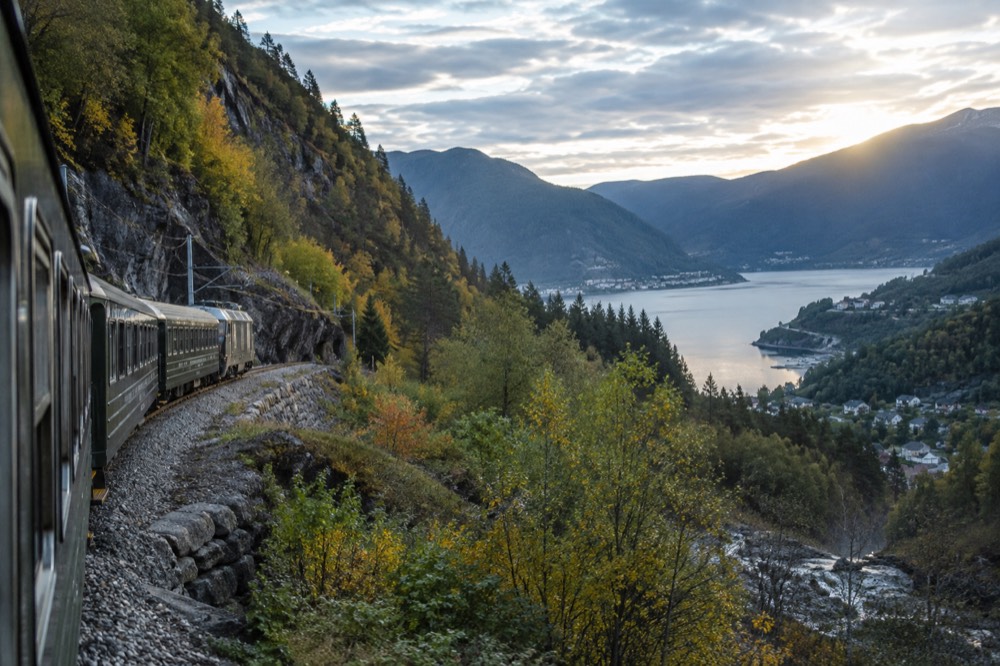
Is the Flåm Railway a Better Use of Your Day?
For many visitors, yes: the Flåm Railway branch line, paired with a Sognefjord boat leg, is a more concentrated dose of the same scenery, and it can be done from Oslo as a single very long day trip. The full Bergen line spreads its drama across hours, while the Flåm branch compresses the mountains-and-fjord experience into a shorter, steeper, more famous descent. If fjord scenery rather than the city of Bergen is your actual goal, the branch line is the sharper tool.
The branch line is the centerpiece of what the travel industry sells as the Norway-in-a-Nutshell routing, which the site covers in full in the Norway in a Nutshell guide and the Flåm Railway guide. The concept is simple: rather than riding the whole Bergen main line, you branch off partway, descend to the fjord village of Flåm by one of the steepest standard-gauge railway lines in the world, and continue by boat on the Sognefjord.
The trade-offs are real. Doing it as a day trip from Oslo means a very early start and a very late return, and the public-transport version involves stitching together several timed connections, any one of which can slip. The private version removes the connection risk entirely, which is why it exists and why it reviews well: the single worst way to experience Norwegian scenery is while watching a departure board and hoping. The full index of guides sits on Oslo Travel Guide. The full index of guides sits on Oslo Travel Guide.
The private full-day option pairs the Flåm Railway with the Sognefjord and returns you to Oslo the same evening, and it is the best-reviewed same-day answer to this exact question on the roster. For travelers who cannot give two days to an overnight in Bergen, it converts the Nutshell idea from a logistics puzzle into a single booking. You can also check availability for the Sognefjord and Flåm day trip alongside the internal write-up.
When Does the Train Clearly Win?
The train wins when Bergen itself is the destination, when you have at least one night there, and when the journey is daylight-limited anyway because you would lose those hours to an airport. It also wins for anyone who dislikes domestic flying, for photographers who want the plateau, and for travelers connecting the two cities as part of a longer Norway loop. It loses badly for a tight schedule, a same-day return, or a winter week with short days and heavy cloud.
A few scenarios make the decision obvious in each direction.
If your Norway trip is Oslo plus Bergen, with a night or two in each, the train in one direction is close to mandatory. Most itineraries on this site, including the 3 days in Oslo itinerary, assume you will spend your Oslo time on the city and the Oslofjord, then hand the mountains to the intercity leg. Riding the train west and flying back east is the classic combination, and it is the one that leaves the fewest people regretting the purchase. Bergen rewards an overnight in a way few Norwegian cities do: the Bryggen wharf, the fish market and the Fløibanen funicular are all within a short walk of the station, so the train delivers you directly into the middle of the thing you came for.
If your trip is Oslo only, with a spare day, the full Bergen line is the wrong tool. You would spend the entire day on trains and arrive back with nothing but a window seat's memory of a plateau. The fjord alternatives around Oslo itself are the better fit. The ferry-and-foot island hopping tour on the Oslofjord is the Oslo-specific product the fjord makes possible, and it fits inside a half-day rather than consuming one whole. The Oslofjord cruise guide covers the boat options, and the island-hopping walk is the most-reviewed way to do it. The islands it reaches, including Hovedøya with its ruined Cistercian abbey and the swimming beaches of Langøyene, ride on ordinary Ruter tickets from the Aker Brygge piers, which makes them the cheapest fjord-water experience in the region by a wide margin.
| Your situation | Better choice | Why |
|---|---|---|
| Oslo plus Bergen, one night each | Train one way, fly the other | Full plateau crossing plus a fast return |
| Oslo only, one spare day | Fjord day trip or Oslofjord boat | Bergen line consumes the whole day |
| Winter, short days | Fly, or pick a fjord tour | Plateau section may be in darkness |
| Photographer, long summer days | Train, westbound | 18-hour June daylight over the plateau |
| Dislike domestic flying | Train both ways | Two crossings, two full days |
The winter point deserves emphasis because it is the one people get wrong. In late December the Oslo region sees under six hours of daylight, and the plateau stretch is exactly the part of the line a midwinter departure hides. A summer booking and a December booking are not the same product, whatever the timetable says. That said, a winter crossing has its own audience: the Hardangevidda under snow, seen from a warm carriage in the few hours of blue light, is a serious landscape, and the line's snow galleries are at their most dramatic when there is something for them to hold back. Just go in with your eyes open about how much of the ride you will actually see.
What Should You Know Before Booking?
Book ahead, pick a daylight departure, sit on the correct side for the western descent, and treat the onboard café as a backup rather than a plan. Those four decisions cover almost everything that separates a great crossing from a disappointing one. None of them costs anything extra, which is unusual in a country this expensive.
The booking side first. Norwegian long-distance fares are demand-priced, and the spread between an early booking and a walk-up purchase can be substantial. The same logic applies to the return leg if you are flying one way: Norwegian domestic aviation is competitive precisely because it is a high-volume route, and the bargains go to people who commit early. If your dates are fixed, book early; if they are flexible, the shoulder months of May, early June and September combine decent daylight with thinner demand.
The practical side is mostly about the mountain stretch. The plateau sits above the tree line, which means wind, and the weather up there is a different proposition from the weather in Oslo on the same morning. A clear forecast for the crossing is worth checking the day before, and the Norwegian meteorological service's forecasts are the reference the whole country uses. If the plateau is forecast in cloud, the eastern and western thirds of the ride still deliver, but the famous middle will be a white-grey blur, and that is the risk you take.
Finally, remember what this ride is not. It is not a heritage railway with a gift shop, and it is not a cruise on rails. It is a scheduled intercity service through some of the most quietly dramatic terrain in northern Europe, and its value depends entirely on whether that sentence appeals to you. For most people asking this question, it does.
Common Questions About the Oslo to Bergen Train
is the train ride from oslo to bergen worth it?
For most travelers, yes, provided the journey itself is what you are buying. The line crosses the Hardangevidda mountain plateau and descends to the coast at Bergen, and the middle stretch is genuinely spectacular. If you only need to get between the cities quickly and cheaply, fly instead.
How long does the Oslo to Bergen train take?
The journey takes most of a day, so treat it as a full-day activity rather than a commute. Timetables and exact durations vary by departure, so check the operator's live listing or the Vy planner when you book.
Is the train better than flying from Oslo to Bergen?
On pure speed and price, no: flights are shorter and usually cheaper. The train wins on the experience, because the plateau crossing is scenery no flight or road can offer. Many travelers ride the train west and fly back east.
Is the Flåm Railway better than the full Bergen line?
They serve different goals. The Flåm branch is a shorter, steeper, more concentrated fjord descent that can be done from Oslo as one long day trip, while the full Bergen line spreads its scenery across a full day and ends in Bergen. Pick Flåm for fjords, pick the main line for Bergen.
What is the best time of year for the Oslo to Bergen train?
Summer, for daylight. Oslo's day length runs from 5 hours 53 minutes in late December to 18 hours 50 minutes in late June, and the plateau section is the part a dark winter departure hides completely. June through August gives you the full crossing in light.
The short version: the Bergen line is worth it when the ride is the point, the flight is worth it when the city is the point, and the Flåm branch is worth it when the fjord is the point. Decide which of those three you are actually buying, and the answer to this question answers itself.