Is Oslo or Copenhagen Better?
A head-to-head comparison of Oslo and Copenhagen for city breaks: cost, weather, daylight, museums, food and which city fits which trip.
Is Oslo or Copenhagen Better?
Neither city is simply better, and the honest answer is that Copenhagen wins a first-time city break while Oslo wins a trip built around nature, daylight and the water. Copenhagen is denser, easier to cycle, cheaper to eat well in and more polished for a two- or three-day visit. Oslo costs more, spreads wider and demands a little more planning, but it hands you a fjord, forested hills and islands inside the city limits, which Copenhagen simply does not have.
That one-line verdict hides the real decision, which is about what kind of traveller you are on this particular trip. The two capitals are often lumped together as "Scandinavia" by people who have been to neither, and they do share a look: clean lines, blond brick, water on at least one side, coffee taken seriously, and prices that make visitors from almost anywhere else wince. Beyond that surface they diverge sharply, and choosing the wrong one for the wrong trip is the difference between a great week and an expensive shrug.
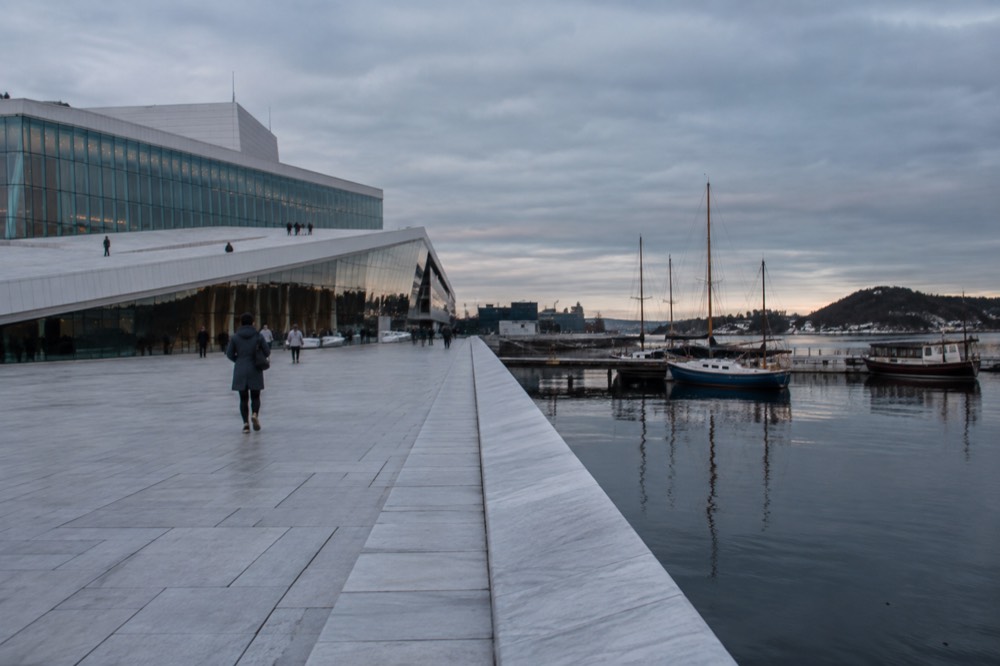
Oslo is a capital that keeps escaping its own city limits. The metro runs from the centre into Nordmarka, a protected forest of trails and small lakes, in under forty minutes. The Oslofjord pushes islands into the middle of the harbour, and you can ride an ordinary public ferry out to Hovedøya or Gressholmen on a regular transit ticket. The Opera House roof is a public plaza you walk up for free. Copenhagen, by contrast, is a city that turns inward: its pleasures are interior and urban, the cafés and bakeries of streets like Jægersborggade, the Tivoli gardens, a harbour cleaned up so thoroughly that people swim in it off the Islands Brygge quay. Both are real. They are just different products.
This page works through the comparison the way you would actually decide it: what each city is best at, what each costs, what winter does to both, how easy each is to reach and move around in, and what you can genuinely book once you are there. Every Oslo figure below comes from the city's own published sources, the tourist board, the transport authorities and the museums themselves, so you are comparing real numbers rather than vibes.
What Kind of Trip Is Oslo Better For?
Oslo is the better city for anyone whose holiday needs the outdoors in it: hikers, swimmers, island-hoppers and anyone who wants a capital with forest at the end of a metro line. It is also the better choice for design and maritime history, with the Fram and Kon-Tiki museums, the Opera House and the National Museum's Edvard Munch room all within a compact waterfront. If your ideal evening is a boat deck rather than a bar stool, Oslo wins outright.
The thing that makes Oslo unlike almost any other European capital is scale of access. From the Nationaltheatret station in the absolute centre, T-bane Line 1 climbs to Frognerseteren at the edge of Nordmarka in about twenty minutes, and from there you are on foot in a forest the city protects rather than builds on. In summer the same ticket logic carries you onto the water: the island ferries B1 and B2 leave from Aker Brygge on an ordinary Ruter fare and circle Hovedøya, Lindøya, Gressholmen and Langøyene. There is a ruined Cistercian abbey on Hovedøya, and Langøyene is the swimming and camping island. No other capital in this comparison offers that, and Copenhagen's equivalent, the trip up the coast to Louisiana Museum of Modern Art or the Kronborg castle at Helsingør, is a train ride rather than a ferry.
The museums tilt maritime and polar in a way Copenhagen's do not. The Fram Museum holds the ship that carried Fridtjof Nansen and later Roald Amundsen into the ice, and you walk aboard it. Next door, the Kon-Tiki Museum holds the balsa raft Amundsen's contemporary Thor Heyerdahl sailed across the Pacific in 1947. Both sit together on the Bygdøy peninsula, reachable in summer by a museum ferry from Rådhusbrygge 3, and a combined Kon-Tiki and Fram ticket costs 325 NOK at the door. Add the National Museum in the centre, which holds one version of The Scream, and MUNCH by the opera house, and Oslo's museum story is genuinely distinctive rather than a regional variant of the Louvre-and-friends formula.
Oslo is also the city for a particular kind of quiet. It is the smaller capital by feel, with a centre you can cross on foot in half an hour and neighbourhoods like Grünerløkka that feel like a town rather than a metropolis. If Copenhagen's crowds along Nyhavn or Strøget on a Saturday strike you as the point of travel rather than the price of it, Oslo will feel like relief.
The practical anchor for all of this is the Oslofjord itself, and the fastest way to understand what the city is built around is to get out on the water in your first hours there. The silent electric fjord cruise, the city's best-reviewed activity on any platform, runs 90 minutes with audio commentary, and it reframes everything else you will do on the trip.
If you would rather earn your orientation on foot, the free highlights walking tour covers the centre in about two hours on a tip basis, and the Kon-Tiki Museum ticket is the single best pre-booked museum entry on the Bygdøy peninsula. Between those three you have the fjord, the streets and the polar history, which is most of what Oslo is.
What Kind of Trip Is Copenhagen Better For?
Copenhagen is the better city for a short, food-led city break: it is flatter, denser and built around cycling, with a bakery and natural-wine culture that is genuinely the best in the Nordic region. It is also the easier city for design shopping, amusement-park history at Tivoli and a car-light centre that a first-timer can navigate in an afternoon. If your trip is two days of eating, walking and looking at shops, Copenhagen is the stronger pick.
Copenhagen's density is its superpower. The inner city sits inside a ring of water, the distances between the cathedral, the Round Tower, the royal palaces and the harbour baths are short, and the bicycle infrastructure means you cover them at a speed Oslo's hills discourage. The cycling-city reputation is earned: the lanes are wide, separated from traffic and used by everyone from small children to ministers, and the rental systems are built for visitors. Oslo has bikes and a growing network, but the city rises from sea level at the fjord to the wooded hills inland, and a rental bike in Oslo is a workout in a way it rarely is in Copenhagen.
Food is the second reason people choose it. Copenhagen holds a concentration of Michelin-starred restaurants out of proportion to its size, and the ripple effect of that high-end scene is a city where the mid-range is exceptional too: the smørrebrød lunch tables, the hotdog stands that locals defend seriously, and a bakery culture built around cardamom buns that people queue for. Oslo eats well too, and its own food halls like Mathallen are worth a morning, but Norway's alcohol taxes and the general price level mean the eating-out gap between the two cities is real and it runs in Copenhagen's favour. Statistics Norway's 2025 price-level survey puts Norwegian food and non-alcoholic drink prices 33 percent above the European average, and alcohol and tobacco at more than double it, which is the number behind every Oslo beer receipt.
The third reason is polish. Copenhagen has been a destination for decades longer and it shows in the smoothness of the visitor experience: the airport rail link, the walkable core, the sheer number of small independent shops selling Danish design. Oslo has caught up fast on hotels and restaurants, and its own design identity, seen in the Barcode skyline and the MUNCH building, is newer and rawer. Some travellers prefer raw. That is a matter of taste, and both positions are defensible.
Where Copenhagen cannot follow Oslo is into the wild. Its harbour is a working port cleaned up for swimming, which is lovely, but there is no island archipelago in the middle of the city, no forest metro line, and no fjord cruise in the Oslo sense. If your Copenhagen itinerary is three days of urban pleasures, this does not matter at all. If you are the kind of traveller who gets restless on day three without a hill to climb, it matters a lot.
Is Oslo or Copenhagen More Expensive?
Oslo is the more expensive city, and measurably so: Norway is the sixth most expensive country in Europe on Statistics Norway's 2025 price-level survey, with household prices 28.6 percent above the EU average, while Denmark sits closer to the European mainstream. The gap is widest in alcohol and restaurants, where Norway runs at more than double the EU average for drinks. Where Oslo is not unusually dear is museums, public transport and the outdoors, much of which is free.
The honest cost comparison is not "Oslo expensive, Copenhagen cheap", because neither is cheap. It is that the money goes to different places, and a traveller who plans around the cheap parts of Oslo can close much of the gap. The Norwegian numbers are precisely known because the national statistics office publishes them: 33 percent above the European average for food, more than double for alcohol and tobacco. Danish prices are high too, but they do not carry those multiples, and the everyday experience of a beer or a glass of wine reflects it. Norway's state alcohol monopoly, Vinmonopolet, is the only shop in the country allowed to sell wine and spirits, it closes on Sundays and public holidays and early on Saturdays, and supermarkets are limited to beer and cider at 4.7 percent ABV. The practical effect for a visitor is that drinking out in Oslo is a planned expense rather than a casual one.
Where Oslo's costs are friendlier than its reputation suggests is admission and transport. The major museums cluster in a narrow band: the Fram Museum at 180 NOK, Kon-Tiki at 180 NOK, the Vigeland Museum at 120 NOK, the Ski Museum and Holmenkollen jump tower at 195 NOK. MUNCH costs 280 NOK, with under-25s paying 100 NOK and 17-and-unders free. The Oslo Pass, at 580 NOK for 24 hours and 845 NOK for 48, covers more than 30 museums plus all public transport in zones 1 through 4N, including the Vy trains to and from Gardermoen airport, and three Bygdøy museums at full price already total 560 NOK against that 24-hour pass. The outdoor headline items cost nothing at all: Vigeland Park is free, open 24 hours a day all year, and the Opera House roof is a public walkway.
| Cost item | Oslo (NOK, published) | Notes for the comparison |
|---|---|---|
| Oslo Pass, 24h adult | 580 | Over 30 museums plus all transit in zones 1-4N |
| Oslo Pass, 48h adult | 845 | Includes Vy airport trains, not Flytoget |
| MUNCH, adult | 280 | 200 NOK after 18:00; under-25s 100; under-18 free |
| Fram Museum, adult | 180 | Combined Kon-Tiki + Fram ticket 325 NOK |
| Kon-Tiki Museum, adult | 180 | Family ticket 2 adults + 5 children 400 NOK |
| Vigeland Park | Free | Open 24 hours, all year, no ticket |
| Flytoget airport train | 268 one-way | Vy trains cover the same run for about half |
| Vigeland Museum, adult | 120 | The park itself is free; the museum is paid |
Copenhagen's equivalents are not itemised here because no verified primary-source table was captured for them in this research pass, and an invented price is worse than none. What can be said from the Norwegian side of the ledger is directional and sourced: the overall price level in Norway is the sixth highest in Europe, the alcohol gap is the single largest line item, and the parts of Oslo a visitor can do for free, the sculpture park, the opera roof, the islands on a transit ticket, are unusually generous for a capital at that price level. Budget roughly, not exactly: expect Oslo to cost more per day for the same eating and drinking pattern, and expect the difference to shrink the more your itinerary is museums, ferries and walking.
Oslo or Copenhagen in Winter?
Oslo takes winter more seriously and gives you more to do with it: cross-country ski trails in Nordmarka reached by metro, a torchlit forest walk with a campfire, snowshoeing and a learn-to-ski half-day inside the city limits. Copenhagen's winters are milder and greyer, and the city leans on Tivoli's Christmas season and hygge interiors rather than snow. For a winter trip, Oslo is the more interesting city; for comfort, Copenhagen.
The winter difference starts with geography. Oslo sits at 59.91 degrees north, which sounds northerly but is south of the Arctic Circle, and its winter is dark rather than extreme: the December solstice gives the city 5 hours 53 minutes of daylight, with sunrise at 09:18 and sunset at 15:11. Copenhagen, further south, gets a slightly longer winter day. Neither city has midnight sun in summer, and any page claiming Oslo does is wrong; what Oslo has instead is a June solstice with 18 hours 50 minutes of daylight, the sun setting at 22:43 and rising at 03:53, so the sky never goes fully dark. The swing between the shortest and longest day is more than a factor of three, and it is the single most under-planned fact about a Norwegian trip: what you can do in Oslo in July and what you can do in January are almost different holidays. The full index of guides sits on Oslo Travel Guide. The full index of guides sits on Oslo Travel Guide.
What Oslo does with its winter is unusual for a capital. The Skiforeningen association grooms ski trails across Nordmarka and publishes live snow-depth and condition reports, the metro delivers you to the trailhead, and the Korketrekkeren toboggan run descends from the Holmenkollen area on a route the city leaves open to the public. There are bookable winter experiences that have no Copenhagen equivalent at all: a guided snowshoe hike in the forest, a learn-to-ski half-day, and a torchlit evening walk with a campfire, all inside the city's boundaries. The dark season also produces the evening myths-and-legends walking tour, a two-hour history walk built for the months when the city goes dark at four.
Copenhagen's winter pitch is different in kind. Tivoli's Christmas market seasons the gardens with lights and rides, the cafés do what Danish cafés do, and the city is walkable enough that cold is a coat problem rather than a logistics one. Snow is less reliable there than in Oslo, and the flat harbour-side layout means the wind off the water is the thing visitors remember. If your winter trip is about atmosphere and interiors, that is a perfectly good product. If it is about actually doing winter things, Oslo is the only one of the two that can hand you skis.
Which City Is Easier to Reach and Get Around?
Both capitals are easy to fly into and superbly connected by rail, but they reward different styles: Copenhagen's airport sits closer to its centre with a short metro ride in, while Oslo's Gardermoen is 50 km out with a 20-minute Flytoget express at 268 NOK or a Vy train at roughly half that on an ordinary transit ticket. Inside the cities, Copenhagen is the cycling capital and Oslo is the ferry-and-metro capital, and both work without a car.
Oslo Airport, Gardermoen, is a long way out, but the links are fast. The Flytoget airport express runs about every ten minutes and covers the run to Oslo S in roughly 20 minutes at 268 NOK adult one-way. The trick most guides miss is that ordinary Vy regional and local trains call at the airport too, take about 23 minutes, and ride on the ordinary Ruter zone system: the airport is in zone 4N, and a transit ticket covering the zones is valid on them, with the Oslo Pass covering them outright. That is a saving of roughly half on the same track. Copenhagen's airport is much closer to town and served by a metro line that reaches the centre in about fifteen minutes, which is the smoother arrival of the two.
Once you are in the city, the contrast repeats. Copenhagen is flat, compact and organised around the bicycle, and the visitor infrastructure for cycling is the best in the world; most people who choose it do not need to be talked into it. Oslo is hillier and organised around its T-bane metro, trams and the harbour ferries, and the ferries are the joy of the system: the island boats are ordinary Ruter services, while the seasonal Bygdøy museum ferry from Rådhusbrygge 3 is a separate operator that does not take Ruter tickets but is covered by the Oslo Pass. Out of the Bygdøy ferry season, bus 30 serves the peninsula year-round.
Between the two countries there is a train worth knowing about: the Oslo to Copenhagen ferry-and-rail routes and the Oslo to Stockholm and onwards connections are covered in detail on their own pages, and the direct night-train question between the two capitals has its own answer on this site. Neither city is hard to reach from the other, so the choice is genuinely about which one gets the extra days, not about how to connect them.
What Can You Actually Book in Oslo That Copenhagen Has No Answer To?
Oslo's bookable experiences are built around water, forest and polar history, and three of them have no Copenhagen equivalent at any price: the silent electric fjord cruise, the island-hopping ferry-and-foot tour, and the torchlit winter forest walk with a campfire. Copenhagen's bookable best is food tours and Tivoli. If the reason you travel is to do a thing you cannot do at home, Oslo's roster is the stronger one.
The headline product is the fjord. The silent electric boat with audio commentary is the city's most-reviewed activity on any platform, running 90 minutes from the centre out into the Oslofjord, and it exists because the geography allows it: the fjord narrows past islands and forested shorelines within sight of the City Hall. The traditional wooden sailing ship version runs two hours and is a genuinely different experience, canvas and creak rather than silence. The island-hopping tour spends over three hours ferrying and walking between the fjord islands, and the full-day five-island boat tour takes the same idea and stretches it across six hours. Copenhagen has harbour tours, and they are pleasant, but the harbour there is a port and a canal system, not an archipelago.
The second tier is the guided-walk tier, and Oslo's is unusually deep. The free highlights walk is the largest free tour in the city and the default budget answer, while the paid options run from a two-hour central walk at the budget end to a small-group tour capped at ten people, a private walk with a local running two to six hours, and specialist history walks including an evening myths-and-legends tour and a WWII occupation-history walk rated a perfect 5.0 by its guests. The themed free walk on Oslo's contrasts, rich and poor, east and west, does something the standard highlights loop does not attempt.
The third tier is the museum-and-landmark tier, where the Kon-Tiki Museum ticket is the best-reviewed museum entry in the city and the natural anchor of a Bygdøy day, and the Holmenkollen and Vigeland half-day bus tour is the only reliable way to reach the ski jump and the sculpture park in one morning without a car. A full-day bus-and-fjord combination exists for visitors, particularly cruise passengers, who want the whole city in one purchase.
So Which Should You Choose?
Choose Copenhagen for a two- or three-day city break built on food, cycling, design and polish, especially in the shoulder season. Choose Oslo if the trip is four days or more, if it is winter, if the outdoors matters, or if you want the fjord and the islands in the middle of your city break. Splitting a week between the two, Copenhagen first and Oslo second, is the itinerary that wastes neither of them.
The decision rule that holds up best is the length rule. Copenhagen rewards density: it is at its best when you are on foot or a bike, moving between meals, and three days is enough to feel finished. Oslo rewards spread: the fjord wants a half-day, Bygdøy wants a day, Nordmarka or the islands want another, and the museums are strong enough to compete for the rest, so four to five days is the natural size of an Oslo trip. Travellers who give Oslo two days see the centre and leave; travellers who give it five start sentences with "we did not get to".
Season tilts it too. From late May through August, both cities are excellent and Oslo's daylight is a spectacle in itself, with evenings that stay light past ten and a water temperature around 15 to 20 °C at the official swimming spots in July and August. From October through March, Oslo is the more interesting proposition for the winter reasons above, but it is also the darker and more demanding one, and a visitor who wants comfort in those months may honestly be happier in Copenhagen. April and the Christmas weeks are close to a coin flip.
Money should not be the deciding factor, but it should shape the itinerary. If the budget is tight, Oslo done around the free sculpture park, the opera roof, the islands on a transit ticket and the free walking tour is entirely possible, and the free things to do in Oslo page itemises it. What will hurt is the restaurant and bar bill, and no planning removes that. Copenhagen costs less to eat and drink well in, and if food is the point of the trip, that is the answer.
For readers who want to keep digging on the Oslo side of the argument, the things to do in Oslo page is the full list, and the is Oslo expensive page runs the cost comparison in detail. On the Copenhagen side, the Oslo vs Stockholm and Oslo vs Bergen comparisons cover the same question for the other Nordic capitals, and the honest summary of all three is that Oslo is the outdoor one, Copenhagen the food one and Stockholm the grand one.
Common Questions About Is Oslo or Copenhagen Better
is oslo or copenhagen better?
Neither is simply better. Copenhagen is the stronger two- or three-day city break, built around cycling, food and a compact walkable centre. Oslo is the stronger choice for a longer trip, for winter, and for anyone who wants fjord, islands and forest inside the city limits. Decide on trip length and on whether your ideal day ends on a boat deck or in a bakery.
Is Oslo more expensive than Copenhagen?
Yes, measurably. Norway is the sixth most expensive country in Europe on Statistics Norway's 2025 survey, with prices 28.6 percent above the EU average, food 33 percent above and alcohol more than double. Denmark is high by European standards but not at those multiples. Oslo's museums, transit and outdoor sights are the affordable part; restaurants and alcohol are where the gap bites.
Which city is better in winter, Oslo or Copenhagen?
Oslo, for activity: it has groomed cross-country ski trails reached by metro, snowshoeing, a learn-to-ski half-day and a torchlit forest walk, none of which Copenhagen can offer. Copenhagen is milder and greyer and leans on Tivoli's Christmas season and its café culture. Oslo's December days are short, about 5 hours 53 minutes of daylight, so plan around the light.
Is Copenhagen easier to get around than Oslo?
On a bike, yes: Copenhagen is flat and has the best cycling infrastructure in the world, and its airport is closer to the centre with a metro link. Oslo compensates with its metro, trams and the island ferries on ordinary transit tickets, and its airport express, Flytoget, covers the 50 km from Gardermoen in about 20 minutes, with cheaper Vy trains on the same run.
Can you combine Oslo and Copenhagen in one trip?
Yes, and it is a good pairing. The two capitals are connected by rail and sea routes, and a week split between them, with Copenhagen's density first and Oslo's spread second, wastes neither city. Give Copenhagen two or three days and Oslo four or five if you want the fjord, Bygdøy and the islands rather than just the centre.
Which city has better museums, Oslo or Copenhagen?
They are different rather than ranked. Oslo's are distinctive: the Fram and Kon-Tiki polar ships on Bygdøy, the National Museum with The Scream, and MUNCH. Copenhagen's are broader and more classical, with a stronger design tradition. If polar and maritime history appeal, Oslo wins; for design and painting breadth, Copenhagen holds its own.